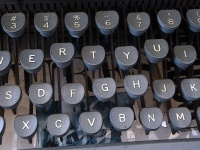
The Typewriter
Technology was not part of the everyday world in the 1950s and 1960s. Our phone was attached to the wall. We had a party line. No celebration was involved. Several people shared the same line.
If you wanted to make a call, and someone else was busy discussing how terrible a neighbor looked with hair the color of an orange cat, you could interrupt or wait. Neither was a good choice.
When I needed to write a school paper, I went to the library and rummaged through the card catalogue. One row of drawers next to another. If the subject wasn’t boring, this task was!
The librarian found the research book I needed via the information on the card. Then I copied what I needed along with the reference onto my notebook.
Sometimes, the material was available in the World Book Encyclopedia. Our family bought a set from a door-to-door salesman. The series contained anything you wanted to know about aardvarks to zippers, provided you didn’t need in-depth information.
Typing the final result made Atlas’s job of carrying the Earth appear easy. I started with a manual typewriter. A sheet of carbon paper was placed between the original and the copy. Since the backspace didn’t provide an eraser, either the entire page needed to be retyped or the error needed to be covered with a white blob cover-up.
Erasable paper eventually came onto the scene. However, it smudged. And, of course, the biggest mistakes appeared at the bottom of the page. I didn’t keep track of the time needed to complete one five-page assignment. On my father’s Royal typewriter. In a basement corner.
It was a royal pain. The advantage? Only one I can see. I sure learned discipline. And gratitude. When the task was completed. Eventually.
.
 terrypetersen
Leave a comment