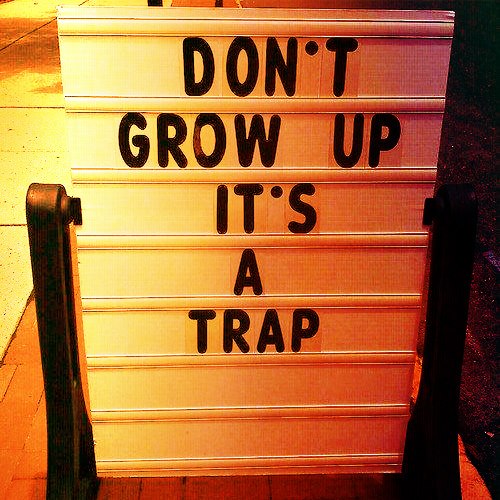
“Most people don’t grow up. Most people age. They find parking spaces, honor their credit cards, get married, have children, and call that maturity. What that is, is aging.” ― Maya Angelou
Haibun for a father
One quick kiss for your daughter and you and your new red walker head for the dining room where Sunday’s fried chicken and sweet potatoes wait. No cauliflower. You will watch to see how many residents leave their boiled vegetables on their plates, gifts for the garbage, your hatred for vegetables universalized.“No room at the table to chat,” you tell your daughter and son-in-law. “It’s okay to leave now.”
She wonders what thoughts you drag with each slow step. Your doctor doesn’t take long-term nursing home patients; his associate does, and he is on staff. Your daughter told you this less than an hour ago. You want to think of home as the place where you raised your kids, where you did your woodworking, and where you loved your wife.
But you knew, you’ve always known it is different now. You said you could sleep for 24 hours and never get enough rest.
Your daughter replays your words as if she could change them. She enters the key code to exit and pretends they are only lights and buttons.
One leaf falls on water It will float across or break into new parts like seeds.
Two Canada geese settle into an angled parking space in a Wal-Mart lot. They take turns sharing shreds of bun left in a torn red McDonald’s box. One goose eats. The other stands watch for danger.
A car honks, its sound louder than any a goose could create. The noise interrupts their feast. Harsh and threatening human voices follow. The geese flee.
From their aerial perspective the birds agree— Excellent volume. Lacks style.
Everyone knows my name, face, and products. I appear on screens across the world. Wealth and I speak a coded language, encrypted inside green and silver. Luxury touches every corner of my existence. I touch no one. Distance keeps profits safe.
Then, for fun, I bet my associate, “If I walk through one of my factories in a central state and someone recognizes me, another layoff is possible. The workers are not watching what they are doing.”
I did.One of the older men on the line almost ran into me.
“Geesh, do you know who that is?” another man whispered. He was loud as thunder. “Quiet, Jake, his son was laid off last time around. He couldn’t feed eight kids no more. His baby died last week.”
I finished my check without adequate detail. I will send someone from my staff for the next inspection. Workers need to watch where they are going.
“Need help carrying groceries?” a young man calls from across the street. Wednesday evening and our trash cans are at the curb ready for weekly pickup. Our next-door neighbor moved them before he tended to his own.
I smile at gifts surrounding my husband and me, at the brown, black, and white faces that reveal hearts exploding with care.
Garbage exists inside and outside the population. Love moves it along.
Grief is like the ocean; it comes in waves, ebbing and flowing. Sometimes the water is calm, and sometimes it is overwhelming. All we can do is learn to swim. Vicki Harrison
One sip of coffee. I ask it to wash away chaos inside my head, to stop yesterday from flooding the kind of memories that jolt reality, to cause a friend’s dead fingers to move again.
Outside, the wind stops as if it understands. All moments end.
I recall making my friend laugh. A story about childhood innocence.
Now may I hold onto that memory at least for the next moment.
When we are children, we seldom think of the future. This innocence leaves us free to enjoy ourselves as few adults can. The day we fret about the future is the day we leave our childhood behind. Patrick Rothfuss
Nope, No Wedding Yet
The rock at the bottom of the street of my grade-school home was like a mini-mountain, perfect for climbing. It was hidden behind enough trees to be its own paradise, a place for a kid to climb and become king of the world. At nine, I saw nothing peculiar about a strawberry-blonde girl king.
The great play arena eventually disappeared as developers plowed through. But in the mid-1950s, Joe and I claimed the world. He was my self-proclaimed boyfriend. Fourth-grade style. I hadn’t graduated from paper dolls and mud pies, so the notion of a white veil followed by a life in the kitchen sounded as appealing as living with a perpetual mop. I was allergic to homework responsibility, much less life responsibility. Imagination had greater appeal. Joe was a friend who happened to be male.
He wasn’t like the other guys in my class. I knew his family wasn’t tidy. I didn’t care. He was Joe. He didn’t need the meaner boys around him to be okay. He wasn’t the tallest and most handsome. Mom never met him. That alone was good enough for me. Outside, Joe and I could always be free. From homework or chores. We challenged an open space where the air moved freely around our imaginations and the blue sky was on our side.
“Hey,” he said one day. I saw a kind of shy smile in his brown eyes that didn’t match the same dirty blue jeans he wore all the time, and he planted a kiss right smack on my lips.
I thought, oh yuck, but didn’t want to hurt his feelings. Joe wore a kindness that transcended grime. You had to face foreign lands on a rock to see past the classroom, to understand Joe. We never talked about school stuff. Only the next jaunt into places we changed simply by creating them.
“I’ve got a special surprise for you since your birthday is coming up,” he said. “Come to my house.” We cut through two yards and landed on his street in three eyeblinks.
“Hey, Mom!” he called. “Where’s the engagement ring I found? I am going to give it to Mary Therese.”
Mary Therese! My at-school name. I groaned. Oh no. Formal talk. Sounded like a nun. Not me. I’d never hit anyone with a ruler in my life. And I would be off balance with a rosary that big at my waist.
A wedding would spoil that lifestyle but neither wife nor sisterhood sounded appealing. And call me Terry, my at-home name.
How could I say something about how I thought girls had to at least have boobs before getting engaged without sounding personal? But Joe’s mom wasn’t mine. The question would need to wait.
“Oh Joe, I’m sorry,” his mother said, not sounding sorry at all. “That ring got accidentally flushed down the toilet.”
Joe groaned. His head down, and his right hand on his head. Now that I didn’t need to worry about a commitment, gratitude filled every cell of my tiny being. Who needs a ten-year engagement? Or worse, a lost recess for a wedding ceremony.
Yet somehow Joe quickly recovered.
Our relationship ended long before puberty. As time passed, I hoped Joe found someone. Later. Much later. Long after the septic system absorbed my first engagement ring. I always wondered whether it had been born in a box of Cracker Jacks or found on a sidewalk.
At least now if someone asks if I ever broke someone’s heart I can say, “No. The ordinary toilet took care of that for me.”







 terrypetersen