Feeds:
Posts
Comments

Posts Tagged ‘childhood innocence’

One eye sees, the other feels. (Paul Klee)

This year will probably be the last one for our artificial Christmas tree. The bottom lower branch no longer lights. Our angel has toppled so many times she lies, as if exhausted, at the base. She is supposed to be reigning from above. Maybe she is afraid of heights. I suspect that is better than being a fallen angel.

My husband and I celebrate the full twelve days of the season, even if those days include the ordinary chores of laundry, rug-scrubbing, and bill-paying. Holiday music plays in the background. The greatest celebrations include a full day with our grandchildren.

On December 26 Miss Rebe pretended to be mommy-having-a-baby. Her imagination swelled as she followed that experience with a brain, and then a heart transfer with her newborn. None of these moments fit into anything resembling real life. However, Rebe did understand that surgery includes cutting followed by blood. Even in play young people recognize suffering.

“Don’t look, Daughter,” she told me. Of course within seconds the transformation had occurred and been reversed—several times. In a kindergartener’s world magic slips into the ordinary as easily as wind blows through an open window.

Somehow Rebe’s fantasy touched something real. Physical brain and heart transfers don’t exist beyond imagination. Empathy does. Answers may not come in easy packages. Time may not heal. In-a-better-place isn’t always the best response. Yet a quiet soul and listening ear can speak in unexpected, healing ways.

Most holiday seasons are tainted in some ways; that’s the nature of anything that has created form. This December has been filled with sadness, illness, and tragedy. I have seen friends and acquaintances suffer. Some have died, suddenly, at a moment when the lights were expected to be brightest. Instead they extinguished.

After her imagined ordeal Rebe told Daughter it was time to go home. Apparently she had returned into pretend-mommy mode. Baby, yet unnamed, lay tucked in the crook of her arm. We were on our way. She didn’t say where.

But then, life’s journeys aren’t mapped anyway.

pic from the Optimism Revolution

love tainted world Optimism Revolution

Read Full Post »

The great thing about getting older is that you don’t lose all the other ages you’ve been. (Madeleine L’Engle, 1918-2007) 

I made a big mistake when I told my two older grandchildren about the time my brothers climbed into the dollhouse my grandfather made for me. Since the house had been created for thumb-sized dolls, not little boys, the walls collapsed onto them.

Kate and Rebecca were horrified. Two giants had invaded precious pretend space and demolished it. Back then I probably saw the torn walls as slaughtered puppies. Now, I understand the viewpoint of my younger brothers, an exploration into uncharted territory. I really don’t think they planned destruction; it happened as a side-product of their exploration. Somehow, I expected my little girls to see with my adult point of view. They didn’t.

When Kate knew my youngest brother was coming to the house, she asked, “Is he one of the brothers who broke your doll house?”

“Uh, no, he was too little.”

I have a few weeks before my other brothers face my girls’ wrath—for a misdemeanor committed before computers, space travel, cell phones, and flat-screen television sets existed. Any pictures from that era would have been in black-and-white. They couldn’t have been instantly posted on Facebook.

Then again, my granddaughters may forget all about the long-ago dollhouse. Actually it’s likely. The holidays are filled with far more interesting opportunities. If the subject comes up I could ask if they ever made a mistake and then felt sorry about it later. The word, oops, appears early in a child’s vocabulary. I could mention again the story about the time my brothers and I wanted to play Indians in the basement when I was about four-or-five-years old. We needed a campfire. So I gathered some sticks from the front yard, placed them on the cement floor, and then lit them from the pilot on the hot-water heater. Fortunately, my mother had a good sense of smell.

“Did you get a spanking?” Kate asked.

“I don’t remember that part. But you can be pretty sure I did.” I certainly earned one.

The consequences of a fire in the basement didn’t occur to me at preschool age. I had planned to put it out. There was a faucet a few feet away, right next to the wringer washer. As an adult the thought of flames in the house strikes me with intense fear. I’ve apologized to my parents many times over the years.

Yet, somewhere deep inside me is that little adventurer who wondered what-would-happen-if? She learned to respect the parameters of reality, but appreciates the spunk of the kid with just a touch of mischief inside.

Yes, I loved that dollhouse my grandfather crafted for me. He was an incredible, gentle man. I loved my brothers even more. And, I still do.

save the kid in you

Read Full Post »

The potential of the average person is like a huge ocean unsailed, a new continent unexplored, a world of possibilities waiting to be released and channeled toward some great good. (Brian Tracy) 

The outdoor parade at Rebecca’s kindergarten is cancelled. An indoor march will need to suffice. I’m surprised by the silence I feel inside the school.  I may be a few minutes early. But I can’t be the only parent or grandparent who wanted a good parking place. The lot isn’t empty.  I don’t look for Rebe’s daddy. He couldn’t have arrived yet. He called from work less than an hour ago to let me know about the change of plans.

The closed inner door is no surprise. It’s a security measure. The quiet, however, shouts change. The violence at Sandy Hook and other schools has affected facilities everywhere. When Kate was this age there would have been a group in the waiting area outside the office. Camaraderie, enthusiasm, and anticipation would have swelled, even in a small group, perhaps moved to the gym.

Someone from the office I recognize smiles and gestures me inside. I sign-in and she gives me a neon red badge. “Do you know where Rebe’s room is?” she asks.

I don’t. She leads me to the correct corridor. A few adults, probably teachers and aids, seem to be planning something. No children are in the room. Rebe’s teacher says the class is in the music room next door. I am welcome to visit. All this time I wonder where the rest of the visitors are hiding. Is hide-and-go-seek on the agenda? No one was in the gym. My watch reads 10:20. Class dismisses at 11:00. I assumed 10:30 should be a good time to arrive.

Rebe’s smile widens, yet she refrains from rushing into my lap. I can tell by her body language that she is using considerable restraint. When the teacher announces that the children will be watching a movie with Disney songs I see a chair in the back of the room and ease toward it. Perhaps if my granddaughter doesn’t see me the temptation to step out of line won’t be as difficult.

“Sing if you know the words, boys and girls,” the teacher says. A few of the kids turn around as I join in on such oldies as “Zip-a-dee-doo-dah” and “A Very Merry Unbirthday,” but they don’t comment. I keep my voice soft. After all, this isn’t a performance. I am visiting their space.

I am the only adult visitor in the music room.

If the action begins at 10:30 it will start late. My watch reads 10:40. Greg, Rebe’s daddy, calls my cell phone. He is in her classroom. Security has fragmented the visitors. Their numbers don’t appear until our little parade reaches the gym, hardly a mob. How many folk can get off work on a Thursday in the late morning? However, there are enough to create an audience to make a circle of children feel special. Greg may be present, but he needs to return to the office.

The children look no different than they did when fourth-grader Kate was beginning school. Superman flexes his immature muscles, ghouls rule, and one boy asks if he got to be in the picture Greg took of Rebe. I nod. He beams. However, I don’t recall Kate telling me about the drill they had at school about what-we-would-do-if-the-bad-people-came.

Rebe hugs me as I leave. So does one of the other girls. All I know about her is that she is in Rebe’s class, and that she is a precious kindergartener. One hug can’t overcome hate and fear. The problems that lead to violence are deep-rooted. They don’t have an easy fix. They need the attention of all, an awareness that transcends security.

Rebe is Rosie the Riveter. She wears a badge that reads “Yes, we can.” Perhaps that message can be extended beyond World War II. It will take time. Any worthwhile cause does.

hug power Charles M. Schulz Museum

Read Full Post »

Man is most nearly himself when he achieves the seriousness of a child at play. (Heraclitus, philosopher, 500 BCE)

Sometimes what begins as a mistake can end right-side-up.

I’ve left physical therapy and I’m on my way to pick up Rebecca from kindergarten. Her daddy calls my cell phone. Both Daddy and I remembered the wrong dismissal time. Rebe’s big sister is in fourth grade now. That seems like longer ago than it is. Morning kindergarten ends at 11:00, not 11:30. Since the time in my car reads 11:10, the chance of a punctual arrival doesn’t exist. My ancient Toyota has no time-machine properties. In fact it locks and unlocks with an old-fashioned key—not a remote control.

“Rebe’s okay,” my son assures me. “She’s in the office.”

Now I need to keep the speed somewhere close to the limit. The needle on the gauge wants to jump into the panic zone, next to how I feel. However, after turning left instead of right only once, I arrive. My granddaughter has the attention of everyone in the office. She trusts that Grandma will come. Her smile calms me immediately.

Since Grandpa is out-of-town until Tuesday he couldn’t have helped. Her babysitter isn’t available today. We would never have planned for the office to take over for a half hour. But today it worked, and I’m grateful. My therapy didn’t end until 11:00.

“We have six hours of Grandma-Rebe time,” I tell my granddaughter.

“Is that long?”

“Long enough to have lunch, go swimming, and have dinner together.”

“Yay! Can we go to your house, too?” she asks.

“Don’t see why not. It’s our day. Let’s play follow the leader. You lead.”

“The kids stay on this side of the sidewalk because it’s safer. We had a fire drill today, with fake smoke. I kept away from it though because we were learning what to do if it was real.” Rebe walks as if she were on a tightrope. My act looks less natural. I consider it a privilege to follow the kids’ route.

I watch my granddaughter and know the example I follow is worthy. She enjoys the moment, recognizes its beauty.

“What are you going to dress up as for Halloween?” I ask.

“Rosie, the Riveter.”

“Great. That’s history. From what was called World War II. Did you know that Rosie, the Riveter is older than I am?”

“Older than Mommy, too.”

I’m grateful for swallowed laughter. Our little girl’s feelings get hurt when she thinks I’m laughing at her, not her innocence. Rebe’s mommy is a tall, attractive brunette—she’s the same age as my son. However, time and age are relative terms in our kindergartener’s world. When she turned six a little over a week ago, she told her daddy, “In ten years I can drive.”

Right now I would rather play follow the leader, and act as if time didn’t exist. This day is precious. The gift of unconditional love abounds. And I’m enfolded in its child-sized arms.

Rosie-The-Riveter-Button

Read Full Post »

Wheresoever you go, go with all your heart. (Confucius)

Kate sits on my bed with my guitar between her knees as I tell her the names for the strings: E, A, D, G, B, and E. Some of the strings are as much as a full step sharp. They need considerable adjustment. Pain has curtailed my playing for longer than I’d like to admit.

“One of the first things you are going to need is an electronic tuner,” I tell my granddaughter. On the bed isn’t the best place to play, but we aren’t going to get as far as a real song. Not yet. We’ll just see where the open chords are, and how they sound.

I hold my Big Baby Taylor for the first time in a long while. The weight feels precious in my lap and I realize I’ve missed her even if she hasn’t missed me. “This is what a minor chord sounds like and this is how a major chord sounds. They each have a different feel.”

Kate listens carefully and I realize that one chord is not enough to show a mood, just as a single word is never sufficient to give an adequate view of anything. I should have played at least a phrase or two. A first impression isn’t always accurate either. When one of my water exercise classes became aqua zumba, I thought, I dance like a cardboard cutout. I’ll never learn it. The class has ended now and I’d do it again in a heartbeat.

“Taylor,” Kate says looking at my case. She’s a Taylor Swift fan and loves the song, “White Horse.” I hold my breath, unsure how much my nine-year-old granddaughter understands about romantic relationships. The love inherent in everyday giving seems sufficient for a girl who still treasures her American Girl dolls.

“Your turn.” I give her the guitar back. “This is an expensive instrument. But I trust you.”

Kate’s E-minor sounds amazingly crisp for a first-time try. She and I both smile. She talks about all the instruments she wants to play. And I encourage her.

“Not going to be easy,” I say hoping my smile hasn’t faded. “But it will be worth it.”

Kate may not be old enough to be in double-digits yet, but she’s seen the ups and downs of life already. One of her school mates died of cancer this summer. Another friend was disabled by a freak accident when she was three-years-old. Kate has volunteered at the Free Store. She knows designer clothes are not her natural right.

She has no idea how beautiful she really is.

“You play,” she says.

There isn’t much time before Daddy will be here so I show her a few chords: C, G, E, and F, using a variety of strums and picking patterns.

“That sounds pretty,” she says.

“You can do it, too. And more.”

Her long legs are tucked under her and I suspect her thoughts reach into possibilities. No, I can’t see her thoughts, only her expression and glistening eyes. I suspect she sees some day, far away. I see now, a fourth-grade-girl with the world ahead of her.

Wherever you go, go with all your heart, Kate. Go with all your heart.

secret of genius child Optimism Revolution

Read Full Post »

The world is like that—incomprehensible and full of surprises. (Jorge Amado)

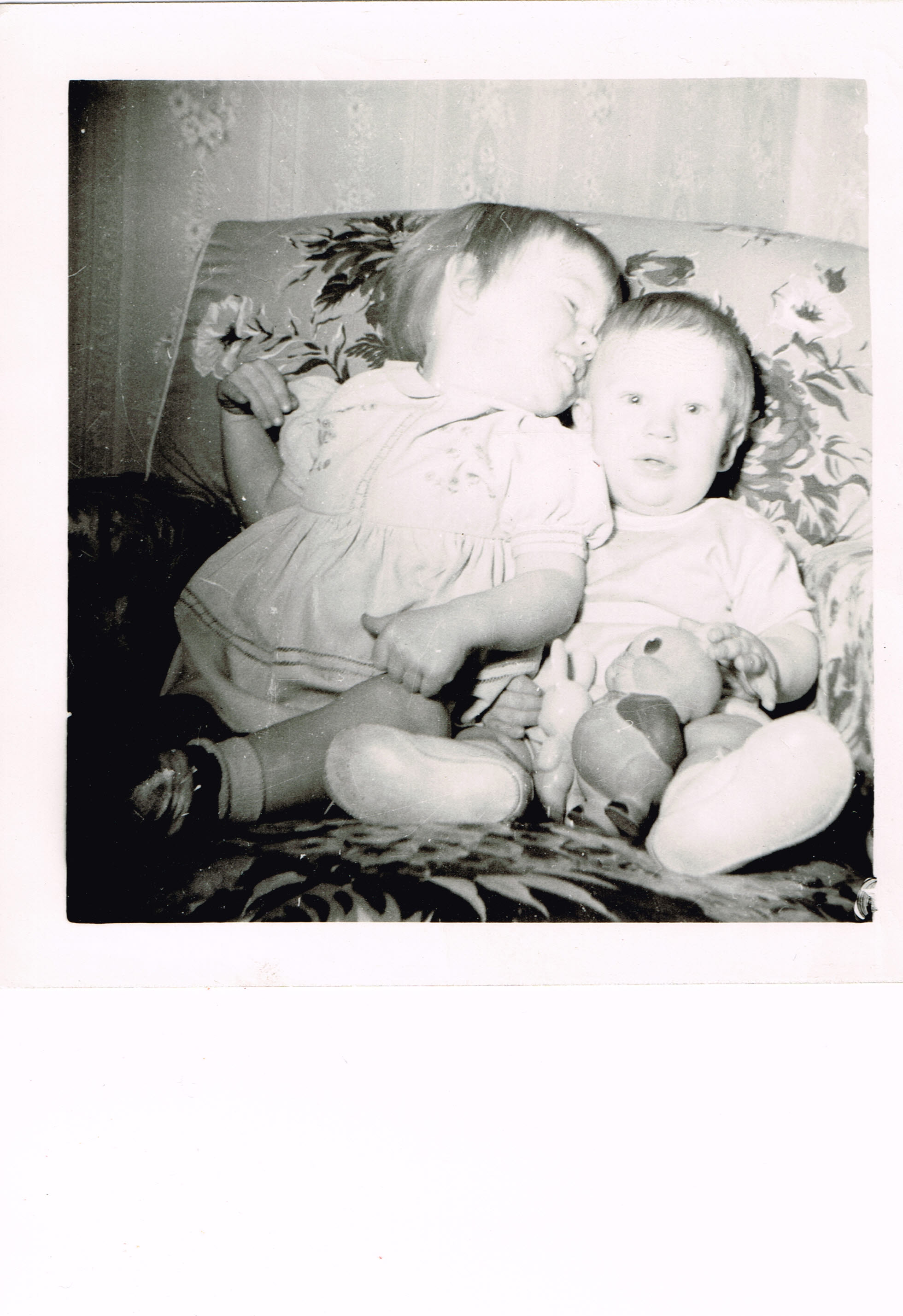
This photo of me and my brother is over sixty years old. It needs a caption: You mean this is my sister and I’m stuck with her? Or, that wasn’t a kiss, it was so slobbery I thought you were a Great Dane. I can’t use the informal word, pic, for any of the photos I found hidden in our attic. They belong to the time of rotary phones and black-and-white television. Folk wore suits and dresses, even to sporting events.

I can be found among my brothers easily in the collection. I’m wearing the frills. And yet the expressions on the faces of my family remain universal: Enthusiasm. Joy. Excitement. Wonder. Change the hairstyles and put jeans and sweatshirts on the people in the scenes and they couldn’t be distinguished from one taken in a modern family fifteen minutes ago. Although I’m not sure how to describe my brother in this picture: surprised maybe, definitely cute.

Little people remain little people in any age, in any culture. For me life didn’t exist beyond that floral stuffed chair and my back yard, Mom, Dad, Grandma and Grandpa and my brother, Bill. The future extended no further than alphabet soup for lunch or a picnic with Aunt Bette and Uncle Harold. Childhood seemed eternal.  Even at the advanced age of five, the fact that I would one day become a grandparent would have sounded as outlandish as Jack climbing the beanstalk and facing a giant. Actually, the giant appeared more believable. After all, I had scarcely reached the height of an adult’s naval by that time, probably not that high. I was a runt from the day I was born at four pounds and seven ounces.

Children believe life is what they live, wherever it is. In peace or in war. In the city or country. In a healthy home or one where love is only a word.

The multiple scenes of a baby girl in a silly floppy hat give me the notion that my family was excited to begin a new generation. Not everyone has had that experience. People tend to expand their own experience into another person’s thinking. One of my favorite quotes comes from Anais Nin, “We don’t see things as they are. We see them as we are.”

Perhaps that is why I find it so important to tell my grandchildren how innately good they are, every time I see them. At least once. And to encourage them when they show compassion for others. Nine-year-old Kate talks about setting up a benefit for a friend in need. No, I have no idea how she would do it. But that won’t stop me from encouraging her. The world is filled with surprises, and even if those surprises aren’t wonderful, if children learn they have power deep inside, they will be okay. At least eventually. That is my prayer.

Bill and me 08192013_0000

Read Full Post »

In this world, you must be a bit too kind to be kind enough.
(Pierre Carlet de Chamblain de Marivaux)

Ella runs toward another child with white-blond hair as if their fair heads were halos meant to merge.

“Hi! Hi!” Ella is finally talking. Her vocabulary is limited. She still uses sign language for most communication. Down syndrome has affected her development. But she has always expressed enthusiasm with complete clarity.

The boy seems puzzled, but accepts our little one’s hug. His sister, perhaps a year younger, continues toward the parking area at the Museum Center. Then she hesitates. I suspect she isn’t going to miss out on the love her sibling is getting. Ella doesn’t disappoint her.

Ella, Grandpa, and I are on our way to the Museum Center. However, our three-year-old girl is in no hurry. Each step on the journey brings its own adventure. She sees a little girl in a stroller and blocks Mama’s path to ooh and ah over someone younger than she is.

While my husband and I apologize for the interruption I hear my name called. I see Marcia, a very special friend who has enlightened my life’s path in deep and beautiful ways. I’m both surprised and happy to see her. Her smile fits the halo image. An embrace feels in order.

She introduces me to Mama and the little one in the stroller. The child is on her way to nap time and barely tolerates Ella’s gushing. Fortunately, the little girl isn’t screaming yet. And I am grateful.

I don’t count the number of stops it takes to get to the door. After all, we aren’t late for a plane. A fountain, a cloud, or a block of cement can fascinate if approached with curiosity. Adult responsibility has damaged a lot of my spontaneity. If I don’t catch my granddaughter’s life lessons, she will show me again, without any sign of irritation.

In one play area inside the museum she insists upon putting on a sheriff’s vest by herself. Unfortunately it includes a scarf with an opening along the back that could be an extra arm hole. Although Ella never figures out how to maneuver the vest, she doesn’t give up, and she doesn’t throw a tantrum and blame costume construction for getting in her way. Life is what it is. Difficult. She has known that since she was born seven weeks early with multiple medical needs. She has overcome most of them.

One girl seems insistent upon going up a slide the wrong way. Ella waits patiently at the top. Within minutes the two children are playing together. The other girl runs back to Ella to give her a hug before she leaves with her grandparents.

One embrace has led to another. So simple and honest. And it took a child with a tripled twenty-first chromosome to begin the cycle. May one kind gesture direct another… and another…and another.

hug

Read Full Post »

If you talk to a man in a language he understands, that goes to his head. If you talk to him in his language, that goes to his heart.  (Nelson Mandela)

Service we needed done in our house takes up a large portion of the afternoon: drilling, decisions, and comforting a five-year-old who doesn’t like noise. No time left to go to the Y for a swim. I expect Kate and Rebe to express serious disappointment. They handle the situation well.

Rebe gets custody of PBS Kids on my iPad while nine-year-old Kate and I do artwork in the second-floor storage area of our house. There is no air-conditioning here since we have no place for duct work, but this has been declared girl territory, a clubhouse arena of sorts. The heat isn’t as horrid as August usually offers. I’m holding out. Rebe manages for a while, and then returns downstairs to the cooler air and Grandpa.

“You can have this page,” Kate says, tearing it out of her brand-new book of designs to create and color. “You can make cards for the family, and then copy them on the computer.” Kate is always planning. She wants to turn our storage area into a play room. That will take not only time but ingenuity. With Kate’s enthusiasm, however, I can see it happening.

She watches as I show her how to blend colored pencil, rounding strokes inside a circle, adding depth by easing orange around the edges of yellow. “See how it looks if you leave a tiny bit of white in a block of turquoise—on purpose.”

We share, heart to heart. I feel free to tell her that someday Grandma and Grandma may need to sell this house and move to a condo, when Grandpa gets too old to mow the grass. Not now. Someday.

“I hope that never happens,” she says. “There are too many memories in this house.”

I am impressed by the depth of a child who hasn’t reached double digits yet. She adds that she is not disappointed that she didn’t get to swim today. She got to spend time with me.

I look around at the haphazard space around us: old blankets, photos, a box with my old published materials, the dolls I bought for my mother—nothing of outstanding value. No one from Better Homes and Gardens has ever approached us with an offer to do an article. Nor do I expect any in the future. Yet, I am blessed.

Finally Rebe returns upstairs, her demeanor comments on the heat as she looks at us working in the corner. “Whatever are you thinking?” she asks.

Kate and I laugh. One more memory has been added to the rest.

learning from children  morning coach

Read Full Post »

There’s something ugly about the flawless. (Dennis Lehane)

As a child I thought perfection was attainable. Expected. On multiple levels.

On an achievement test my sixth-grade teacher emphasized how important it was to erase completely. Pencil residue could be picked up and two filled-in boxes would mean an automatic wrong answer. I sat in the back corner of the room and sighed. That day had been particularly difficult, although I don’t recall why.

Not far into the test I needed to erase. The process became gruesome to this literal student. I moved so slowly through the pages that I eventually gave up. The next year the psychologically ignorant teacher positioned us in rows according to the grade we got on that test. There wasn’t enough room for the last two rows of desks—they were shoved together. I sat in the dummy section. After all, if we cheated the answers were bound to be wrong.

I must admit that seventh grade turned out to be fun. I sat next to the class clown. However, the image that teacher had of me stuck and showed up in my grades. Once again, why bother?

Then, that winter we were given an assignment to write a one-act play based on a book by a Catholic author. Mine was taken from “Fabiola” by Cardinal Nicholas Wiseman, first published in 1854, a, thick book from my parents’ book shelves. It spoke of persecution in the lives of early Christians in the catacombs during the reign of Roman Emperor Diocletian. My teacher did not believe I had read the book much less written the play. My parents needed to verify the fact that I had chosen each word with the required fountain pen at the kitchen table. I had to bring the book to class so that both the principal and teacher could see that I had not plagiarized my assignment. Strangely, I was not frightened. I knew the work I had done was honest.

I won first prize in the Greater Cincinnati area from that one-act play. My grades improved drastically. Yet I was the same child, in the same row. By then I wouldn’t have chosen to sit anywhere else.

Those students I sat next to weren’t dummies either. Perhaps their skills didn’t include diagramming sentences and answering multiplication tables within a given number of seconds. I have no doubt that those conjoined rows housed kids who eventually owned their own businesses or who became beloved parents and grandparents, exemplary citizens, military heroes. They became folk who could find that glitch in a car’s engine no one else could find. Many probably graduated from college and earned degrees because they had learned to work for what they wanted.

They created common miracles no one ever chronicled. We are all important—in different ways.

(pic from Positive Words to Love By)

dogs and differences Positive WoRds

Read Full Post »

Breathe. Let go. And remind yourself that this very moment is the only one you know you have for sure. (Oprah Winfrey)

Water is a symbol for the unconscious. I may not be in a deep sleep, approaching a great sea, but the Y pool brings its own unexpected gifts. I find myself drawn to people who tell me stories, or share wisdom. Some of the facts in the next paragraph have been altered—for the sake of anonymity. The purpose of this sharing is for enrichment, not gossip.

Two women always smile when I arrive. They live generosity. The father of one of the women is being forced to move to a nursing facility. He is neither ill nor feeble. She stands with him, not with the convenience of other family members. I listen, blessed. The other woman cares for her brother-in-law who has a debilitating illness. This does not keep her from volunteer work among other disabled people. The gentle spirits of these women blend into the pool water, mix with the chlorine somehow, and make me richer.

On another day I bring my granddaughters to the indoor swim lanes. Rebe pauses at the shallow end and picks up a water weight. Her imagination continues on land or in water. She pretends to be an instructor, directing me, her make-believe daughter.

“These are really heavy,” she says. “So be careful.”

“How much do they weigh?” I grin knowing that she has no idea how much is too much.

“To infinity and beyond,” she answers with make-believe authority.

“Such a goal,” I think. A few minutes ago I encouraged my girls to go for their dreams. Actually I have no idea where my five-year-old granddaughter gets her ideas. But in the water today, her eyes tell me she is happy. This is female-bonding day: Grandma, Kate, and Rebe. We have plenty of time left before Mommy and Daddy arrive to bring the girls home.

Nine-year-old Kate continues to swim laps, grateful that there are no adult-swim-time interruptions in the indoor lanes.

And the water responds with caresses as gentle as the strokes we create. I celebrate the sweetness of this “now.”

Sure, life on life’s terms continues. This time in the pool is only a respite. I can only pray for my friends who face injustice. A raging thunderstorm makes the drive home slow, as I calm a frightened kindergartener by telling her to count after she sees lightening. If the boom takes a while, the strike is far away. If the thunder comes quickly it has already passed by—and it hasn’t hit us.

“Okay, girls, hit the garage door opener!” I call as we arrive home.

They don’t need to be asked twice.

The troublesome storm continues a little while longer. But the sun has never left. It returns like a good parent.

sail boat

Read Full Post »

« Newer Posts - Older Posts »