Feeds:
Posts
Comments

Posts Tagged ‘determination’

MARILYN’S CHILD

by Terry Petersen 12/7/99

Forgiveness is the fragrance that the violet sheds on the heel that has crushed it. (Mark Twain)


Joy to the World” rose dulcimer sweet and holiday warm from my car radio as I pulled into the church parking lot last December 23. The song’s bright spirit irritated me.  It reminded me of the heat in my ‘85 Buick—hell-fire hot on high or dead cold on any other setting. Turning off the ignition eliminated the carol, but it didn’t solve my problem.

          So why was I going to a Christmas program, advertised as experiential, in a grumpy mood? A place where joyous carols were inevitable? I could convince myself that I was here because some random sign recommended the evening: Be in St. Patrick’s lot at seven. A bus will take you to the program from there. Location will not be announced.  This is a definite don’t-miss!  But my reason was less noble. I had refused to go with Jack and Tara to the airport to pick up my mother. My mother’s plane arrived at seven—I wanted to be almost anywhere else. This sign was the first thing I saw on my escape route.

          Tara had brought a white poinsettia for Grandma Paisley. With her own money. I don’t know where my fifth-grade daughter found such fondness for the old witch. It’s not like Grandma gave her any more than an obligatory birthday gift now and then, usually the wrong color and the wrong size—from the double-mark-down, non-returnable rack.

           Tara hadn’t even seen her grandma in two years. Mother moved to Florida in November on a whim. She didn’t even say goodbye. She just packed a suitcase and moved into an old friend’s apartment in case she decided to move back. She stayed for six months but didn’t pay rent—the friend evicted her.  So much for Mother’s friends. I’m not certain where she went after that.

          I couldn’t understand Jack’s enthusiasm for Mother’s visit either. He had been so supportive of me when I went into counseling, so depressed I grew dehydrated by crying. Not literally, but it felt that way.

          The counselor was only minimally helpful, too confrontational. She had the audacity to suggest that I intentionally put on weight to hide my obvious resemblance to my mother. Yes, we both have eyes the color of weak coffee, slender noses, and square chins. 

           However, I’ve never been drunk in my life. And you can be certain Tara didn’t learn profanity from me. Any resemblance is skin-deep. That monotone-professional-doc-distance that the therapist used made me even more angry.

          “Anna,” Jack said sighing. “Paisley has been sober for five weeks now.”

          “So, you say. She also told you she’s vegetarian,” I said, shuddering because Jack said my name with disdain, yet referred to his mother-in-law by her first name. “She’ll take one look at our Christmas turkey and call us a bunch of carnivores.  Then she’ll spread wheat germ into my cookie dough as if she were disinfecting it.”

          “But nothing like that has happened yet.”

          “Right. The key word is yet.  Have you ever heard Mother say one kind word to me? And has she asked to say one word to me?”

          “Compliments aren’t her way,” he answered.

***

          I locked my old Buick and zipped the keys in my purse, I felt betrayed. Tara was barely ten years old. She didn’t know any better. But where had Jack’s support gone? I knew—to the airport to bring home a woman destined to destroy the happiest season of the year.

          I was the last person in line to get on the bus.

          “Not much of a turn-out for a production that’s supposed to be so incredible,” I mumbled.

          “Oh, people are busy and over-committed this time of year,” the young, pregnant girl in front of me said.  She had thin, stringy hair, washed, yet hastily combed, so it dried in haphazard clumps. She wore a faded wool coat that was the same shade of sweet potato orange as her hair. Two oversized buttons connected with their buttonholes at her neck and across her chest. Successive buttons and buttonholes grew farther and farther apart, exposing bib overalls over a belly ripe for birth.

          I decided she couldn’t possibly be married. “Too bad you couldn’t bring your husband with you tonight,” I said, with only the barest tinge of regret.

          “Oh, but he is here,” she said revealing a mouthful of crooked teeth. “He’s driving the bus.”

          Two green, bulging trash bags lay on the seat behind the driver. She dropped them next to her husband, in the space between the driver’s seat and the window. He turned around and grinned. I guessed him to be part Mexican, a good ten years older than the girl. He had long, straight, dark hair that looked even straighter jutting out from a tight, brown knit hat. I wasn’t impressed with him either.

          The girl motioned for me to get into the seat first.

          “My name’s Marilyn. What’s yours?” she asked.

          “Anna Barnes,” I answered. I didn’t really want to tell her, but “none of your business” contains three more syllables. I looked out at the pale flurries swirling in the darkness as if I really cared about them.

          “We have an Ann in our famil…,” she said.

          “That’s nice,” I said as free of affect as I could.

          “I’m sorry you need to be so angry,” she said.

          “What makes you think I’m angry?” I turned to face her.

          “It’s thick around you, dipped-in-concrete thick.”

          “If I were angry, could it be any business of yours?”

          “Oh, we’ve had to forgive lots of folks who don’t understand the birth of this child.  Haven’t we, José?”

          José nodded and I felt emotionally naked and stupid in front of these bizarre strangers, despite the fact that my views were probably identical to the views of the forgiven.

          “Nice lofty thought,” I said.  “But some people deserve to be kept at a distance.”

          “Maybe,” she said.  “But keeping them off saps my energy.  Besides, this baby is due any day now!  He’s my first and I have no idea how long my labor is going to be.”

          By now we were thirty miles east of the city, cornfield country.  José turned down a narrow, unpaved road.  The loose rocks made it difficult to drive with any speed.  About one-half mile down, he stopped the bus at a farmhouse.  One light shone from what was probably the living room.  Silently he got out of the bus, walked to the door, and knocked.  No one answered, he knocked again.  The light in the house went out.  José climbed back on the bus.

          “We’ll try farther up the road,” he said to Marilyn.

          He started the bus again and drove ten more minutes until we came to another house.  He got out again and knocked. A man came to the door. Gesturing and pointing, he said something to José we couldn’t hear.  José smiled as he re-entered the bus.

          “Maybe not what we’re looking for, but this is it,” he said to Marilyn.  Then he took the green trash bags to the back of the bus. Most of the people in the bus looked puzzled as the men and women in the last three rows reached into the first bag. Inside were angel costumes, white robes with gossamer wings attached.  The angels sang as they pulled the robes over flannel shirts and faded blue jeans, “Silent night, holy night. All is calm. All is bright…” 

Their voices blended a Capella—bass, alto, and tenor—with simple, unpretentious strength. A man opened the second bag and brought out shepherd costumes. He passed them out to anyone who would take one, then stood carrying a lantern.  Outside the bus he lit the lantern while the angels continued to sing, “Oh, holy night. The stars are brightly shining…”

          José took Marilyn’s arm and led her behind the house to a barn.

          The people inside the bus followed.

          The man with the lantern opened the door of the barn as Marilyn and José went inside. “In those days a decree went out from Caesar Augustus,” he began, loud and clear without help from a microphone.

          There were no chairs, but I didn’t feel like sitting anyway.

           The singers directed us to join them in “The First Noel.” I don’t have much of a voice, but even I couldn’t disobey angels.

          Marilyn looked at me and smiled. Somehow, from center stage she didn’t look like an ignorant young girl to me anymore. She was smiling into my soul as if she could see all the concrete-angry ugliness I cherished. Yet she chose to care for me anyway. I wasn’t ready to accept or give that kind of love yet. But I was willing to learn—difficult visitor at my house this Christmas or not. 

Merry Christmas

  The illustration was made from a public domain image, color paper, and a piece of an old Christmas card.

Read Full Post »

"Why do we have this desire to tease the innocent? Is it envy?" 
Donna Tartt


Hate Mail

I see the twelve-year-old girl in my memory
as her mother holds a note left in their mailbox.
You are a baby and we hate you.
Two giggling girls, their mission accomplished,
run down the street. “They are jealous,” 
the mother of the twelve-year-old girl
 says in a tone unfamiliar to her daughter,
one that sounds protective, a sound that
doesn’t center on Ten-Commandment 
stoicism.  Did her mother suggest 
that maybe the taunting the preteen hears 
could be separated from social disaster?  
Since the family lives inside concepts, not hugs,
the girl stares, uncertain, into the narrow dead-end street.
She doesn’t know a possibility has been planted. She
will thank her mother fifty years later.


Read Full Post »

One more time. I will try one more time. Copy and paste no longer works. Highlighted text no longer becomes bold. No, I do not plan to turn my computer into electrical compost. I may need to change web servers after all these years of sharing. Sure, I will accept help. However, please remember that my age is the ancient symbol for the eternal, or completion, the number 7, listed twice.

I celebrate this moment and pray that the goblin inside the webpage can be removed without ceremony. I don’t want to frighten the neighbors. In the meantime, I am adding my quote for the day at the end. And hope this isn’t a final moment, at least in this forum.

Experience is the hardest kind of teacher. It gives you the test first and the lesson afterward. Oscar Wilde.

Read Full Post »

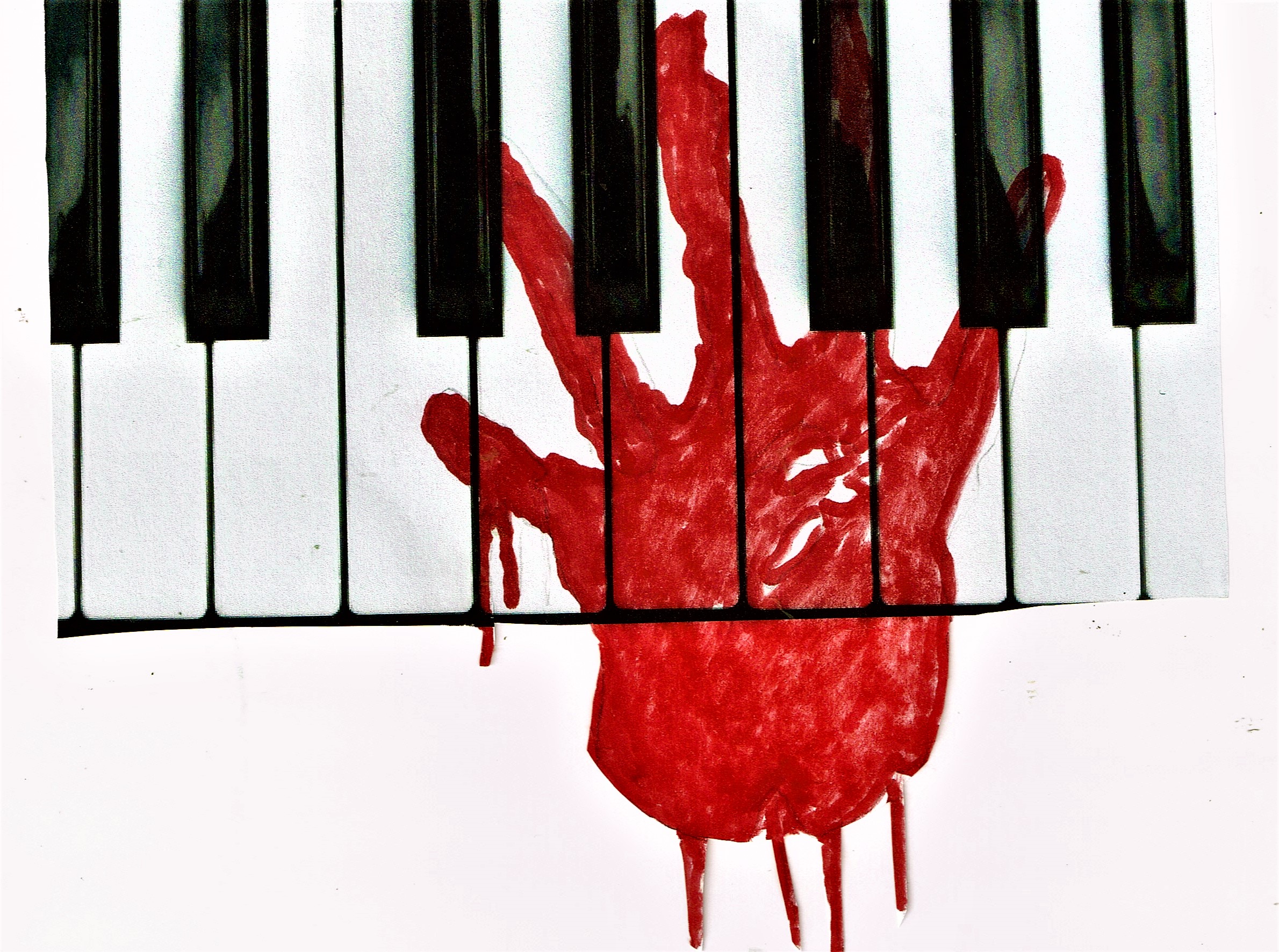
bloody keyboard

Monsters exist, but they are too few in number to be truly dangerous. More dangerous are the common men, the functionaries ready to believe and to act without asking questions.” ― Primo Levi

Dachau, May 1938

(Six months before The Night of Broken Glass)

Part I

The little girl overheard Mama tell Great Uncle Benjamin, “I feigned interest in marketplace pork.”

He answered, “You can’t fool Nazis. You should be true to yourself.”

The little girl was pecking the piano one key at a time, black and white, high and low tones. Uncle’s happy songs lay hidden inside the sounds like secret buried treasure, with a beauty that stretched from one side of the keyboard to the other, sweet sounds that rose and fell, music that told a story she wasn’t allowed to repeat, not even in whispers.

She wondered why the sons and daughters of  Abraham and Jacob’s Traditions should anger anyone. The child searched and found only dissonance under her fingertips when she added more than one key. Uncle had promised to come at noon the next day and lead her small fingers across the scales, but it would take work, an attentive ear, and love. She would practice. And learn.

But dark filled the sky And Uncle never arrived.

Papa came home and said Uncle had been taken. Papa had missed capture by a shadow.

He’d found a way to leave Munich with her and her mother, a passageway as narrow as the eye of a needle used for silk, dangerous, yet their only hope.

And the little girl followed, believing that Uncle would come someday and lead her hands into music because she could work, and listen, and love as well as anyone.

Part II

Benjamin felt the heat of the men next to him, a herd, silenced by fear so strong it had an odor, gut-wrenching and rancid.

One of the guards outside the gate glanced at Benjamin and then looked down. The guard’s face looked familiar.

Benjamin and the young guard stood beside a message bent into the metal: Arbeit Macht Frei, Work sets you free.

The guard had been his student, a youth who expected a golden sound from a flip of the wrist and a closed ear.

Benjamin’s six-year-old niece tried harder.

He imagined her waiting for him as he dropped his shoes next to the others, outside the sign marked brausebad, the bathhouse, the place of cleansing, perhaps the beginning, perhaps the end, but never destruction.

He prayed that even if he couldn’t return, and his niece didn’t learn his song, she would create her own.

previously published

Read Full Post »

“Darkness cannot drive out darkness: only light can do that. Hate cannot drive out hate: only love can do that.”
Martin Luther King Jr., A Testament of Hope: The Essential Writings and Speeches


Dear Dr. Martin Luther King,

May I speak to the Martin you were when your grandmother died?

Thanks.

I’m asking because I’m a grandmother now. My grandchildren look to me to discover who they are. They learn from the attention I give to them. By my presence. Death took your grandmother and hope left you.

You regained more than hope. You let an entire group of people know who they are.

 It’s a privilege to be a grandparent. And yet the child inside me pretends to be gone. I developed into a loving, accomplished woman who helped pay a stranger’s bill in a grocery store. Yet, I struggle sometimes to feel important enough to get past moments when I was a lost child too. The sun is not gone. The world celebrates today because you planted love, Dr. King. I can’t deny recurrent feelings but can allow them to pass and recognize the whole.

Love, may we learn to allow it to spread inside and outside of our families and neighborhoods.


The illustration is taken from a public domain drawing. There are many, just as Dr. King’s gifts are many.

Read Full Post »

An eye for an eye will only make the whole world blind. 
― Mahatma Gandhi

Men willing to break their own arms
rather than race into fire and death,
war games played without winners.
The news spreads in endless loops
on screens with color but no dimension
while some watchers gasp, yet
others pass a bowl of snacks,
grateful the pain strikes in another
language, continent, time zone.

Human beings willing to reach
beyond a huff or pant. One country
touching another. One person
letting peace stretch beyond a closed
room. We will not let war
cage the world with hate. Or apathy.
Or depression. It will take time, but,
let us discover peace. Together.

Read Full Post »

“Wrinkles should merely indicate where smiles have been.” – Mark Twain

No Clapping Zone

Dupuytren’s Contracture in my left hand
joins with an arthritic thumb to create
its own clumsy five-digit island.

On my right hand, a long-ago 
partially healed broken middle finger
refuses to bend. And avoids vulgar messages.

None of the ten appendages chooses 
to juggle anything more challenging
than a dose of Tylenol.

On one point both hands agree.
No clapping possible.
We look like drunk spiders.

And yet, both left and right concur
in more important matters.
In everyday places.

Let’s cook a meal. Ignore the spills.
Or type this poem, or send a message
to someone who needs support.

Let the larger audience carry
the greater approval for performances.
These hands will offer gifts. Just give them time.


Read Full Post »

“Never believe that a few caring people can’t change the world. For, indeed, that’s all who ever have.” 
Margaret Mead


Women’s March
From Caleb’s Point of View
 
My name is Caleb. I’m ten years old.
I wear a sign that says, 
I march for my sister,
and my mom didn’t make me do it.

Great-Grandma links 
her left arm into my right. She holds a cane 
and shuffles from one foot
to the other, an offbeat rhythm
reminding me of an old-fashioned scratched CD.

Dad helps Great-Grandma from the other side.
The kind crowd gives us plenty of room.
Great-Grandma’s parents died at Auschwitz.

Our family matriarch marches 
in silence. I am only a kid, yet
the pain of her story has leaked 
into our lives. I know its depths.
Mom rushes ahead with my sister.
 
A woman nods toward my sign.
"Perhaps your sister can become president
one day." Dad and I look at one another
with the same tight-lipped understanding.

When Mom runs my sister laughs
and kicks her legs as if she could control them.
Mom pauses and waits for us to catch up.

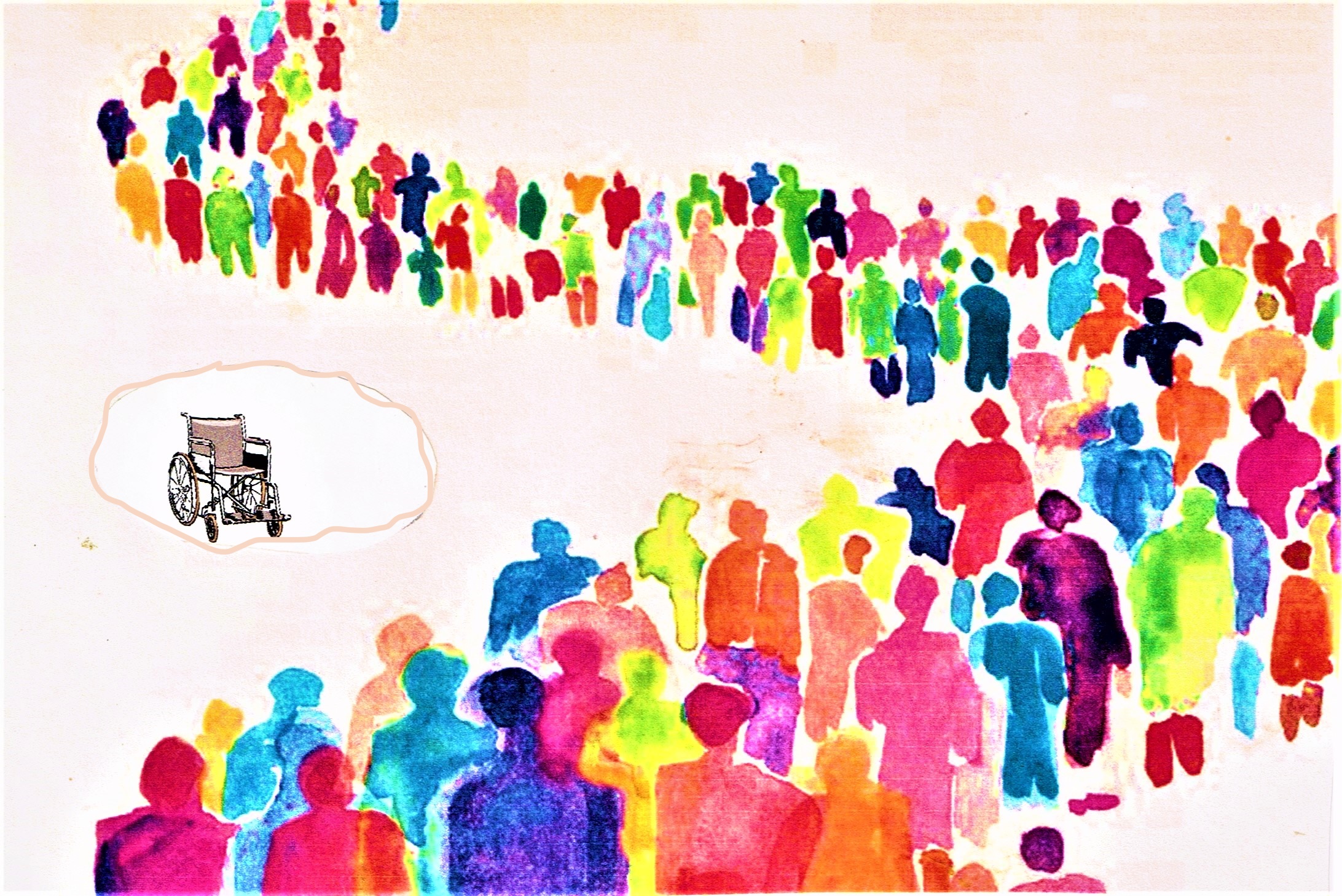
My sister tries to rise from her wheelchair,
her legs weak as dried kindling.

She squeals with delight and flaps her arms
when she sees us.  I don’t march for my sister
to become great. I march for my sister
to be accepted for who she is.


originally publishing in For A Better World 2017
illustration made from public domain images and cut paper

Read Full Post »

It does not matter how slowly you go as long as you do not stop. (Confucius)


CONTRAST

The news broadcasts the story in an infinite loop.

Nine people killed, one an unborn baby.

Boy or girl, identity as unknown

as the reason for the bullets that stopped them.

I listen to commentary

about hate and racism while a wren

travels from tree to wire, the place where

larger birds claim territory. 


Perhaps, there is no genuine connection.

Only a brief metaphor. And yet

I wonder if change can begin

with subtle movements.


first published in Piker Press

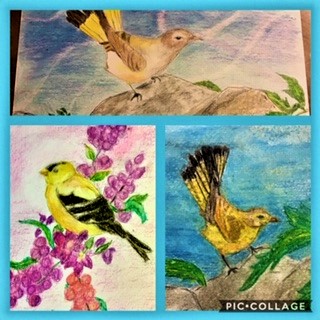
illustration made from recent colored penciled drawings

Read Full Post »

We’re capable of much more than mediocrity, much more than merely getting by in this world. (Sharon Salzberg, Real Love: The Art of Mindful Connection)

A Child’s description of a YMCA pool. “Nothing like the ocean…deeper even at the beginning.”

Two brothers enter the pool. I hear the younger boy say to the other, “This water is eleven feet deep. But it is nothing like the ocean. The ocean is deeper even at the beginning.”

I smile at the child’s innocence. His simple joy. The boy has his green wrist band now. So, he can plunge into the deep end. With confidence. Swim tests completed.

Unfortunately, during Covid19 days those times need to be reserved. Socially distanced. Limited. Nevertheless, I watch the family interact. Enjoy. Celebrate. As I tread water. And reality. As well as I can.

“You have a delightful family,” I finally tell Mom. She smiles. A camera slung around her shoulders. Pictures captured inside.

She is an attractive lady. Black hair almost to her shoulders. Smooth skin the color of dark chocolate. The boys are a tad lighter, with a chestnut tinge. Lean. Active. The father, attentive. Smiling. He doesn’t see me. I smile anyway. To a beauty that I recognize inside him.

And I think about how the ocean seems deeper, even at the edge. A long way between shores. A deep space between peoples.

“Have a blessed day,” I say to the woman as this group’s assigned time ends. As the staff prepares to clean. To keep the space safe during a pandemic virus.

Safe. Such a short word with such an expansive unsaid meaning.

Peace. For all.

Read Full Post »

« Newer Posts - Older Posts »