Swollen, toxic, ignorant of motherhood, you lie in your post-World War hospital bed, and wonder if you’ve heard lies. How can a newborn, untouched by her life source, be fine?
You see, hear, touch, smell nothing but bleached sheets and ward antiseptics. The baby develops away from you in a nursery. You return home. Without her, cord leaked into your severed womb.
At home, baby grows fed on evaporated milk and rules made of rules. Should-be’s without question. The child reaches for you, to break the barrier, but not until long after she delivers your grandson.
Does the touch feel real? By then your weakness has led to the inevitable.
Your great-granddaughter finds your photo in an old album. “That’s my mother,” your daughter says. “You would have loved her.” The chasm finally closes. For no good reason at all.
Dear Ruby, I realize I should explain why I’m writing an old-fashioned letter instead of talking to you in person. I’m not sure what I want to say. There would be too much silence between words—not a thoughtful pause, but Ausable Chasm without its beauty.
Remember rock climbing at the chasm on our honeymoon? Was there ever anything typical about us?
Our wedding day, when for better or worse was a phrase that had as much significance as a television commercial for the terminally naive.
In black and white, that’s all we had in the 1950’s. Black or white cowboy hats determined whether a character was on the side of the law or not. You said that bullets killed both sides equally. I noticed only action and fantasy.
We were young. I wanted to get a job and protect you forever. As the mom, the cook at home.
“No way,” you answered, sweetness mixed with acid. You needed a career as well.You rerouted my chauvinism and triggered my admiration. However, my ignorance could only be channeled so far.
Our baby. A boy. Lived three hours.
“But, sweetheart, he didn’t have a chance anyway.” I tried to comfort you with facts instead of arms. “His brain and kidneys were not properly developed.” Perhaps I need to say goodbye to both George Henry Sr. and George Henry Jr.You mourned our baby. I lost you.”
Draft Two:
Dear Ruby, In my dream last night I bought a second engagement ring for you. But the ring disappeared when I tried to slip it on your finger. And you got angry as if I were trying some ill-mannered magic trick… No, I can’t admit that. It overflows with insecurity.
Attempt Three:
Dear Ruby, I worked late again the day we reconciled. It had been dark when I entered my brother’s house. His wife left food for me. She is kind, but sometimes feeling sorry for me leaks out of her and stains my ego. Thanks for taking me back. I have something important to tell you. I’m a changed man—odd timing, I’ll admit, but for the first time in my life, I see clearly you have always been the stronger half. Okay, minus the five months when we were separated. You got a break.
When we are children, we seldom think of the future. This innocence leaves us free to enjoy ourselves as few adults can. The day we fret about the future is the day we leave our childhood behind. Patrick Rothfuss
Nope, No Wedding Yet
The rock at the bottom of the street of my grade-school home was like a mini-mountain, perfect for climbing. It was hidden behind enough trees to be its own paradise, a place for a kid to climb and become king of the world. At nine, I saw nothing peculiar about a strawberry-blonde girl king.
The great play arena eventually disappeared as developers plowed through. But in the mid-1950s, Joe and I claimed the world. He was my self-proclaimed boyfriend. Fourth-grade style. I hadn’t graduated from paper dolls and mud pies, so the notion of a white veil followed by a life in the kitchen sounded as appealing as living with a perpetual mop. I was allergic to homework responsibility, much less life responsibility. Imagination had greater appeal. Joe was a friend who happened to be male.
He wasn’t like the other guys in my class. I knew his family wasn’t tidy. I didn’t care. He was Joe. He didn’t need the meaner boys around him to be okay. He wasn’t the tallest and most handsome. Mom never met him. That alone was good enough for me. Outside, Joe and I could always be free. From homework or chores. We challenged an open space where the air moved freely around our imaginations and the blue sky was on our side.
“Hey,” he said one day. I saw a kind of shy smile in his brown eyes that didn’t match the same dirty blue jeans he wore all the time, and he planted a kiss right smack on my lips.
I thought, oh yuck, but didn’t want to hurt his feelings. Joe wore a kindness that transcended grime. You had to face foreign lands on a rock to see past the classroom, to understand Joe. We never talked about school stuff. Only the next jaunt into places we changed simply by creating them.
“I’ve got a special surprise for you since your birthday is coming up,” he said. “Come to my house.” We cut through two yards and landed on his street in three eyeblinks.
“Hey, Mom!” he called. “Where’s the engagement ring I found? I am going to give it to Mary Therese.”
Mary Therese! My at-school name. I groaned. Oh no. Formal talk. Sounded like a nun. Not me. I’d never hit anyone with a ruler in my life. And I would be off balance with a rosary that big at my waist.
A wedding would spoil that lifestyle but neither wife nor sisterhood sounded appealing. And call me Terry, my at-home name.
How could I say something about how I thought girls had to at least have boobs before getting engaged without sounding personal? But Joe’s mom wasn’t mine. The question would need to wait.
“Oh Joe, I’m sorry,” his mother said, not sounding sorry at all. “That ring got accidentally flushed down the toilet.”
Joe groaned. His head down, and his right hand on his head. Now that I didn’t need to worry about a commitment, gratitude filled every cell of my tiny being. Who needs a ten-year engagement? Or worse, a lost recess for a wedding ceremony.
Yet somehow Joe quickly recovered.
Our relationship ended long before puberty. As time passed, I hoped Joe found someone. Later. Much later. Long after the septic system absorbed my first engagement ring. I always wondered whether it had been born in a box of Cracker Jacks or found on a sidewalk.
At least now if someone asks if I ever broke someone’s heart I can say, “No. The ordinary toilet took care of that for me.”
In their innocence, very young children know themselves to be light and love. If we will allow them they can teach us to see ourselves the same way. Michael Jackson


Nature’s Creations 101

A young boy clasps a crayon with his fist
and draws an oblong, orange sun
with long uneven spokes.
He scribbles a
blue-clouded sky.
His big brother points out
the real sky
with patterns his kindergarten
colors can’t imitate.
The boy wads his drawing and his art into a ball
and throws it at his sibling.
Their mother grabs the crumpled paper.
She tells her sons
Nature creates superb designs.
But the sun is too hot
and too far away
to fit on the refrigerator.
Could the child please try again.
And, would Big Brother
please tend to
another art work Nature has provided.
The lawn needs to be cut.
GRANDCHILD NUMBER THREE

Truth lifts the heart like water refreshes thirst. (Rumi)

Black and white image
a face    an arm within a blurred arc    a girl
her parents     with their big blue eyes
envision bright blue charm progressing
within that growing face

Grandma decides
she’ll be a blonde like Mommy
with her keen insight
earn an MBA like Daddy
or    perhaps discover a cure for disease
challenge the world of sports

but truth appears on the film
a flaw     or so it would seem
the twenty-first chromosome triples instead of doubles
one surgery promised at birth
a second four months later

the first will strike her gut     the second her heart
Baby’s body develops within Mommy
as Baby’s outside world
grasps truth    embraces it
small hands    double jointed
blue eyes    maybe   that seek    observe
belong to a spirit as sacred as any in
a world dubbed normal

as Baby’s parents and grandparents and friends
open their own guts
allowing no room for anything less
than wonder
and it arrives within her spirit
A friend is a gift you give yourself. (Robert Louis Stevenson)
BETWEEN CHESTER AND ME
Mom and her friends said Chester’s dad was nuts for sending him to an expensive private school after he failed third grade in public school. Again. Especially since the money he spent on out-of-parish tuition could have replaced that worthless pickup truck he drove. But I pretended I didn’t hear. Mom didn’t care what I thought anyway. She said I may be eight years old, but I could give out eighty-years-worth of opinion. Seems to me I wasn’t allowed to have one different notion about anything, much less too many.
“We get nasty notes about how much money we owe,” Chester told me, his mouth so full of crooked teeth, even I stared, and I was his best friend. “But Dad always pays. Late maybe. Just has to borrow a little once in a while.”
“So, doesn’t change a single game we play,” I said. “Uhm. You can’t come over today. I’ve got a doctor’s appointment, just for a check-up. See you at school tomorrow.”
I ran off before Chester saw the lie in me. I wish he wouldn’t tell me about his money problems. His dad’s dark shaggy beard and one pair of paint-spattered jeans told me he didn’t have much, unless he owned more than one pair of pants with a star-shaped tear in the knee with copper flecks of something on the seat. Chester wore old clothes like the ones we gave to the Salvation Army, things that were too shabby to wear, but too good for rags. Mom said I should never say anything mean to him. But I shouldn’t bring him home either.
“Stacey, Chester’s not all there. Do you know what I mean?” she said.
“Not all where?” I lifted the lid to the sugar jar and tapped the sides. I thought about sucking on one of the crystal chunks that fell into the center, but I didn’t really want it. Besides, it would fall apart as soon as I picked it up. Just like most of my arguments with my mother.
“Don’t pretend ignorance,” Mom said. “You never know what someone like that is going to do. Besides, it wouldn’t hurt for you to play with another girl now and then.”
I knew better than to argue anymore. I always ended up with extra chores if I did. But Mom didn’t understand. The other girls wanted to be fashion designers or actresses. Or they played with dolls in boring lace dresses and talked for them in voices that sounded like they’d been sucking in helium balloons. I never understood how someone could prefer fancy-pretend to football. Of course, some of the boys would think they had to be bosses. I hated that. Chester never played by those rules.
Once I broke a string on a brand-new gold yo-yo. I tried to tie the broken part back on but knew that wouldn’t work. I was just being stubborn and trying to prove a point about how I lost good birthday money on a piece of junk. So, I got mad and hurled the worthless thing at a fat old tree. Chester grabbed the two broken halves and covered his ears with them.
“Hey, Stacey? Look, my head’s winding the string.” He squatted down and stood up again until he got dizzy. Then he stuck his tongue out at me, and I laughed so hard I forgot to be in a bad mood.
In class, Chester would suck in air through his teeth and fold his arithmetic papers like an accordion. Sometimes his answers were so wrong the other kids laughed their heads off. Then it would take Mrs. Craftwood at least five minutes to quiet everybody down. But I wouldn’t laugh, even if Chester said something really funny, like the time he asked if the earth was hollow like the globe in the science room.
“Yeah, hollow like his head,” Jerry Freeman whispered. Then he stared at me. “Are you going to marry Hollow Head?” Every freckle on Jerry’s face flashed malice.
I tripped him when he went to sharpen his pencil. He bruised his elbow when he fell into another kid’s desk. I claimed it was an accident, but I didn’t look the least bit sorry. Mrs. Craftwood sent me to spend the afternoon in the principal’s office, and I had to sweep floors after school, but it was worth it.
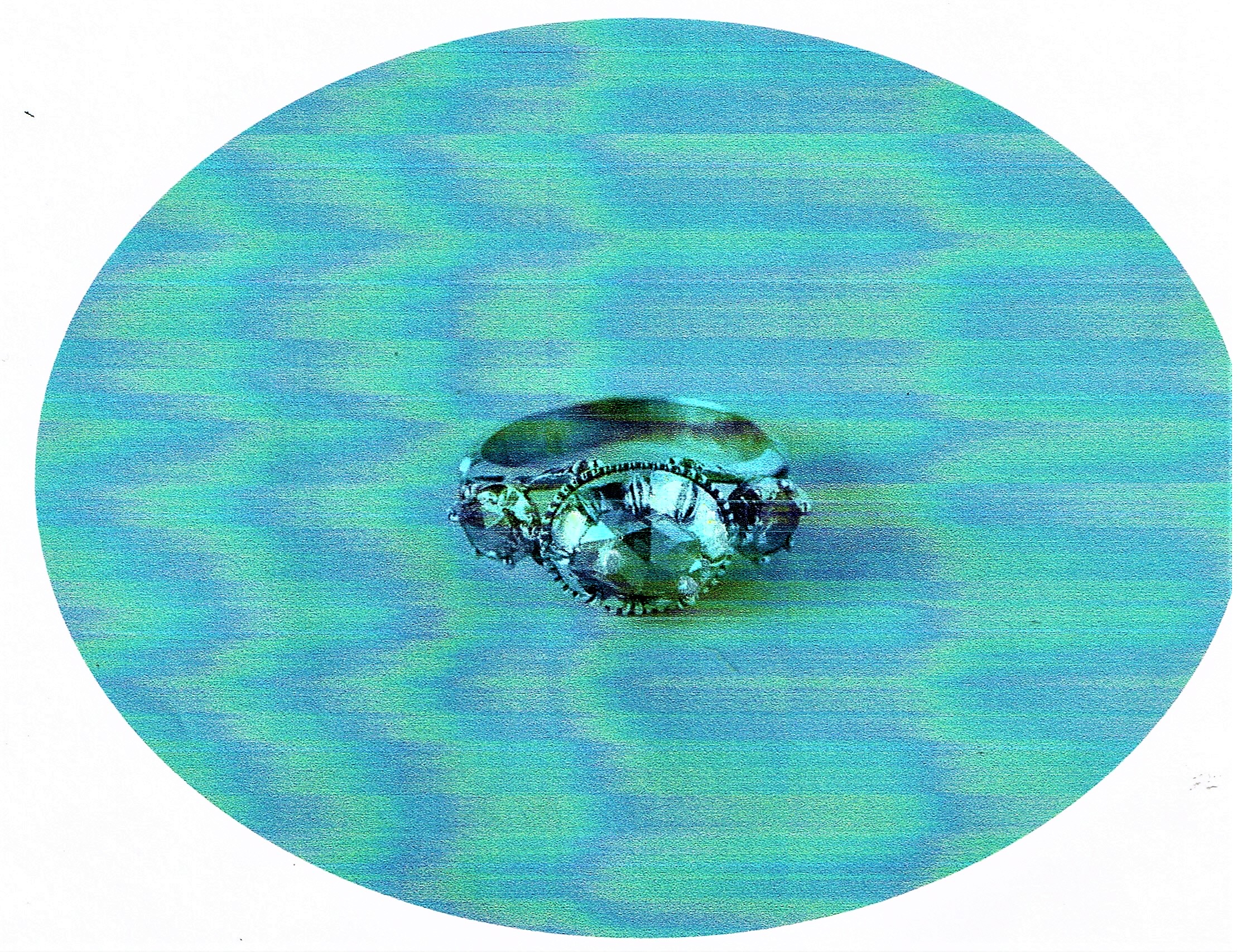
Chester kept a tiny, gray velvet box hidden in his pocket. A ring with a big white diamond lay in a soft spongy space inside. He said it belonged to his mom. She died and went to heaven not long after he was born.
“You can’t touch it, Stacey,” he said. “Only I can do that ‘cause it belonged to my mom. I like to hold it and pretend she’s right next to me. Dad said she had hair dark as molasses and a voice that made the angels cry.”
He rolled the ring in his palm, then held the jewel to the sun, as if he could see more than a few sparkly places. Then he carefully put the ring back inside, and we ran to find swings next to one another on the playground. If there weren’t any, we climbed the monkey bars, and he never seemed to care that I always beat him to the top.
One day in the lunchroom, Mrs. Craftwood saw Chester take the ring out of his pocket. She dragged him to the principal’s office. I threw away the other half of my bologna sandwich and followed them. They didn’t close the door. I saw everything.
“This ring had to be stolen,” Mrs. Craftwood told Mrs. Austin, “because this boy’s father is incapable of affording something like this.”
Mrs. Austin glared at Chester. “Stealing is a sin, son. You should know that.”
After school when Chester’s dad got to the principal’s office I sat outside the office and listened again. I knew that he had a job in a big, important office a long time ago, but the company closed one day, and he never found another job like it. Then after his wife died, he moved into an old four-room house on the edge of town and did odd jobs now and then. Folks said he didn’t seem to care anymore. But when he charged into Mrs. Austin’s office, it was clear he cared about something.
He didn’t say anything while she and Mrs. Craftwood accused Chester of stealing. Then he asked if either one of them took a close look at the ring.
“Why should that be necessary?” Mrs. Austin asked.
“Because it doesn’t take much light to see the truth in that diamond. Let me guess. Came in a gray box. Smells a little like grass stains and peanut butter.”
“What are you talking about, sir?” Mrs. Austin said.
I had to cover my ears because Chester’s dad got so loud. And this time the door was shut. He’d slammed it when he went inside. Hard.
“Would a real diamond look as scratched up as the side of a matchbox?”
“Please lower your voice,” Mrs. Craftwood said.
“Not until you return his mother’s ring.”
I wanted to lean into the door and catch everything that went on, but then Chester’s dad started talking about how his wife deserved better, and so does Chester. Wasn’t so exciting anymore. Something I couldn’t explain made me feel strange, almost like I walked into the boys’ dressing room by mistake. So, I sat on the bench outside the door and waited for what seemed like a long time.
“Thank you,” Chester said as his dad opened the door. Simple, like nothing was ever taken from him in the first place. He didn’t even see me right away because he was too busy slipping the ring on and off of his finger.
But his dad’s face looked so red it must have hurt. I could have sworn it burned right through his whiskers. He stopped when he saw me. “Stacey, you’re a good kid. Chester’s crazy about you. Don’t ever get too big for yourself.”
“I won’t,” I said. But I thought that was a strange thing to say.
Chester never did come back. He went away to a special-needs school on the other side of town. Mom said it was time for me to start playing with normal children.
“What’s normal?” I asked, and Mom accused me of being smart aleck.
But this time I wasn’t.
After that, I decided it was best to be vague about what I was doing. Sometimes I went to Chester’s house and we explored the woods behind it. We hoisted ourselves into the trees with lower branches and hunted for birds’ nests and woodpecker holes. He carved our names into a young beech tree.
“Someday when we’re old enough, let’s get married,” he said. “We’ll come back here and I’ll draw the heart and put the date on it.”
“Maybe,” I said. “But let’s look for salamanders down by the creek now.”
“Okay. But why can’t we ever go to your house to play?”
“Mom said I had to play outside. She’s cleaning.”
“You said she was sick last time,” he said.
“That’s because all she does is clean. And that much cleaning would make anyone sick.”
I stopped going to his house as much because I got tired of lying. To Mom. To Chester. Then one day I told Mom I was going for a long bike ride all by myself. I went to Chester’s house, but no one was there. When I peeked into his house it was empty, blind-dark. On the way home I felt mean, like somehow, I made Chester move away. I stopped at our beech tree in the woods, took a sharp rock and etched a shallow, lopsided heart around our names. It didn’t look very good. I’m not sure why I did it. Playing house never appealed to me. And Chester and I were never boyfriend and girlfriend.
But when I went to my cousin Janet’s wedding that summer, I thought about what it would be like to be a grown-up getting married. Maybe just for that day I would be willing to wear a lace dress, one made by a silly third-grade girl who grew up to be a fashion designer. Of course, I didn’t want to marry just anybody. The groom needed to be special, someone like Chester, who could give me a fake diamond, yet be real inside.




 terrypetersen