Feeds:
Posts
Comments

Posts Tagged ‘grandchildren’

Love as if never getting tired. (Mother Teresa)

My energy level isn’t where it belongs—I choose a get up at 4:30AM, write, start-crockpot-soup and-then-marathon-until-10:00 PM regimen. At mid-afternoon I would crawl into bed and call it a day if I could. Four-year-old Dakota comes to my side. Jay and I are babysitting. I would be fatigued even if my schedule were as blank as copy paper sealed inside the original packaging.

“Play with me,” Dakota says.

He’s wearing his ubiquitous tool belt. I suggest we find something suitable to repair with a plastic wrench. But his pretend mind and mine aren’t in sync yet. Eventually I pick up my iPad. We find scenes from “Home Alone II.” Then he discovers a game where Santa’s beard is decorated—or mangled—in a barber shop. I help him find a razor in the set of game tools. Santa will be bald this year, with green fuzz. We laugh. Dakota’s dark eyes light up brighter than our tree’s.

The world as he recognizes it during each moment, is all that exists.

We are not officially his grandparents. Perhaps, someday, his mommy and my son will marry. In the meantime, I painted him in as the fourth cool snow-person grandchild on our seasonal wall hanging. I bought it several years ago and added the details.

Dakota is two years younger than our youngest granddaughter. The only boy. He creates an even number to our children’s group. The two older girls have already made future family plans for the fuller set, far beyond a reasonable expectation, including home-away-from-home rooms in our house. I don’t care. The girls’ enthusiasm is both encouraging and beautiful.

When Grandpa Jay arrives home Dakota meets him at the door. Jay has achieved rock-star status in this little guy’s eyes. And all Jay needed to do was take him to the YMCA to shoot baskets. My husband wore out long before Mr. Dakota did.

Later Jay fights sleep at our son’s house and Dakota reaches into the refrigerator for two tubes of yogurt—one for each of us.

“Want to see my room?” he asks.

Really I’d rather ask Jay to move over. I won’t. My neck is begging for a hot compress. I feel twice my age, a feminine form of Methuselah reincarnated.

Instead I answer, “Sure.” Mother Teresa did not leave the words “as if” out of her statement about love. Real life limits remain.

The rewards, however, continue.

4 grandkids

Read Full Post »

Children don’t need much advice, but they really do need to be listened to and not just with half an ear. (Emma Thompson)

Eight-year-old Rebe and I have a girl-bonding day. We are mermaids at the YMCA Water Park. Young mermaids! I need a lot more imagination than she does to fill this role. She explains the scenario and I follow, adding as much absurdity as I can.

The pool is divided into sections. Upper-class kid mermaids swim in the larger, shallow, easy-to-manage section. The lower class lives in the slightly deeper territory. I tell her I can’t fathom wealth, so I will tread water. (I prefer this area anyway.)

Of course her game morphs and she spends most of the time in the freer kicking space. She can swim. I celebrate listening to her banter. She doesn’t want to leave as the time grows closer.

“One more minute.” She raises one finger. Then she smiles. “Five more minutes?”

Rush-hour traffic isn’t going to get any better one way or another. Dinner is semi-prepared. Daddy won’t be picking her up for two and one-half hours.

“Five more minutes,” I say.

She grins.

Then a tall, slender woman pushes a young man in a wheelchair into the water. The young man is paralyzed. Rebe watches as the woman, smiling, pulls him from the chair and works his arms and legs through the warmed water.

“Therapy?” Rebe asks in a soft voice.

“I think so.”

“Or fun?”

“Maybe that, too.”

A huge man with skin the color of milk chocolate enters the water. He helps. I think about what a good idea his presence is. His size and strength could be helpful getting the young man back into the chair. The thin, pale woman and the large man laugh and joke with the younger man. I see the paralyzed man bat his hand at them. A response, probably enormous judging by the cheer of his two helpers.

“Therapy,” Rebe repeats. “Or maybe they are family.”

I pause taking in the beauty of my granddaughter. The two assistants look nothing alike. Yet, Rebe and I both know families—more than one—with a father the color of dark honey, fresh graham crackers, or gourmet licorice, and a mother as pale as apple blossoms or an unpicked peach. Rebe looks inside to who an individual is. The outside is secondary. She goes to a school where color is superficial; I live in a neighborhood where skin colors match the picture below.

Probably not, I think. “Maybe,” I answer.

I tell Rebe it is time to go back to my house. Grandpa is waiting for us. But I am grateful for those five extra minutes. They brought a larger gift than 300 extra seconds in pool water.

skin colored crayons

Read Full Post »

I am incapable of conceiving infinity, and yet I do not accept finity. I want this adventure that is the context of my life to go on without end. (Simone de Beauvoir)

As autumn puts on the last of its show I remember the mini-vacation Jay and I took at Hocking Hills. I walked the trails and paid no attention to that silver band around my wrist with the tiny clock on it—I could have been wearing my watch upside down. It wouldn’t have mattered.

Perhaps that freedom gave me the illusion that utopia existed, at least somewhere; I felt healthy, young, my chi as vitalized as it had been when I said I-do in July of 1971, when I felt as if I would be age 25 forever, continuously renewed. In Hocking Hills nature and I seemed unified. Beauty appeared in every direction.

The real world has returned. Another YMCA friend faces chemo and then radiation. A fellow writer friend fights for her life in an out-of-state hospital. I discover that several people aren’t doing as well as I had hoped. My sister-in-law has been to hell and back again. Her attitude, however, glows. She encourages others. She lives the life-explanation Francis Weller explores in the October issue of Sun Magazine, The Geography of Sorrow. Pain and loss, joy and peace co-exist in order to create a complete existence.

In our American society we expect to begin and end with perfect emotional control. Weller analyzes our bias against public grief. I read the article so slowly it took me several days to absorb each word.

I think about this again as my two older grandchildren, my husband, and I watch Where Hope Grows. The girls have already seen the movie. Rebe and Kate are only eight and eleven years old. Yet, they get it. They suggested the movie. Not every reviewer agrees. The creators made the mistake of using the word, God. However, I recognize more showing than telling, more action than preaching.

Calvin Campbell has sought the answer to life through drink. His choices inevitably fail him and he goes to Produce, a young man with Down syndrome, for the secret to his happiness. An unexpected story unfolds.

My granddaughters know how tragedy looks and feels. Kate’s friend fell through a patch of ice when she was three-years-old; the friend is permanently disabled. I wrote about it in a poem I titled Chrysalis. It was originally published by Saad Ghosn in the annual anthology, “For a Better World 2012.” It will be reprinted in Piker Press on November 23. 

The girls also know how to love. When their young cousin Ella sees them she is ecstatic. She talks about them often. Ella, of course, like Produce in Where Hope Grows, knows the secret of happiness. She is satisfied to be herself. She accepts the moment, and lives it fully.

Perhaps full joy isn’t found in happily-ever-after dreams. It lives in the mundane, the muck, the malformed, and the miracles revealed through inside-out transformation. Into the whole.

strong people don't have easy pasts

Read Full Post »

The soul is healed by being with children. (Fyodor Doskoevsky)

Halloween. And I offer to stay at my son Steve’s house to wash dishes. But his girlfriend Cece says, “Let’s all go. I will wash the dishes when we get back. Then you relax and play with Ella.” Cece doesn’t want me to miss out on the fun.

And fun is only the beginning. “Candy. Look. More candy,” Ella exclaims after she has stopped at only a few houses. Her costume is inexpensive and hand-wash-only fragile, the kid-popular, Doc McStuffins. However, Ella’s sweet smile brings her extra treats at several stops.

At first she approaches each house with her bag behind her back. Then she eagerly opens it with an excited “trick-or-treat.” Her cautious move has become a run. The neighborhood knows how to celebrate. Groups gather outside with bonfires, cackling witches, lit pumpkins. Kids fill the streets. Two children are in wheel chairs. I pause to say Happy Halloween, but don’t linger for conversation. Tonight is the time for action.

“Look,” Ella says to passers-by. She opens her bag and displays her treasures with pride. No one chides her or mentions that she has special needs.

At one house an empty chair blocks the sidewalk, but the front door is open. Ella runs toward the golden-glow space inside the house. The empty chair signals my intuition. I decide to follow her. An elderly man answers.

“Oh dear,” he says. Apparently his wife, who should be holding down the fort, has left with the treats.

Instead of responding with disappointment or anger Ella reaches into her bag and pulls out a box of candy. The man doesn’t understand at first. Then he realizes that Ella is sharing from her bounty.

His wife arrives and gives Ella a few extra pieces. Our little girl grins. Wearing her gratitude on her face.

As Ella descends the stairs toward Daddy, Cece, and Grandpa I tell the couple that our granddaughter with Down syndrome has had two open heart surgeries. She is resilient. Her open heart touches anyone who will recognize her gift.

The man has tears in his eyes. He did not accept Ella’s candy. He did receive her touch of love. And all Ella needed to do was to be Ella.

And I am grateful to Cece, too. Sure, I would have been happy to stay back at Daddy’s house, wash dishes and hand out candy. Instead I have the privilege of watching beauty in action.

The plates and utensils wait until we came back. Ella does not fuss when Daddy does not allow her to have all of her bounty at once. She savors each bite. I hope to learn how to savor each moment, too.

learning from children morning coach


Read Full Post »

Any fool can be happy. It takes a man with real heart to make beauty out of the stuff that makes us weep.  Clive Barker

Ordinarily when Jay and I pick up Ella from school he drives and I sit in the back with our granddaughter. I monitor snacks, play games, or read books with her.

Today I am at the helm of my ’97 Toyota. Ella repeats, “Grandma’s car.” She wants to know where Grandpa is.

“He went to the doctor. He will be home later,” I tell her. But I can’t see her face in the rear-view mirror. My mindset is in sync with her older cousins. They think that a hypodermic needle is to be avoided at all costs. But since Grandpa is a grownup, he would be just fine. I assume Ella’s viewpoint to be similar.

“If Grandpa gets a shot we will give him a big hug!”

There is silence in the back seat, followed by, “Grandpa be okay. I be okay.” Ella’s sweet voice cuts through me as the chorus repeats.

“Yes, he will. Grandpa will be home soon.”

The drive from Ella’s school to our house is just over ten miles. I feel as if I am driving cross-country.

Text Grandpa as soon as you get in the door, Ter. Tell him to call so that Ella can hear his voice.

On the outside I would appear calm. The car remains on the road. I stay within the speed limit. Inside I chide myself for a stupid mistake. Ella has had two open-heart surgeries and one minor surgery on her wrist. The word doctor opens a Pandora’s Box. She does not want her grandfather to fall prey to its powers.

Fortunately Grandpa hears the beep on his phone. He is leaving the office. “Grandpa be okay” takes on a new tone as Ella hears his voice.

“Let’s hide,” she says, anticipating hide-and-seek when Grandpa returns. Our little girl has no sense of time. Jay will not be home for another twenty-five minutes. I hold her in my arms and look into her huge blue eyes, possible now since I am not behind the wheel of the car and she is not bound to her car seat.

Sure, I will play this mock-game with her. The hiding place she chooses is in plain sight. And so is our little girl’s incredible beauty. Her internal powers shine: the gifts to love unconditionally, to simply be without comparing herself to anyone, and to bounce back after every fall.

I suspect there are people who look at us as we go to a park or enter a restaurant and think, How sad! That little girl has Down syndrome. Or worse, they identify her as a tripled chromosome and call her a Down syndrome child, throw around an R-word or two, and dismiss her importance. I can’t change that notion on my own. But I can make a dent in that perception.

Organizations like the National Down Syndrome Society and our local group, The Down Syndrome Association of Greater Cincinnati, help to crush myths and show how valuable each individual is. Success for many more persons with Trisomy-21 is possible, even inevitable. Yes, the child born with the genius IQ someday may create formulas, ideas, new drugs, and inventions that change the world. But the child born with an extra chromosome has the knack for changing the heart. Now.

Ella may not be able to express Osho’s quote pictured below in words. However, she lives it. I am fortunate to be her student.

life is not logic Osho

Read Full Post »

There is no real ending. It’s just the place where you stop the story. (Frank Herbert)

From my grandchildren’s point of view my published book is something like an honorary mention trophy. Nice on a shelf. When I gave my eight-year-old a copy of “The Curse Under the Freckles,” she wanted to know where the pictures were. The girls are more impressed by ice cream—chocolate chips blended in sweet raspberry flavoring. Or a day of pretend with Grandma. Touch a child’s life directly; that is what matters. The words will hit later.

My older son, Gregory Petersen, is also a writer. His book, Open Mike, was published through Martin Sisters several years ago. He is working through an agent with his next book. Greg is capable of writing thousands of words a day even though he has a full-time position that includes a leash phone; he takes his job as daddy seriously. I am more proud of him for his excellent relationship with his daughters than I am for his incredible ability with words. And his gift for expression is exquisite.

All life can be presented as a story. I often have difficulty turning that perception off because imagination doesn’t always fit the moment. For example: in the middle of the night. Oh sure, I’m told to write ideas down, whenever they come. But that doesn’t seem to be realistic when the notion isn’t a one-liner. The rolling avalanche of a plot and the inevitability of sleep deprivation are counter-productive in the long run.

Sometimes relaxation comes from reading—letting the thoughts of others feed me, especially when those thoughts lead to the profound. My sister Claire shared a book she had already read, Same Kind of Different as Me. It fits into the grab-the-soul category. Thanks, Sis.

Authors Ron Hall and Denver Moore tell a true story. Ron is an international art dealer. Denver is a modern-day slave, a sharecropper, who runs away into a life as a homeless person and decides it is better than being unofficially owned. The love of Ron’s wife, Deborah, leads toward an unlikely friendship.

Denver Moore says, “I found out everybody’s different—the same kind of different as me.” What and how he discovered that similarity, the human center-core spirit, is where the beauty of the story lives—sometimes clothed in miracles, or incredible pain, or deep sadness.

Stories never really end. The characters in my own tales develop a kind of reality. But in fiction, at least before publication, entire chapters can be erased and rewritten and then changed again. The past, present, and future are as pliable as soft clay.

In Hall and Moore’s story the facts of their lives remain solid because “The Same Kind of Different as Me” is non-fiction. At the end of the narration at almost seventy, Denver admits he has a lot to learn. The last page is not the last page.

In April Paramount plans to release a movie starring Greg Kinnear, Renee Zellweger, and Djimon Hounsou based on Ron and Denver’s New York Times best seller’s impossible journey. I did not know this until I checked the Internet for more information about the original publication.

Impossible, hidden, a forgotten acorn that becomes an oak…who knows? The story continues…Any story can continue…

same kind of different as me

Read Full Post »

I remind myself every morning: Nothing I say this day will teach me anything. So if I’m going to learn, I must do it by listening. (Larry King)

Rebe, my soon-to-be-eight-year-old granddaughter, loves to play any game that involves mommies, dolls, and the lives of families. My role changes at her whim. And I am okay with that. My pretending stays within the realm of fiction. Reality intervenes, even in fantasy. Plot, grammar, logic, and a reasonable timeline are required. Even an insane character requires motivation, albeit skewed.

Play doesn’t come naturally for me anymore. Unless it includes humor. Then it isn’t really pretend; it’s called drama. Too much time has passed since I wanted toys for Christmas. Sometimes I act the part of Rebe’s offbeat daughter.

“Mommy, can I drive your car to kindergarten? I won’t smash it into a tree this time.”

That makes her laugh. Or, she tells me I’m in fifth grade not kindergarten, and the event never happened. Another reason why following Rebe’s imagination is impossible to follow. For the most part however, I listen, and discover who my young descendant is.

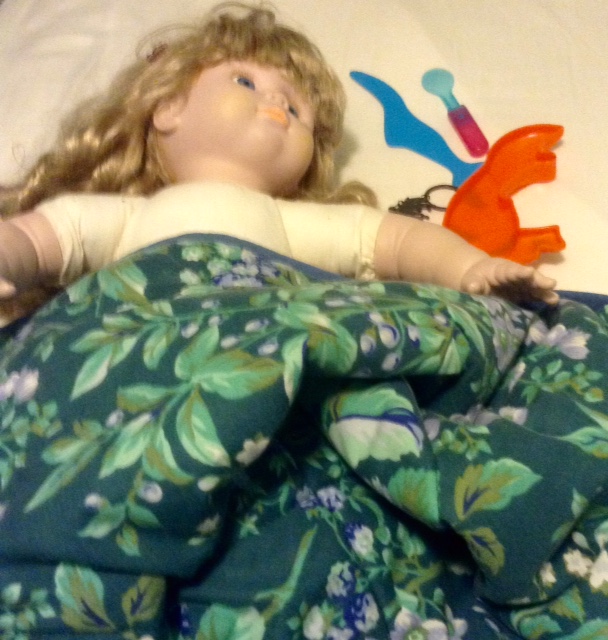
At first she is the mommy. Then she takes her baby with the soft tummy to the doctor. And she assumes the role of pediatrician. I’m not sure whether I am the sit-in for the mommy or an older child as she examines baby with makeshift instruments: a plastic spoon and knife, a key chain, a puzzle piece.

Her expression turns serious. “Most babies are normal,” she says. “And that is good.” Then she pauses after more pokes and probes and faces me. “But this baby has special needs. And that is good, too.”

She hands me the doll. My jokes have disappeared. I am in awe of a second-grade girl who speaks with wisdom. The softness of the toy and the softness of her words sink into me.

I have nothing to say.

doll

Read Full Post »

You build on failure. You use it as a stepping stone. Close the door on the past. You don’t try to forget the mistakes, but you don’t dwell on them. You don’t let them have any of your energy, or any of your time, or any of your space. (Johnny Cash)

Somewhere around two in the morning I waken with a throbbing right hand. Did I roll over onto it? Did my sleeping body drift into the past and forget that arthritis rules my right thumb. Inflammation tells each movement what it can do and what it can’t. And it is a strict taskmaster.

Of course I rebel. I have writing projects to complete, and the cooking, cleaning, and laundry don’t do themselves. Fantasy appears only in story form. Even on the written page reality intervenes. Sure, I can invent a character, a girl who floats into the air at will. However, if she levitates at the local Seven-Eleven havoc will appear, unless, of course that is part of the plot.

A cold compress helps my hand. It tells it to stop complaining for a few minutes anyway. Somewhat. So does calming thought. But sleep does not return. I get up at four and begin to write, trying to embrace the silence as a gift. I add a page to my next novel, then another. This does not mean they won’t be backspaced later. A story has progressed. The missed sleep will demand to be repaid later. For now I take advantage of the moment.

The ache reminds me that I am alive. Fully. In this moment. I’m told this is the most common form of arthritis. Osteoarthritis. As my parents, aunts, and uncles told me: “It won’t kill you. You’ll just die with it.”

Finding someone with more serious problems is easier than I would like. I’ve been praying for a young friend who is expected to be in intensive care for longer than the two weeks originally expected. She, too, is a writer. And a reader. Her security is a book resting on her chest along with the ambiance of IVs, monitors, and an existence where pain owns the building. She has had two surgeries. Complications continue. So far her miracle begins with survival.

A child close to me has a friend who died of a rare inherited disorder; her sister has the same disease. My little friend is reluctant to talk about her grief. So I cannot reveal her identity. Life and joy do not circumvent difficulties. They travel through them.

The sun peeks through the window of my office, also a toy room, the place where my grandchildren and I play. The rays will find family pictures, disorder, my half-empty coffee cup, and possibilities I don’t see yet.

Sure, I would like to take the brace off my hand post-miracle. But I’m not going to count on it. However, I haven’t typed the ending to my story yet. That choice isn’t mine anyway.


seeing the inside brightness

hand brace09212015_0000

Read Full Post »

The voyage of discovery is not in seeking new landscapes but in having new eyes. (Marcel Proust

Ella is scarcely buckled into her car seat after kindergarten when she dumps out her backpack. “See,” she says opening a black binder. “My homework.”

“This is mine,” she adds showing me a page with squiggled lines of crayon. “I color.” Papers fly all over the back seat. I grab them. My juggling skills need practice. Jay is driving. I am sitting in the back seat with Ella—not to spoil my granddaughter, but to spoil me.

She turns to an earlier page. The paper clip sealing those completed pages flies off. I have no idea where the clip belongs, even if I could locate it on the dark floor. Chances are her mommy will know what to do. For now I gather the loose items into Ella’s backpack and ask our granddaughter to pretend to be the teacher. I will be the student.

She points to numbers one through ten and identifies them in a clear, I-know-this voice. If I ask her to repeat the lesson she will refuse. Either I catch it the first time or lose. Ella will not perform. She has been reading phonetically for over a year. On her own terms.

See-what-I-know is not in her repertoire.

Eventually, perhaps, she will learn how to play the going-to-real-life-school-game. For now I try to discover what she understands from what I can discern. Not from what I assume.

I kiss her on top of her white-blond head. “Want to go to the park?”

“Playground,” she answers.

I smile at an even-better-than-yes answer. She has chosen a synonym.

“You’ve got it!”

Our little girl may carry an extra chromosome, but she sure isn’t a syndrome. Yes, it may be easier to say Down syndrome child—but it isn’t accurate. She doesn’t fit into a category, a label. She has blue eyes, a winning personality, straight blond hair, the flexibility of a wet sponge, and Trisomy-21. She has the syndrome, but it is only one small part of who she is.

And I wouldn’t want her to be anyone but Ella. She reminds me of life’s priorities. They live in her spirit. Because of her I have the opportunity to become a better person. A little bit at a time.

We learn together, taking turns as teacher and student. Student and teacher…Graduation isn’t on the agenda. We both continue to grow.

at West Fork park September 14, 2015

Read Full Post »

When will you learn that there isn’t a word for everything? (Nicole Krauss)

Ella has had enough play for the evening. Daddy is playing in a softball tournament. His team won the first game and the second is in progress. She doesn’t even want my iPad, usually a sure thing. She eases into my lap as we sit in the concession area and asks for her friend Nona. I didn’t see the little girl during the first game.

Nona is years younger than Ella. But our granddaughter doesn’t limit her friendships to children her age. Nona has a sparkling personality. And she has inherited artistic skills. I suspect that she and Ella communicate on non-verbal levels, through action, color, play. Little people see more than adults realize.

artwork by Nona Adams-Jones

artwork by Nona Adams-Jones

Ella puts her head on my chest. I straddle the hard bench and I’m amazed at the length of time my senior body remains still without stiffening into one four-foot-eleven-inch cramp. Something innately beautiful in Ella softens me.

Simultaneous loud conversations merge into a rumble. Ella’s arms are covered with dirt from the playground area. Her hair could use a brush. At the table across from me someone spills a beer into peanut shells on the concrete-slab floor. The noise and distraction don’t stop my granddaughter from falling asleep. I can’t take off her glasses without waking her.

This frozen-grandma scene would not appear to be pleasant. Nevertheless, I choose to remember it—every detail. I have no desire to join the laughter surrounding me. I would rather savor holding this blonde little girl, recognizing the trust she has in me, basking in her unconditional love. Another kind of artistic moment.

Soon she will awaken, sleepily, and see Daddy. He is her world. She is excited to give him her coloring page from daycare. I will give up this moment soon enough. For now there is no need for words. I remain still. Privileged. The grandmother of a girl with Down syndrome and up gifts.

Art comes in all forms. Sometimes words fail when they try to capture gifts that develop and change as this moment eases into the next.

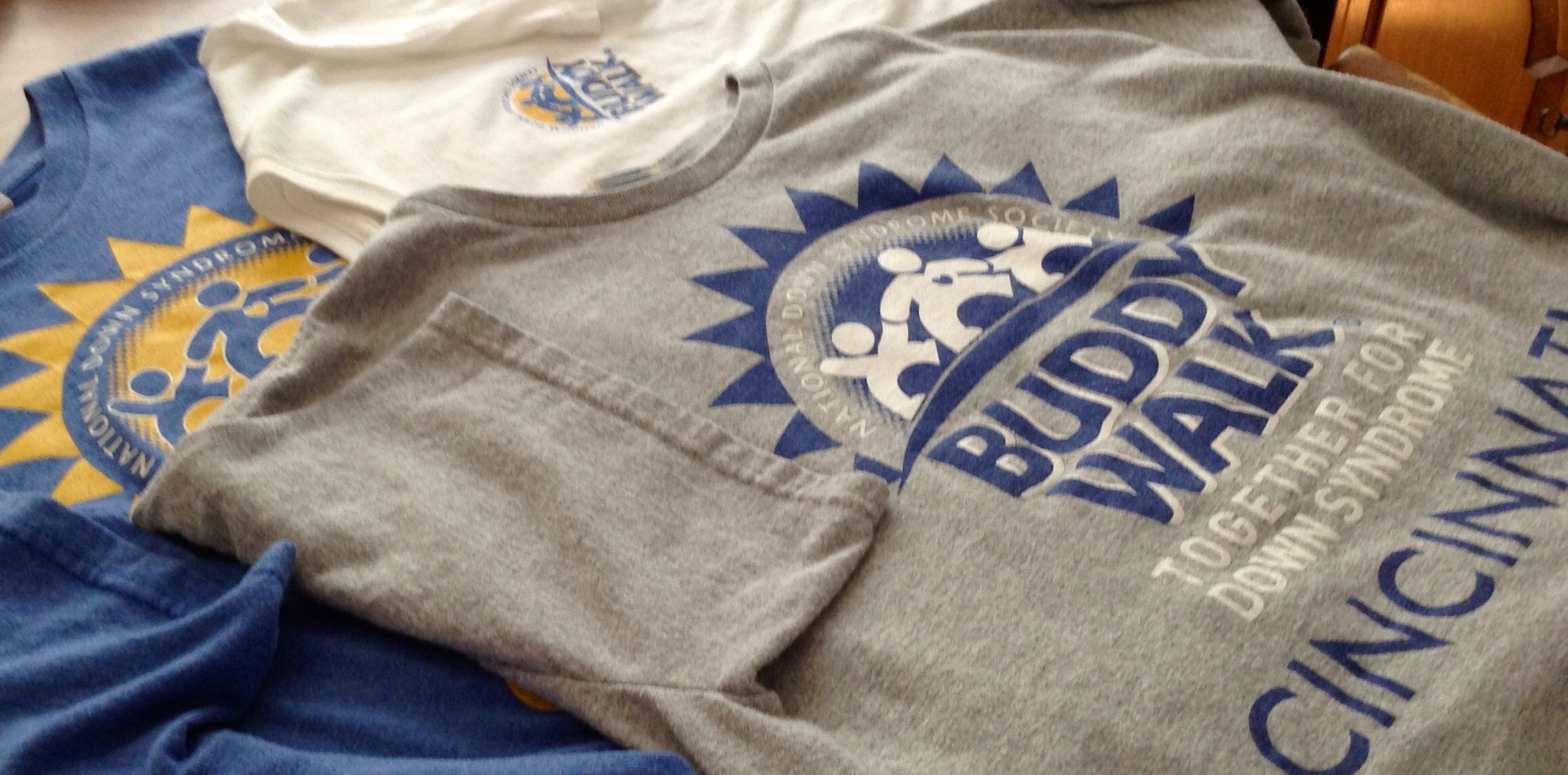
shirts from past celebrated Buddy Walks

My husband and I wear these often as we watch our Ella grow.

Buddy Walk shirts


Read Full Post »

« Newer Posts - Older Posts »