Feeds:
Posts
Comments

Posts Tagged ‘wisdom’

Each minute we spend worrying about the future and regretting the past is a minute we miss in our appointment with life. (Thich Nhat Hanh)

The electricity flashes off about eight in the morning, turns on again, and then gives up seconds later. I’m in the shower. Fortunately there is enough light to turn off the water and grab a towel.

The computer screen is a dull, uncooperative black. Google is as accessible as the inner chambers of a collapsed, condemned mine. At least temporarily.

I’m grateful my car is out of the garage because the garage door doesn’t have a convenient old-fashioned handle. It has a one-track attitude; it responds only to an electronic opener—and intact electricity. Sure, the door can be opened manually. If you are taller than the average fire hydrant.

Apparently the power outage has affected more than our short street. A traffic light at a major intersection is out. I am grateful for courteous drivers. Yes, they do exist. Unfortunately, the-guy-with-the-need-to-read-bumper-stickers-while-driving-seventy-miles-an-hour-three-inches-from-your-bumper demands more attention than the individual who understands four-way stops at a malfunctioning light.

The plot thickens. The electricity returns. About three hour later. But, suddenly we lose our land line, television, and Wifi connections.

A slow, steady rain falls, but no heavy wind, no indication of a thunderstorm. I think about unexpected struggles. Sometimes they are trivial, like a delay in access to my beloved connections to the world. Then again they can be violent, obviously coming from an uncontrollable force. The death of a faithful friend or family member, or a major loss.

And sometimes struggles come from unexpected, uncomfortable change. The slow disintegration of the agility in my hands, suddenly cramping without warning, or a discomfort that works its way into pain. Example: I suspect I pulled something in my left arm during an exercise class, but no length of rest, no amount of heat or cold, helps.

The nagging thought that this pain could be something more than a minor mishap crosses my mind. Not helpful. So, I imagine fear dissipating with the next breath, or out through an ear or… a nostril—don’t care where it escapes as long as it leaves. If something serious is happening let me face it when it is discovered, not now.

I slip my watch onto my wrist and discover that the time is correct. For a change. It may need a new battery. Or the timepiece may be past its prime. No object lasts forever. Uh, hold that thought until later. A lot later.

I discover that the pain in my arm is caused by a pinched nerve. Exercises that require weights will be off-limits for a while. A while may not have a definite end, but it does have one. Eventually.

Our push-back into an earlier non-electronic era ends as well. Apparently, our contact with the outside world had been stopped by a malfunctioning power brick.

So what is a power brick? I look it up and my virus protection warns me that the page isn’t safe. Other links assume I already know what a power brick is. Google images present pictures so diverse I feel as if I am a kindergartner who has drifted into an advanced technology class, or a pre-school kid who has volunteered to guide customers through Home Depot.

Anyone could easily guess I don’t know what I am doing. Let the experts install the master switch that guides my electronic universe. My husband and I thank our service technician and he thanks us for being pleasant customers.

I celebrate re-entry into the current century and take on gratitude.

My watch’s slowness can be faced later. “Uh, silver time-keeper, I’ll pencil you in for a checkup tomorrow at two.” Of course real life could make some other appointments in the meantime. Who knows? One day, one hour, one second as it develops.
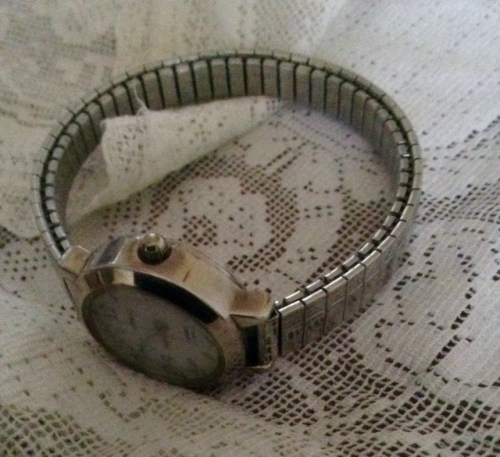
watch

Read Full Post »

Nobody ever figures out what life is all about, and it doesn’t matter. Explore the world. Nearly everything is really interesting if you go into it deeply enough. (Richard P. Feynman)

But I do wonder why. A friend is suffering, fighting for her life. The cause of her illness appears to be random. She is young, with two elementary-school-aged girls. Another person I care about is going through chemotherapy for stage-three breast cancer. Beauty, ugliness, life, death, intertwine. Colors bleed into one another. They rarely remain sterile. Each horizon appears slightly different even in the same location. One same-tint batch of paint may differ slightly from the next batch.

I know this. Yet, I get caught up in either tragedy or joy as if either one were the whole of life. During a water aerobics class one day another woman and I talk. She asks how my book is doing. I tell her it’s okay as far as I know. Several copies of “The Curse Under the Freckles” are available through the Public Library of Cincinnati and Hamilton County.

Eventually, of course, my beautiful grandchildren slip into the conversation. I mention the fun trips I have had with my husband. When I stop long enough to ask about my exercise partner’s life I discover she won’t be having a fun Thanksgiving. She is having surgery, to repair a previously botched surgery. She lives in constant pain.

This time I need to listen. Both ears open, my lips sealed. I remember a phrase used for a children’s class that made me smile at the time: This is my time to talk and your time to listen. Except now the advice is reversed. I stand close, watch every movement she makes.

I place both of my hands on my pool partner’s shoulders and wish her well. For now this is all I can give. She smiles.

The songs presented by Dan Erdman in his most recent Oasis evening come back to me as I leave the water. Dan’s music focuses on the positive, on the real power of love. Sometimes I hum softly as he plays and stifle the desire to belt it out. Occasionally there are moments when all are invited to join in. Then I feel uplifted, engaged. All of it is good.

Dan’s wife, Marcia, is a dear friend. She accepts me at the core of my being, both the places that express savvy and those that need work. She is the most intuitive person I know.

Needs-work seems to be the human condition. And I love people who readily admit they fit into the imperfect category. Together we can explore the world, find the beauty in a decaying leaf, a breaking body, an unpleasant surprise, and pain. We can celebrate with love, even if we don’t recognize the experience as love at the time. Perhaps it is difficult or downright ordinary. I’m not sure that depth can be seen from inside one moment anyway. I think it needs the context of time and distance. And we can’t do that alone. I know I can’t.

Thanks to all my friends along the adventurous path called life.

life challenges PIQ


Read Full Post »

Children don’t need much advice, but they really do need to be listened to and not just with half an ear. (Emma Thompson)

Eight-year-old Rebe and I have a girl-bonding day. We are mermaids at the YMCA Water Park. Young mermaids! I need a lot more imagination than she does to fill this role. She explains the scenario and I follow, adding as much absurdity as I can.

The pool is divided into sections. Upper-class kid mermaids swim in the larger, shallow, easy-to-manage section. The lower class lives in the slightly deeper territory. I tell her I can’t fathom wealth, so I will tread water. (I prefer this area anyway.)

Of course her game morphs and she spends most of the time in the freer kicking space. She can swim. I celebrate listening to her banter. She doesn’t want to leave as the time grows closer.

“One more minute.” She raises one finger. Then she smiles. “Five more minutes?”

Rush-hour traffic isn’t going to get any better one way or another. Dinner is semi-prepared. Daddy won’t be picking her up for two and one-half hours.

“Five more minutes,” I say.

She grins.

Then a tall, slender woman pushes a young man in a wheelchair into the water. The young man is paralyzed. Rebe watches as the woman, smiling, pulls him from the chair and works his arms and legs through the warmed water.

“Therapy?” Rebe asks in a soft voice.

“I think so.”

“Or fun?”

“Maybe that, too.”

A huge man with skin the color of milk chocolate enters the water. He helps. I think about what a good idea his presence is. His size and strength could be helpful getting the young man back into the chair. The thin, pale woman and the large man laugh and joke with the younger man. I see the paralyzed man bat his hand at them. A response, probably enormous judging by the cheer of his two helpers.

“Therapy,” Rebe repeats. “Or maybe they are family.”

I pause taking in the beauty of my granddaughter. The two assistants look nothing alike. Yet, Rebe and I both know families—more than one—with a father the color of dark honey, fresh graham crackers, or gourmet licorice, and a mother as pale as apple blossoms or an unpicked peach. Rebe looks inside to who an individual is. The outside is secondary. She goes to a school where color is superficial; I live in a neighborhood where skin colors match the picture below.

Probably not, I think. “Maybe,” I answer.

I tell Rebe it is time to go back to my house. Grandpa is waiting for us. But I am grateful for those five extra minutes. They brought a larger gift than 300 extra seconds in pool water.

skin colored crayons

Read Full Post »

I am incapable of conceiving infinity, and yet I do not accept finity. I want this adventure that is the context of my life to go on without end. (Simone de Beauvoir)

As autumn puts on the last of its show I remember the mini-vacation Jay and I took at Hocking Hills. I walked the trails and paid no attention to that silver band around my wrist with the tiny clock on it—I could have been wearing my watch upside down. It wouldn’t have mattered.

Perhaps that freedom gave me the illusion that utopia existed, at least somewhere; I felt healthy, young, my chi as vitalized as it had been when I said I-do in July of 1971, when I felt as if I would be age 25 forever, continuously renewed. In Hocking Hills nature and I seemed unified. Beauty appeared in every direction.

The real world has returned. Another YMCA friend faces chemo and then radiation. A fellow writer friend fights for her life in an out-of-state hospital. I discover that several people aren’t doing as well as I had hoped. My sister-in-law has been to hell and back again. Her attitude, however, glows. She encourages others. She lives the life-explanation Francis Weller explores in the October issue of Sun Magazine, The Geography of Sorrow. Pain and loss, joy and peace co-exist in order to create a complete existence.

In our American society we expect to begin and end with perfect emotional control. Weller analyzes our bias against public grief. I read the article so slowly it took me several days to absorb each word.

I think about this again as my two older grandchildren, my husband, and I watch Where Hope Grows. The girls have already seen the movie. Rebe and Kate are only eight and eleven years old. Yet, they get it. They suggested the movie. Not every reviewer agrees. The creators made the mistake of using the word, God. However, I recognize more showing than telling, more action than preaching.

Calvin Campbell has sought the answer to life through drink. His choices inevitably fail him and he goes to Produce, a young man with Down syndrome, for the secret to his happiness. An unexpected story unfolds.

My granddaughters know how tragedy looks and feels. Kate’s friend fell through a patch of ice when she was three-years-old; the friend is permanently disabled. I wrote about it in a poem I titled Chrysalis. It was originally published by Saad Ghosn in the annual anthology, “For a Better World 2012.” It will be reprinted in Piker Press on November 23. 

The girls also know how to love. When their young cousin Ella sees them she is ecstatic. She talks about them often. Ella, of course, like Produce in Where Hope Grows, knows the secret of happiness. She is satisfied to be herself. She accepts the moment, and lives it fully.

Perhaps full joy isn’t found in happily-ever-after dreams. It lives in the mundane, the muck, the malformed, and the miracles revealed through inside-out transformation. Into the whole.

strong people don't have easy pasts

Read Full Post »

The answers you seek never come when the mind is busy; they come when the mind is still, when silence speaks loudest. (Leon Brown)

I am off the grid. No Internet. No cell service. Nature presents the better show at Hocking Hills State Park. Or at least that’s what I tell myself. My husband and I have just arrived. Nature hasn’t had enough time to tell stress to cool-it yet.

The weather couldn’t be better—mid-fifties in the morning climbing to the mid-seventies in the afternoon. Few clouds. No rain expected. I ignore time. My husband and I don’t have a schedule. Our cabin provides no frills. We don’t need them.

People who go to parks tend to be friendly. Striking-up conversations is easy. Serendipity brings unexpected gifts. Since Jay loves to talk about travels, conversation with folk who have already checked out the area directs us to the better trails and the most beautiful views.

I relax—well, somewhat. The restaurant area has a Wi-Fi connection. I am like an ex-smoker opening a pack of cigarettes or a gambler entering a casino. I say I will post just this picture. Then write this message. Then…

The grid becomes gridlocked. And I need a lot of self-talk to press the off button on my iPad. Answers never come when the mind is counting likes on a post. Okay, that is only part of the problem. But I get it. I get it!

Search for

serenity. One more time.

Sun. Hemlocks. Red. Yellow. Orange.

Sandstone caves. One crow calling to another in the distance.

A single step followed by another. Peace. Harmony. Yes, it is possible.

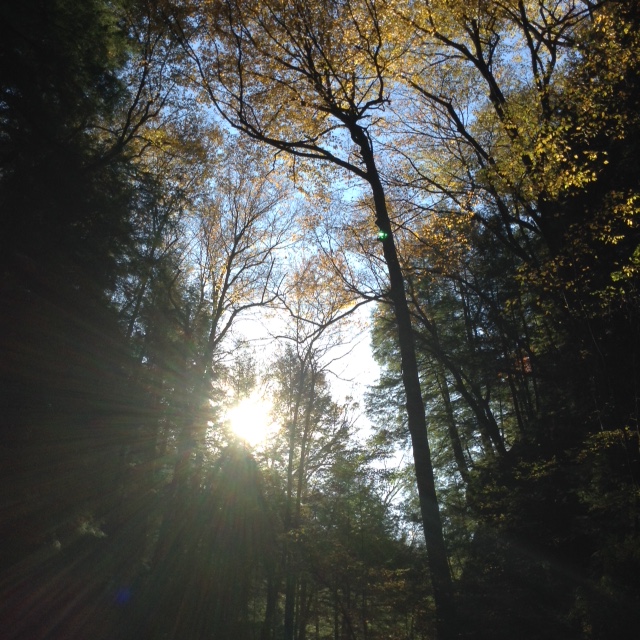
hocking hills sun through trees

Read Full Post »

Any fool can be happy. It takes a man with real heart to make beauty out of the stuff that makes us weep.  Clive Barker

Ordinarily when Jay and I pick up Ella from school he drives and I sit in the back with our granddaughter. I monitor snacks, play games, or read books with her.

Today I am at the helm of my ’97 Toyota. Ella repeats, “Grandma’s car.” She wants to know where Grandpa is.

“He went to the doctor. He will be home later,” I tell her. But I can’t see her face in the rear-view mirror. My mindset is in sync with her older cousins. They think that a hypodermic needle is to be avoided at all costs. But since Grandpa is a grownup, he would be just fine. I assume Ella’s viewpoint to be similar.

“If Grandpa gets a shot we will give him a big hug!”

There is silence in the back seat, followed by, “Grandpa be okay. I be okay.” Ella’s sweet voice cuts through me as the chorus repeats.

“Yes, he will. Grandpa will be home soon.”

The drive from Ella’s school to our house is just over ten miles. I feel as if I am driving cross-country.

Text Grandpa as soon as you get in the door, Ter. Tell him to call so that Ella can hear his voice.

On the outside I would appear calm. The car remains on the road. I stay within the speed limit. Inside I chide myself for a stupid mistake. Ella has had two open-heart surgeries and one minor surgery on her wrist. The word doctor opens a Pandora’s Box. She does not want her grandfather to fall prey to its powers.

Fortunately Grandpa hears the beep on his phone. He is leaving the office. “Grandpa be okay” takes on a new tone as Ella hears his voice.

“Let’s hide,” she says, anticipating hide-and-seek when Grandpa returns. Our little girl has no sense of time. Jay will not be home for another twenty-five minutes. I hold her in my arms and look into her huge blue eyes, possible now since I am not behind the wheel of the car and she is not bound to her car seat.

Sure, I will play this mock-game with her. The hiding place she chooses is in plain sight. And so is our little girl’s incredible beauty. Her internal powers shine: the gifts to love unconditionally, to simply be without comparing herself to anyone, and to bounce back after every fall.

I suspect there are people who look at us as we go to a park or enter a restaurant and think, How sad! That little girl has Down syndrome. Or worse, they identify her as a tripled chromosome and call her a Down syndrome child, throw around an R-word or two, and dismiss her importance. I can’t change that notion on my own. But I can make a dent in that perception.

Organizations like the National Down Syndrome Society and our local group, The Down Syndrome Association of Greater Cincinnati, help to crush myths and show how valuable each individual is. Success for many more persons with Trisomy-21 is possible, even inevitable. Yes, the child born with the genius IQ someday may create formulas, ideas, new drugs, and inventions that change the world. But the child born with an extra chromosome has the knack for changing the heart. Now.

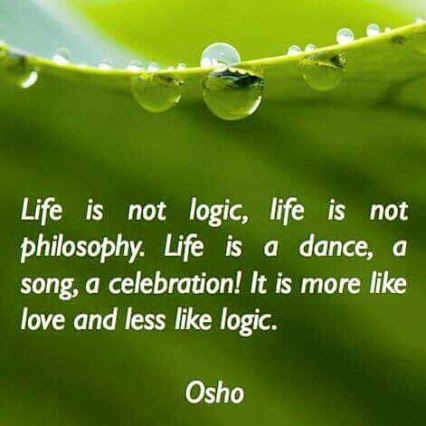
Ella may not be able to express Osho’s quote pictured below in words. However, she lives it. I am fortunate to be her student.

life is not logic Osho

Read Full Post »

There is no real ending. It’s just the place where you stop the story. (Frank Herbert)

From my grandchildren’s point of view my published book is something like an honorary mention trophy. Nice on a shelf. When I gave my eight-year-old a copy of “The Curse Under the Freckles,” she wanted to know where the pictures were. The girls are more impressed by ice cream—chocolate chips blended in sweet raspberry flavoring. Or a day of pretend with Grandma. Touch a child’s life directly; that is what matters. The words will hit later.

My older son, Gregory Petersen, is also a writer. His book, Open Mike, was published through Martin Sisters several years ago. He is working through an agent with his next book. Greg is capable of writing thousands of words a day even though he has a full-time position that includes a leash phone; he takes his job as daddy seriously. I am more proud of him for his excellent relationship with his daughters than I am for his incredible ability with words. And his gift for expression is exquisite.

All life can be presented as a story. I often have difficulty turning that perception off because imagination doesn’t always fit the moment. For example: in the middle of the night. Oh sure, I’m told to write ideas down, whenever they come. But that doesn’t seem to be realistic when the notion isn’t a one-liner. The rolling avalanche of a plot and the inevitability of sleep deprivation are counter-productive in the long run.

Sometimes relaxation comes from reading—letting the thoughts of others feed me, especially when those thoughts lead to the profound. My sister Claire shared a book she had already read, Same Kind of Different as Me. It fits into the grab-the-soul category. Thanks, Sis.

Authors Ron Hall and Denver Moore tell a true story. Ron is an international art dealer. Denver is a modern-day slave, a sharecropper, who runs away into a life as a homeless person and decides it is better than being unofficially owned. The love of Ron’s wife, Deborah, leads toward an unlikely friendship.

Denver Moore says, “I found out everybody’s different—the same kind of different as me.” What and how he discovered that similarity, the human center-core spirit, is where the beauty of the story lives—sometimes clothed in miracles, or incredible pain, or deep sadness.

Stories never really end. The characters in my own tales develop a kind of reality. But in fiction, at least before publication, entire chapters can be erased and rewritten and then changed again. The past, present, and future are as pliable as soft clay.

In Hall and Moore’s story the facts of their lives remain solid because “The Same Kind of Different as Me” is non-fiction. At the end of the narration at almost seventy, Denver admits he has a lot to learn. The last page is not the last page.

In April Paramount plans to release a movie starring Greg Kinnear, Renee Zellweger, and Djimon Hounsou based on Ron and Denver’s New York Times best seller’s impossible journey. I did not know this until I checked the Internet for more information about the original publication.

Impossible, hidden, a forgotten acorn that becomes an oak…who knows? The story continues…Any story can continue…

same kind of different as me

Read Full Post »

Successful people keep their eye on the goal. If they encounter obstacles, instead of focusing on the obstacle, they find a way around it by keeping their goal in mind. It is a mindset of courage which makes it easier to pursue success. (Dr. Anil Kumar Sinha)

Meet Diane Grover, mother of five, a beautiful person inside and out. Diane founded the International Down Syndrome Coalition. She also started the Grand Strand Down Syndrome Society. Now she has created Dreamers Merchants.

This is no ordinary business.

Most employers look at appearances when hiring, even if that bias is subconscious. Somewhere between 17% and 20% of people with disabilities are employed. Diane’s mission is to change that statistic. She does more than hire—she gives these individuals a living wage and recognizes their dignity. In Diane’s blog, Cheerful Persistence, September 2015, she celebrates the definition of dignity.

I applaud people who realize that dignity is innate. It is not the exclusive property of the genius, the wealthy, the gifted, the privileged… In fact, sometimes the educated individual teaches biased info. My friend, Bethany Brianne Hall, helped to clarify some of that misinformation with one of her college professors.

“Genetics and Statistics show that all people with Down syndrome will not attend college. It is nearly impossible for them,” he stated in the context of his lecture.

Bethany did not sit still and fume. She responded with statistics. After class. Bethany was fortunate. Her prof heard her out.

“Do you know who Angela Bachiller is?” she asked. Knowing the question was rhetorical, Bethany continued. “She was the world’s first person with Down syndrome to hold public office. She lives in Spain. Tim Harris owns his own restaurant. And Sujeet Desai, a musician, went to college. He earned a 4.3 average. These are only a few examples.” Bethany suggested that he update his statistics. Perhaps if she had appeared confrontational in front of the other students he may have been defensive. It is hard to say in hindsight.

Then she shared her experience on Facebook. I smiled the width of my face. Perhaps wider. The links in the previous paragraph lead to these persons’ stories. Desai mesmerizes an audience with his music. Tim dances his way to his restaurant. Angela Bachiller’s photo shows a woman either patronized or ignored in public settings. Wrong! She is a public leader and servant.

I smile again now. Diane Grove is destroying the myth that the handicapped are poor workers and less-than individuals.

Di’s youngest daughter, Mary Ellen, has Down syndrome. She calls herself ME. Me! The same pronoun we all use to refer to our inner selves. And that self is incredibly beautiful—no matter how many chromosomes it carries.

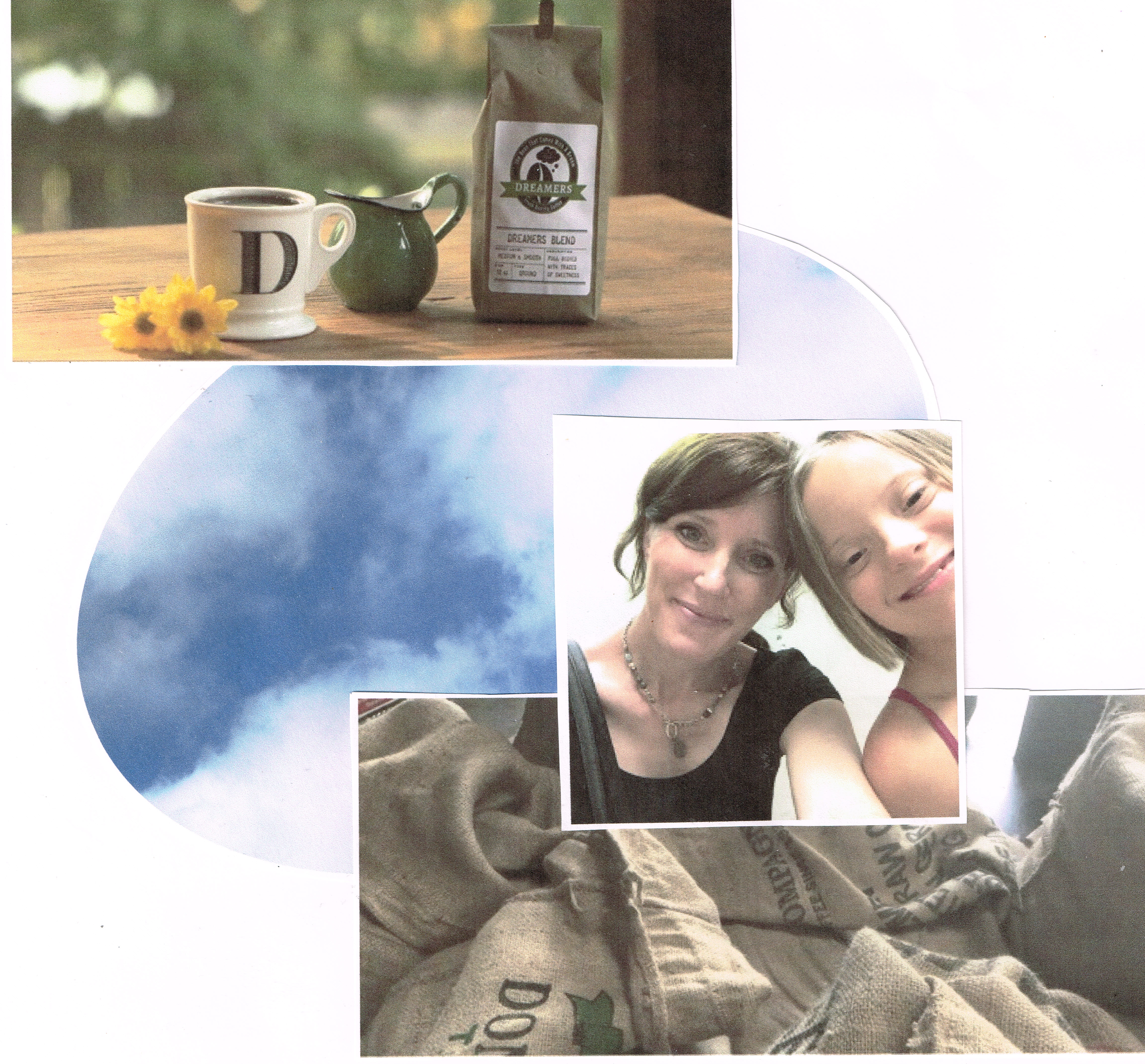
Seven of Diane’s Dreamers Merchants stores opened on October 5. There are now eight stores. Freshly ground coffee can be ordered online. A great gift.

“Maybe, just maybe,” Diane says, “the world is hearing us.”

dreamers coffee10072015_0000

Read Full Post »

I remind myself every morning: Nothing I say this day will teach me anything. So if I’m going to learn, I must do it by listening. (Larry King)

Rebe, my soon-to-be-eight-year-old granddaughter, loves to play any game that involves mommies, dolls, and the lives of families. My role changes at her whim. And I am okay with that. My pretending stays within the realm of fiction. Reality intervenes, even in fantasy. Plot, grammar, logic, and a reasonable timeline are required. Even an insane character requires motivation, albeit skewed.

Play doesn’t come naturally for me anymore. Unless it includes humor. Then it isn’t really pretend; it’s called drama. Too much time has passed since I wanted toys for Christmas. Sometimes I act the part of Rebe’s offbeat daughter.

“Mommy, can I drive your car to kindergarten? I won’t smash it into a tree this time.”

That makes her laugh. Or, she tells me I’m in fifth grade not kindergarten, and the event never happened. Another reason why following Rebe’s imagination is impossible to follow. For the most part however, I listen, and discover who my young descendant is.

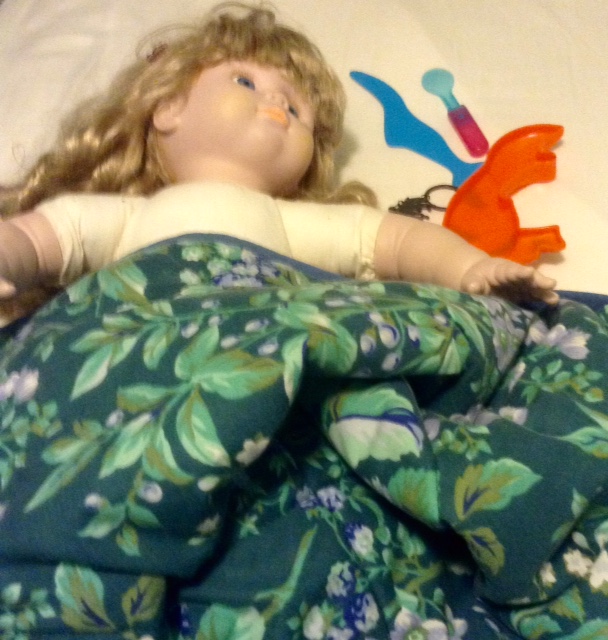
At first she is the mommy. Then she takes her baby with the soft tummy to the doctor. And she assumes the role of pediatrician. I’m not sure whether I am the sit-in for the mommy or an older child as she examines baby with makeshift instruments: a plastic spoon and knife, a key chain, a puzzle piece.

Her expression turns serious. “Most babies are normal,” she says. “And that is good.” Then she pauses after more pokes and probes and faces me. “But this baby has special needs. And that is good, too.”

She hands me the doll. My jokes have disappeared. I am in awe of a second-grade girl who speaks with wisdom. The softness of the toy and the softness of her words sink into me.

I have nothing to say.

doll

Read Full Post »

Start where you are. Use what you have. Do what you can. (Arthur Ashe)

I can tell by the expression on a young friend’s face her news isn’t good. “No change in the tumors,” she says.

She reports no noticeable response to her chemotherapy regimen. She needs a miracle. Now. Something so dramatic it belongs in science fiction. An event the media could exploit. I want a cure that turns a staunch atheist into a street preacher. But I stay with the reality and look her in the eye.

I thank her for continuing to stand upright, giving what she has—sometimes more. I tell her about her innate goodness and hope she is able to recognize it, too. She shares an upbeat moment she had when she volunteered at vacation bible school.

You’re the one who helped me,” a little boy said with enthusiasm. She had taken time with him on a project he had found difficult. I have no idea how well she felt that day. Nevertheless, she saw the beauty in the everyday, the glue-sticky-fingered mundane. I pray for that innate beauty to shrink her tumors. Eventually. Somehow. No matter how impossible that seems to be.

She does what she can…

Loss, I want to avoid it. That wish doesn’t come true, even in less serious matters. Today is the last day for a favorite aerobics instructor. She has found a full time job in her field. My good-byes are one of many.

Then I ask a member of the class how she is doing. She seems quieter than usual. Her brother-in-law has recently died. She is concerned for her husband as well. He was his only sibling.

Fortunately she is a hugger. I use my arms as comfort. They are the only tools I have. The woman’s brother-in-law will not return. But her smile tells me my arms are enough. For now.

This moment leads into the next as it plants possibilities into a limited, yet amazingly full existence.

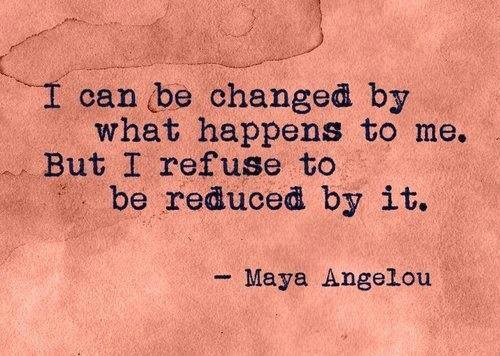
not reduced by what happens to me Optimism Revolution


Read Full Post »

« Newer Posts - Older Posts »