GRANDCHILD NUMBER THREE

Truth lifts the heart like water refreshes thirst. (Rumi)

Black and white image
a face    an arm within a blurred arc    a girl
her parents     with their big blue eyes
envision bright blue charm progressing
within that growing face

Grandma decides
she’ll be a blonde like Mommy
with her keen insight
earn an MBA like Daddy
or    perhaps discover a cure for disease
challenge the world of sports

but truth appears on the film
a flaw     or so it would seem
the twenty-first chromosome triples instead of doubles
one surgery promised at birth
a second four months later

the first will strike her gut     the second her heart
Baby’s body develops within Mommy
as Baby’s outside world
grasps truth    embraces it
small hands    double jointed
blue eyes    maybe   that seek    observe
belong to a spirit as sacred as any in
a world dubbed normal

as Baby’s parents and grandparents and friends
open their own guts
allowing no room for anything less
than wonder
and it arrives within her spirit
The little girl stands on her imaginary stage made of ordinary maroon carpet on an everyday Thursday afternoon. A popular song drifts into the living room from the kitchen where Mommy cooks, and scrubs the floor.
She complains about how quickly three kids get it dirty again. The girl listens to the music and mimics the trills, the rises and falls,
and emotions in the melody, her gentle vibrato promising a clear soprano voice one day. She would have added gestures
for her make-believe audience, but Mommy appears at the doorway wielding her wooden spoon. So-who-do-you-think-you-are?
Mommy turns away without striking. Yet, the girl hears the warning and retreats into the dark, silent spaces between the lace curtains and window.
The song will not disappear. She hears it inside her head and saves the sound for a safer moment
when she will lead her children to follow dreams, write, discover subtleties, laugh, cry, or simply be.
A friend is a gift you give yourself. (Robert Louis Stevenson)
BETWEEN CHESTER AND ME
Mom and her friends said Chester’s dad was nuts for sending him to an expensive private school after he failed third grade in public school. Again. Especially since the money he spent on out-of-parish tuition could have replaced that worthless pickup truck he drove. But I pretended I didn’t hear. Mom didn’t care what I thought anyway. She said I may be eight years old, but I could give out eighty-years-worth of opinion. Seems to me I wasn’t allowed to have one different notion about anything, much less too many.
“We get nasty notes about how much money we owe,” Chester told me, his mouth so full of crooked teeth, even I stared, and I was his best friend. “But Dad always pays. Late maybe. Just has to borrow a little once in a while.”
“So, doesn’t change a single game we play,” I said. “Uhm. You can’t come over today. I’ve got a doctor’s appointment, just for a check-up. See you at school tomorrow.”
I ran off before Chester saw the lie in me. I wish he wouldn’t tell me about his money problems. His dad’s dark shaggy beard and one pair of paint-spattered jeans told me he didn’t have much, unless he owned more than one pair of pants with a star-shaped tear in the knee with copper flecks of something on the seat. Chester wore old clothes like the ones we gave to the Salvation Army, things that were too shabby to wear, but too good for rags. Mom said I should never say anything mean to him. But I shouldn’t bring him home either.
“Stacey, Chester’s not all there. Do you know what I mean?” she said.
“Not all where?” I lifted the lid to the sugar jar and tapped the sides. I thought about sucking on one of the crystal chunks that fell into the center, but I didn’t really want it. Besides, it would fall apart as soon as I picked it up. Just like most of my arguments with my mother.
“Don’t pretend ignorance,” Mom said. “You never know what someone like that is going to do. Besides, it wouldn’t hurt for you to play with another girl now and then.”
I knew better than to argue anymore. I always ended up with extra chores if I did. But Mom didn’t understand. The other girls wanted to be fashion designers or actresses. Or they played with dolls in boring lace dresses and talked for them in voices that sounded like they’d been sucking in helium balloons. I never understood how someone could prefer fancy-pretend to football. Of course, some of the boys would think they had to be bosses. I hated that. Chester never played by those rules.
Once I broke a string on a brand-new gold yo-yo. I tried to tie the broken part back on but knew that wouldn’t work. I was just being stubborn and trying to prove a point about how I lost good birthday money on a piece of junk. So, I got mad and hurled the worthless thing at a fat old tree. Chester grabbed the two broken halves and covered his ears with them.
“Hey, Stacey? Look, my head’s winding the string.” He squatted down and stood up again until he got dizzy. Then he stuck his tongue out at me, and I laughed so hard I forgot to be in a bad mood.
In class, Chester would suck in air through his teeth and fold his arithmetic papers like an accordion. Sometimes his answers were so wrong the other kids laughed their heads off. Then it would take Mrs. Craftwood at least five minutes to quiet everybody down. But I wouldn’t laugh, even if Chester said something really funny, like the time he asked if the earth was hollow like the globe in the science room.
“Yeah, hollow like his head,” Jerry Freeman whispered. Then he stared at me. “Are you going to marry Hollow Head?” Every freckle on Jerry’s face flashed malice.
I tripped him when he went to sharpen his pencil. He bruised his elbow when he fell into another kid’s desk. I claimed it was an accident, but I didn’t look the least bit sorry. Mrs. Craftwood sent me to spend the afternoon in the principal’s office, and I had to sweep floors after school, but it was worth it.
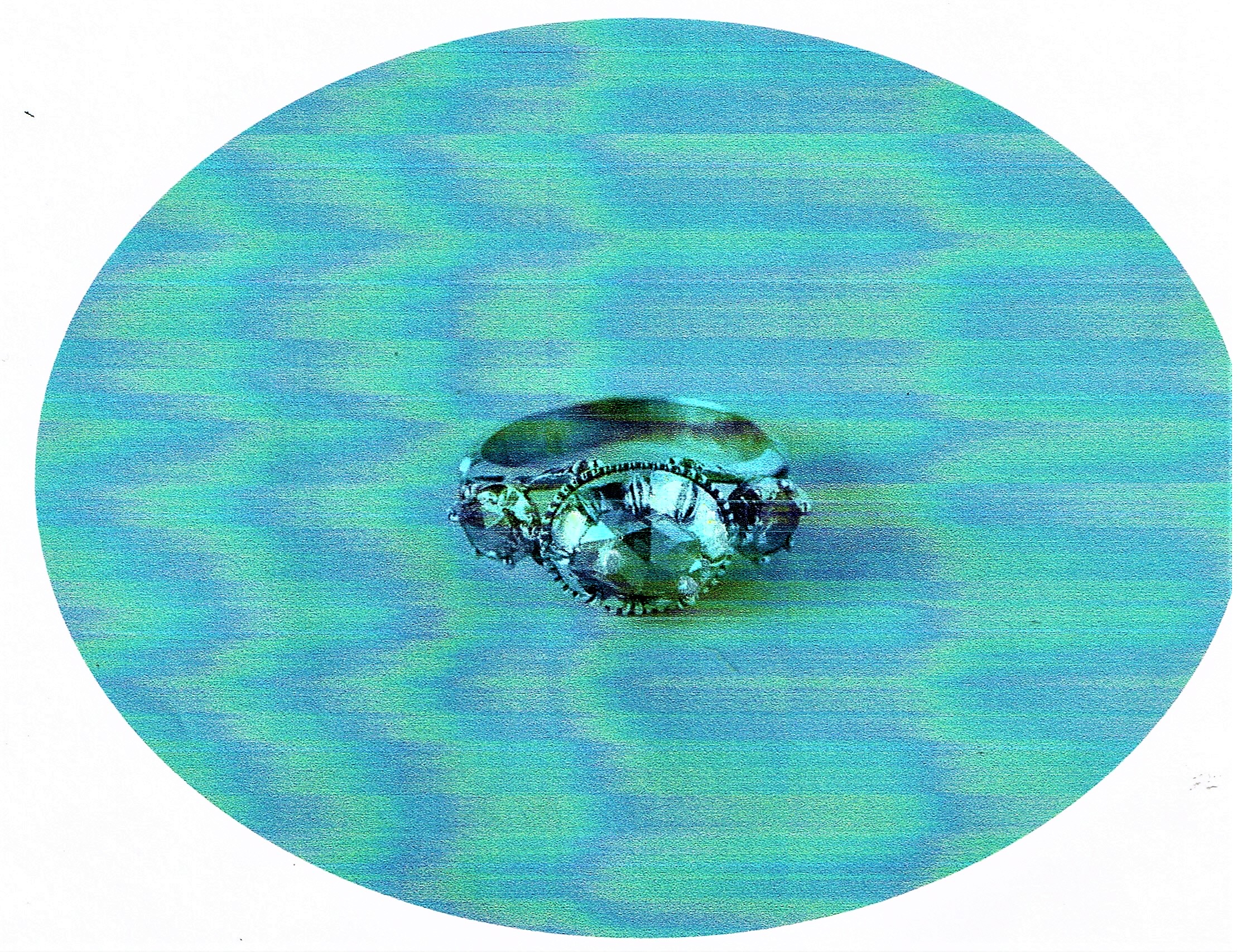
Chester kept a tiny, gray velvet box hidden in his pocket. A ring with a big white diamond lay in a soft spongy space inside. He said it belonged to his mom. She died and went to heaven not long after he was born.
“You can’t touch it, Stacey,” he said. “Only I can do that ‘cause it belonged to my mom. I like to hold it and pretend she’s right next to me. Dad said she had hair dark as molasses and a voice that made the angels cry.”
He rolled the ring in his palm, then held the jewel to the sun, as if he could see more than a few sparkly places. Then he carefully put the ring back inside, and we ran to find swings next to one another on the playground. If there weren’t any, we climbed the monkey bars, and he never seemed to care that I always beat him to the top.
One day in the lunchroom, Mrs. Craftwood saw Chester take the ring out of his pocket. She dragged him to the principal’s office. I threw away the other half of my bologna sandwich and followed them. They didn’t close the door. I saw everything.
“This ring had to be stolen,” Mrs. Craftwood told Mrs. Austin, “because this boy’s father is incapable of affording something like this.”
Mrs. Austin glared at Chester. “Stealing is a sin, son. You should know that.”
After school when Chester’s dad got to the principal’s office I sat outside the office and listened again. I knew that he had a job in a big, important office a long time ago, but the company closed one day, and he never found another job like it. Then after his wife died, he moved into an old four-room house on the edge of town and did odd jobs now and then. Folks said he didn’t seem to care anymore. But when he charged into Mrs. Austin’s office, it was clear he cared about something.
He didn’t say anything while she and Mrs. Craftwood accused Chester of stealing. Then he asked if either one of them took a close look at the ring.
“Why should that be necessary?” Mrs. Austin asked.
“Because it doesn’t take much light to see the truth in that diamond. Let me guess. Came in a gray box. Smells a little like grass stains and peanut butter.”
“What are you talking about, sir?” Mrs. Austin said.
I had to cover my ears because Chester’s dad got so loud. And this time the door was shut. He’d slammed it when he went inside. Hard.
“Would a real diamond look as scratched up as the side of a matchbox?”
“Please lower your voice,” Mrs. Craftwood said.
“Not until you return his mother’s ring.”
I wanted to lean into the door and catch everything that went on, but then Chester’s dad started talking about how his wife deserved better, and so does Chester. Wasn’t so exciting anymore. Something I couldn’t explain made me feel strange, almost like I walked into the boys’ dressing room by mistake. So, I sat on the bench outside the door and waited for what seemed like a long time.
“Thank you,” Chester said as his dad opened the door. Simple, like nothing was ever taken from him in the first place. He didn’t even see me right away because he was too busy slipping the ring on and off of his finger.
But his dad’s face looked so red it must have hurt. I could have sworn it burned right through his whiskers. He stopped when he saw me. “Stacey, you’re a good kid. Chester’s crazy about you. Don’t ever get too big for yourself.”
“I won’t,” I said. But I thought that was a strange thing to say.
Chester never did come back. He went away to a special-needs school on the other side of town. Mom said it was time for me to start playing with normal children.
“What’s normal?” I asked, and Mom accused me of being smart aleck.
But this time I wasn’t.
After that, I decided it was best to be vague about what I was doing. Sometimes I went to Chester’s house and we explored the woods behind it. We hoisted ourselves into the trees with lower branches and hunted for birds’ nests and woodpecker holes. He carved our names into a young beech tree.
“Someday when we’re old enough, let’s get married,” he said. “We’ll come back here and I’ll draw the heart and put the date on it.”
“Maybe,” I said. “But let’s look for salamanders down by the creek now.”
“Okay. But why can’t we ever go to your house to play?”
“Mom said I had to play outside. She’s cleaning.”
“You said she was sick last time,” he said.
“That’s because all she does is clean. And that much cleaning would make anyone sick.”
I stopped going to his house as much because I got tired of lying. To Mom. To Chester. Then one day I told Mom I was going for a long bike ride all by myself. I went to Chester’s house, but no one was there. When I peeked into his house it was empty, blind-dark. On the way home I felt mean, like somehow, I made Chester move away. I stopped at our beech tree in the woods, took a sharp rock and etched a shallow, lopsided heart around our names. It didn’t look very good. I’m not sure why I did it. Playing house never appealed to me. And Chester and I were never boyfriend and girlfriend.
But when I went to my cousin Janet’s wedding that summer, I thought about what it would be like to be a grown-up getting married. Maybe just for that day I would be willing to wear a lace dress, one made by a silly third-grade girl who grew up to be a fashion designer. Of course, I didn’t want to marry just anybody. The groom needed to be special, someone like Chester, who could give me a fake diamond, yet be real inside.
A new store just north of town, designed for writers, opened up this week. The size rivals IKEA, with rooms filled with every imaginable writing tool and solution, definitely at least a day trip. I needed to tie-up two subplots that had gotten kind of knotted. So, I set out to explore Writers Ultimate Solution.
The first floor opens to grammar, punctuation, anything basic. The second caters to all aspects of non-fiction: science, nature, current affairs, blog advice, and cooking. It holds a full-service cafeteria. Just to make a writer feel at home, a dietician sits next to the cashier and hands out rejection slips to those folk whose trays lack adequate nutrition.
The third floor is the poet’s friend. In fact, on the day I arrived, WUS had a three-metaphors-for-the-price-of-two sale, going on. Unfortunately, as it often is with sale items, two lines would fit, but add the third and it sounded like something out of a 1960s Beatnik coffee house. I guess I could use the lines in three different poems, but I didn’t want the cashier to think I was on drugs.
The fourth floor, the most crowded, specialized in fiction, just the section I wanted. It also looked and felt more like a circus. Clowns somersaulted from room to room. The Red Pony dropped something of himself in the hallway. And Curious George kept trying to lead me to the children’s section. “Another day. Another day,” I told him. Guess there’s a good reason why he has been around since the 1940’s. Signs in every room read: The fiction writer’s job is to entertain. The top level of WUS has been designed to stimulate your creativity. Instead, I got a migraine.
A door at the end of one hallway read: Excuses. By this time, I thought it didn’t seem like such a bad idea. Fortunately, I looked inside before I took a step. A cold breeze provided the first hint; there was no inside. It led to a mud pit at least six feet below.
“Our boss’s little joke,” an employee said when I backed into Moby Dick, not Ahab, the book’s main character. I was caught by the whale.
I ended up buying three ballpoint pens, and a half dozen semi-colons that will only apply themselves in the best-suited places—and I got them at a double-markdown price. Interesting that items were marked down so soon after opening. Hope that’s not a bad sign. Maybe it’s a good thing I didn’t grab one of the dollar-mystery bags, probably full of adverbs. My story still sounds like it was written inside a blender. Guess I need more than a superstore.
One day I was speeding along at the typewriter, and my daughter—who was a child at the time—asked me, “Daddy, why are you writing so fast?” And I replied, “Because I want to see how the story turns out!” (Louis L’Amour, novelist)
My grandson and I were riding in the backseat of the car as my husband drove to kindergarten.
As we talked, Dakota picked up my second book in the Star League Chronicles. “What is your picture doing on the back?”
“Uh, I wrote the book.”
“Really?” he said. “It must have taken you at least a half-hour to write.”
“At least,” I responded. “Two years.”
My little buddy was amazed by my slow progress. I didn’t take umbrage. When my middle granddaughter saw my first book, The Curse Under the Freckles, she wanted to know where the pictures were. Grandparents, by my grandchildren’s measure, were invented as playmates, not boring adults who put together words on paper. And take years to write a single story.
Dakota and I enjoy becoming pretend pilots where the newbie Grandma-pilot does practice flights with a hundred passengers aboard. He decides how much gas a plane needs to fly cross-country. Five-dollars’ worth. Or we invent a game played in the gym with a mini football instead of a basketball.
In both plot and play, reality is suspended. Grandson and I open jet windows to shoo birds while Dakota snacks on cheese dipped in hot sauce. Literary subjects never come up.
Of course, the best fictional stories appear real as they unfold. Each life’s story has a beginning, middle, and end, often unplanned.
Sure, I wonder how my life will turn out. Change can happen in the last scene. However, savoring each day seems more satisfying than typing at deadline speed. Life’s end will come soon enough. In the meantime, I have a lot of seeds soaked in love to plant.
I believe in an open mind, but not so open that your brains fall out. (Arthur Hays Sulzberger)
When rain turns ground into mud, and mud spreads through everyday life, maybe I need a cleansing breath or two before getting out the spiritual mop.
A good imagination helps.
A creature like one of my grandchildren’s toys becomes an alien—the outer space variety. He has a name, but it isn’t pronounceable with a human tongue. I call him A-Z, because it is as close as earth interpretation can get. He lands close to a town and enters in the darkest hour of night.
A-Z sees only one person on the sidewalk. The alien’s intuition is strong enough to catch not only the individual’s language, but feelings. This character could be fictional—or it could be me. The alien sends messages of love. Does the earth resident receive them or see only differences?
Oh, I have ideas about how the person on the street could respond with fear and begin an intergalactic war. I also imagine a blind woman who isn’t limited by visual first impressions.
I believe in an open mind. But, exposed to the elements of reality, it gets muddy now and then. Time to return to real life…
When all’s said and done, all roads lead to the same end. So it’s not so much which road you take, as how you take it. (Charles de Lint, writer)
If there are spills on the kitchen floor and crumbs on the carpet during the next few days, I know who did it. Moi. Jay is spending some quality time with his siblings. I chose a quiet retreat pace—if three magazines and two books in bed qualify as embracing-the-simple.
Since I’m not a speed reader, chances are I haven’t exactly created a quiet one-thing-at-a-time retreat pace. My expectations usually include a ridiculous amount of multitasking, using unfocused brain synapses.
I am a writer, one who takes two steps backward and one forward. Today, reverse seems to be the primary gear. I have managed half a paragraph in two hours. The backspace key is getting most of the action.
The phone rings. My youngest granddaughter, Ella, is on the line. “Want to go to the library with me today?” The answer is a no-brainer. Grandma mode is simpler. It requires love. Word order doesn’t take a lot of thought on the grandparent path. I love you is adequate communication. No editing necessary.
Time to drive—through the rain and into the arms of a child.
Inspiration does exist, but it must find you working. (Pablo Picasso.)
Editing a manuscript can be like searching through garbage for lost tarnished silverware. Before the utensils pass inspection, they need to lose some crud. A shine may or may not happen after vigorous polishing.
Living real life is far more difficult. Its garbage never goes away. Peaceful existence demands a less judgmental approach. And—the work is never completed.
Sometimes persons who seemed to be so perfect, flub, big time. A friend disappears when needed. Or worse, dies. The evening news brings more continued discord than it brings news.
And yet, mother nature, world history, and current politics never promised to be fair.
I’m glad I can find inspiration in the love real life allows. Sometimes in the simplest ways. A day with a six-year-old grandchild. An unexpected phone call or thank-you card. A well-timed compliment. A new friend.
Inspiration exists, but it needs more than published-word acknowledgment. Thanks to all for your smiles, in person or via cyberspace. Sent to me, sure. However, any gift offered without expectation, is richer than any polished silver or word. Pass it on…
The tension in my neck tells me I am not in synch with the world as it is. Mass natural disasters are difficult enough to understand; mass hatred is another. I don’t need to delineate any of it. The blind can hear about it, and the deaf can read closed-caption. The unaffected remain in a narrow, wire-thin margin.
Pain begins before the first commercial on any news channel. Gentle heat helps my muscles. Distraction, blended with love, helps my spirit.
My husband and I take Dakota to afternoon kindergarten on Thursdays. Dakota asks me to sit in the back seat with him. We discuss the six-year-old boy world and his unique observations along the familiar route.
This young man notices details: The recycling truck has two steering wheels and two sets of brakes… He discerns how a toy train track fits together. His mechanical expertise will probably surpass mine before he reaches third grade!
During a rare pause Dakota notices the back cover of my second book, Stinky Rotten Threats. It is on the back seat between us.
“Isn’t that your picture? Why is it there?”
I smile. When I am with this young man, my intention is to focus on him. My successes, failures, and mundane trips to the doctor or post office don’t come up. He probably assumes I don’t pretend to pilot a plane without knowing what an instrument panel is. However, other than stocking the refrigerator with his favorite cheese and hot sauce, he wouldn’t know what else fills my day.
“Wow,” he says flipping through the pages without looking at them. “It must have taken you more than an hour and a half.”
Dakota’s notion of numbers and time hasn’t developed yet. I realize I want world change overnight, in my spirit, even if my head knows a sudden transformation is as impossible as writing a middle-grade fantasy adventure in an hour and a half. The Star League Chronicles fights evil—not with fists and swords, but with truth. Even in make-believe, a story takes more than one page for goodness to win.
“Two years,” I answer. “It took me two years.”
He doesn’t say anything, but I suspect he thinks I must be mighty slow.
I don’t mind. Slow is the general idea. My neck thanks me. Growing up all the way isn’t recommended anyway.
Making a living is nothing; the great difficulty is making a point, making a difference—with words. (Elizabeth Hardwick )
A Monday morning toward the end of August. Rebe has said goodbye to braces. Her smile is free from metal. She is at the orthodontist now for the final X-rays. And big-sister Katie and I shop to prepare a special meal for her. Ravioli, her favorite. A dessert Rebe will help make since she will want to be in on the fun. And a carbonated beverage. Cola, a no-no for younger sister for the past two years. Katie and I find small fancy bottles. We choose to savor, not guzzle, since sweet colas and nutrition don’t have much in common.
I tell Katie about the wind and rain at the Hamilton County Fair last weekend. Mother Nature overdid the crowd control. Sure, I had fun and met a few new people. The day was wild. But wildly successful? Not exactly. I expect my granddaughter to go on to other topics: sports, friends, crafts.
Instead she asks, “So, what are you doing to let people know about your book?”
I hesitate. Katie is twelve-years old. My next event could come in a few months.
“What theme comes throughout the book frequently? Use that. In different ways… Make it stand out.”
We are outside a store as she asks. She grabs my heavy backpack and I carry the empty reusable bags for our purchases. I am aware of the disproportion. Not only in weight carried, but in information exchanged. I look at her and laugh.
“What is so funny?” she asks.
“You are. Because you are amazing. Tell me. How do you know all of this?”
“I go to book signings.”
She does. With her father. Gregory Petersen wrote Open Mike. He is working on other novels and has done standup comedy. Katie has made friends with writers. She has a superb imagination. In fact, she gave me an idea I used in my next book. I will give her an acknowledgment.
Not everyone has a twelve-year-old consultant. But then, she fits my audience. And I think about the typical preteen. The typical preteen who lives inside the average adult. In The Curse Under the Freckles Chase doesn’t have much self-confidence. He is surprised to get help from an inanimate thing, a tree, a Rainbow tree that offers magical gifts he could never expect.
The tree helps its Star League member with its multi-hued magic. It draws out the color inside the Star League student.
Since Katie has been helpful I tell her to get something for herself—she buys a present for her sister’s birthday instead. I don’t need to savor sweet cola. I have this precious time with my granddaughter before she starts seventh grade. My Rainbow-tree granddaughter. She brings out color inside me.






 terrypetersen