Feeds:
Posts
Comments

For a man to achieve all that is demanded of him he must regard himself as greater than he is. (Johann Wolfgang von Goethe, poet, dramatist, novelist, and philosopher 1749-1832) 

My two older granddaughters love one another. However, sibling rivalry lives, and Grandma needs creative energy to keep the girls from fighting for her undivided attention.

The three of us sit on my bed as Kate and Rebe create a unique pretend-family scenario. They are two-month-old twins who have grown and developed with freakish speed.

I laugh. “You know in the real world you two would be followed night and day. The paparazzi wouldn’t let you make a step without taking a picture of it.”

“I heard that word before on a show,” Kate says, “but I didn’t know what it meant.”

I explain the word paparazzi and the girls chant pa-pa-razz-i, as if power were in the sound and rhythm of the syllables. Even five-year-old Rebe squeals,” The paparazzi are here,” as she hides under the blankets.

We dramatize situations where our impossible infant geniuses walk, talk, draw pictures, and even write a story about being attacked by a lion, then survive. The monster spies appear at every turn. Before long Kate discovers that fame may not be what it is cracked up to be. She wants to play something different.

Rebe says she is going to stay with the game. The paparazzi have captured her. She is going with them to be famous. Run-and-hide hasn’t taught her the flip side of glitz. At her age, time and place haven’t been pinned down yet. Real life and play wear indefinite edges, like one waterway merging into another. Nevertheless, our five-year-old is reaching for something greater than herself.

As the mood settles Kate decides to write more of the story about the girl, named Kate, who survives a wild animal attack. Maybe she understands metaphor more than I realize, and she’s playing the same game with different characters.

Learning comes in bits and pieces.

enjoy little things words of wisdom

Remember the quiet wonders. The world has more need of them than it has for warriors. (Charles de Lint)

My two other grandchildren are on their way to the Y with Grandpa. Our middle granddaughter isn’t feeling well today. She is staying home with me. When I ask five-year-old Rebe what she wants to do during Grandma-Rebe time, I already know the answer: “Let’s play house.”

Rebe is Mommy, and I am Daughter, no other name necessary.

“It’s time for school, Daughter. But first I have to wrap you in toilet paper.”

Okay. I expect confusion sometime during this experience, but not generally within the first few seconds.

“Uh, did you say . . . ?”

“Toilet paper. It’s Halloween, and you are going to be a zombie.”

“Oh.” That sounds more like a mummy. But, at least we’re back on the same page, and Rebe doesn’t request an actual wrapping. It all happens magically, as if the decision alone makes it happen.

We climb into the “car,” which is actually our rocking chair as a front seat and the couch as the back. I’m buckled into my imaginary car seat. “And tomorrow is Christmas Eve,” Rebe says, appearing pleased to tell me the news.

Wow! Time flies quickly enough in the adult world. In pretend existence the speed of light seems slow.

I expect our little girl to forget the sequence of her plan, but in a few minutes she stops at my crib set and steps out of character. “Grandma, can I move these to the living room?”

I want to say, no. After all, the set was a gift from my parents. The figures are large and breakable. But, Rebe needs to know she can handle the situation, that she doesn’t have to be afraid. She is capable.

“Carry one piece at a time, doll baby. And use both hands. Then, tell me a story about what you are doing.”

She follows directions. However, her voice is so soft and gentle that I don’t hear many of her words. I do catch a sweet, innocent reverence.

Finally, after she has placed the infant in the manger in the center of her scene, she crosses her hands over her chest. “You can be in my heart now,” she says to the figure on the floor.

I smile—at Rebe my granddaughter, at Mommy, my pretending partner. They both need a tissue. But then again, right now maybe I do, too.

the world as it should be

In every conceivable manner, the family is link to our past, bridge to our future. (Alex Haley)

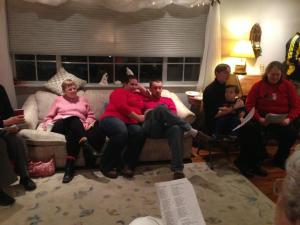
The Statt Family Songfest—this celebration extends far beyond the dictionary definition where an informal group gathers to sing. This musical family and friends meet on an evening after Christmas to  enjoy every verse of thirty-plus Christmas carols. Some of the children play downstairs; the older children join the singing, and the babies dance, recognizing celebration with the innate sense infants enjoy. Harmony seeps into the walls and defies the weather. So what if there is a winter storm warning for tonight. If fear talk is going on, I don’t hear it. Instead piano, voice, and even the clear bell-like tones of a glockenspiel take over the living and dining rooms. Breaks occur either for food and drink or a rousing rendition of Ein Prosit.

I watch as toddlers shake bells or lift their arms touchdown style, a pre-verbal form of hallelujah.

The artificial atmosphere at most parties bore me. I don’t drink alcohol, and while there may be a benefit to discussing the pros and cons of political situations, this kind of talk tends to turn into an “I’m right and you’re wrong” match. The Songfest is different. Music is a powerful spiritual vehicle that unites people.

This year I feel especially blessed. I didn’t have to drive. I can relax and let my friends, Dick and Marie, decide when the snow has become a foe instead of a nuisance. Moreover, I don’t need to get up at the crack of dawn tomorrow. Time isn’t an issue. I can stay until the last note of the last song.

That final song, an a cappella version of “Holy God, We Praise Thy Name,” hits me in a way I didn’t expect. It was my grandfather’s favorite hymn. He was a mild man, quick with a smile. I inherited my lack of height from him. As the song swells I drop back into time. I’m five-years-old and I hear my grandfather’s gentle voice suddenly boom out. He stands, back straight, hands on the pew in front of him. He doesn’t need a book for the words. I stop squirming for a change and lay my hand next to his. He grabs my fingers and gives them a soft squeeze without missing a beat.

In the present time I miss more than one beat, however. I feel my grandfather’s presence in the room. I am also aware of Avita, the mother of our host. “She was a great woman,” one of her grandchildren told me earlier, when I complimented the family. “She taught us how to be like her.”

And I think about learning, not what comes from books, but what comes from being true to who you are. I fight to keep my voice from cracking. “Holy, holy, holy, Lord.”

One corner of Songfest (I’m on the far left in the pink sweater.) photo by Kathy Statt

songfest 2012

There are no seven wonders of the world in the eyes of a child. . .There are seven million. (Walt Streightiff)

I am four years old again. The year doesn’t matter because it didn’t then—I am eternally young. Santa delivers toys. The world reaches no farther than Grandma and Grandpa’s house a mile away. Television hasn’t appeared in our household yet, and the power of the commercial hasn’t been developed either, so I don’t ask for much: a doll, definitely, maybe some new crayons and paper. Coloring books limit my creativity, but fresh clean paper opens possibilities.

However, this year Santa brings the gift that fits me perfectly: a table that is just my size and chairs that I can sit in without dangling my feet. How did he know I would cherish this moment? I sit at my special table and watch the lights on the tree reflect the ornaments. In our house Santa decorated that, too—all while we visited our grandparents’ house and waited for Dad to arrive with the notice. You can come home now: Santa has left for the next neighborhood.

Years later, I learned that S&H Green Stamps made my table possible. Mom and Dad, not elves and reindeer guiding a sleigh, worked to make our Christmases possible. Perhaps I was a strange kid, but I stood in awe as Mom washed dishes and I asked, “You mean, all this time you and Dad have been giving us all this great stuff and giving Santa the credit?”

Mom showed no affect. Even then I thought that was peculiar. At age seven I didn’t know how much it had cost them to give. My father didn’t make a semi-decent salary until I hit middle grades. Somehow Mom managed to make meals for a husband and four kids out of almost nothing. A few pieces of chicken became a delicious soup; flour, sugar, yeast developed into breads suitable for a king’s table.

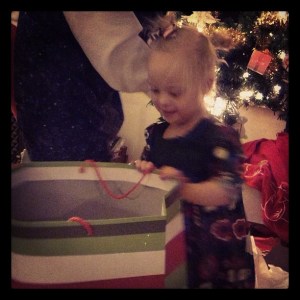
Now, as an adult, I realize that children don’t see with adult eyes. Nevertheless, their vision is valid, even sacred. Our little Ella smiles at a doll house inside a decorative bag on Christmas Day. Her speech is limited, so I can only guess what she thinks. The house is just her size, with little people who can follow her imagination into places only she understands.

What she doesn’t know is that the doll house was bought second-hand, in perfect condition, but nevertheless used. That way her grandmother could purchase other gifts too. Oh well, there’s a saying that goes back to eastern origin that expresses my motivation: “The apple doesn’t fall far from the tree.” And I am grateful for that tree.

Thanks, Mom and Dad.

photo taken by Ella’s Aunt Sarah on December 25, 2012

doll house inside Dec. 2012

Look at everything always as though you were seeing it either for the first or last time: Thus is your time on earth filled with glory. (Betty Smith)

Kate rearranges my Christmas decorations on the windowsill as I prepare the table for cookie baking. Sure, I had items arranged according to size and balance. But her design tells a story. A porcelain figurine becomes a little girl opening a gift. The girl sits in front of a house. She has just finished making a snowman. The entire area is surrounded by angels. Kate takes a wreath that had been encircling a candle and places it on top of the house.

“See, Grandma, the people in the house decorated.”

I smile. The wreath is over half the height of the house. In real life this scene would either appear  on national news or a late-night comedy show. It’s hard to say. Nevertheless, the new arrangement will stay even if it is a tad top-heavy .

Then Kate moves to the manger scene on my breakfront. She picks up an unframed picture of my father in his World War II uniform, and pauses. I wonder what she is doing as she moves the three kings forward—long before the twelfth day of Christmas. The shepherd doesn’t seem to care. He waits, unconcerned.

Ah! The three kings have brought more than gold, frankincense and myrrh: they present a new arrival in the heavenly realm. In this picture he is a young man who had two jobs in World War II: company clerk and bomb disposal. He spoke many times of close calls, when he wondered why he had been chosen to come out alive.

Yet, he lived to be 91, long enough for his eight-year-old great granddaughter to decide that wise men would be willing to push ahead their celebration and appear for a special early visit. “Greetings! We have someone we want your newborn to recognize. His name is Bill, and he has lived a long and fruitful life.”

No, Kate didn’t add those words. She didn’t speak at all—didn’t need to say anything.  Her smile relayed the obvious. Love. It transcends language and opens the way to wisdom.

wisdom

Don’t be afraid to be confused. Try to remain permanently confused. Anything is possible. Stay open, forever, so open it hurts, and then open up some more, until the day you die, world without end, amen. (George Saunders)

The lectern at the church is too high for a woman like me who has slipped under the five-foot mark during the past few years. I smile, exaggerating my tiptoed stance. After all, it’s obvious that my father’s oldest daughter inherited his wife’s height.

Years ago when I acted as lector at another church, there was a wooden stool that could be pushed back and forth for the shorter readers. There isn’t anything like that here. It doesn’t matter. This isn’t a stage; I’m delivering a eulogy. I have five minutes, but hope to relay my message in less than three—not sure my tear ducts will hold out any longer. Now my balance threatens to give up, too; it doesn’t take long before I give up the façade of four-inch high heels and stand flat, my chin hidden as if I were in a bad photograph.

I have decided to be bold and speak as my father, a few octaves higher perhaps, and thank my siblings for the gift they were to him. I may be close to the ground, but my gaze reaches over my brothers’ and sister’s heads. No eye contact now. I’ll save that for later, when tears won’t create a domino effect and flood a perfectly lovely church.

As the service progresses, memories fly through my mind like drunken fireflies. I look to my right to see who is sitting in the pew where I was when my mother died. I recall my father’s quiet slump. Then I’m in a second-grade classroom and back again in the church, in the back, ready to walk down the aisle. Dad is at my side. Forty-one years have dissolved and it’s 1971; I’m about to be married.

In the next moment it’s time to go to the choir loft to lead a simple song based on Psalm 23. I’m uncertain because I haven’t practiced with the organist. I flub the words in one line of the second verse. Not too bad. Can’t let the fumble stop me. I want to be like my sister Claire who has sung Schubert’s Ave Maria so many times, she once sang it accompanied by an organ that sounded like an old-time organ grinder. Her first thought was, Where is the monkey? Yet, she didn’t miss a beat!

I look into the congregation and see my oldest granddaughter Kate staring up at me: the time gap between us is 58 years. Time. Space. Real, and yet illusion. My thoughts are as organized as tossed confetti. And yet . . .and yet . . . despite the sadness I feel a beauty that transcends the moment and embraces eternity.

moment of value Positive WoRdS to LoVe by

So Long, See You Later

Life is an opportunity, benefit from it. Life is beauty, admire it. Life is a dream, realize it. Life is a challenge, meet it. Life is a duty, complete it. Life is a game, play it. Life is a promise, fulfill it. Life is sorrow, overcome it. Life is a song, sing it. Life is a struggle, accept it. Life is a tragedy, confront it. Life is an adventure, dare it. Life is luck, make it. Life is life, fight for it.  (Mother Teresa)

When my mother lay unresponsive waiting for her heart to stop on another December day, I tried to fill the vacuum with something positive, something that could transcend loss. I crawled into the middle of my bed with my guitar and picked and strummed Christmas carols. Silent night, holy night. . . The moment felt silent and holy enough, but lacked calmness and brilliance.

I felt a deep reverence for Mom’s transition into another dimension although I never had a best friend relationship with her. When I was born there was a hole in my umbilical cord; it severed some larger maternal connection before I faced daylight. Mom never had a chance to count my fingers and toes until I was ten-days old.

Even so at Christmas time as I grew older  we harmonized as we washed and dried the dinner dishes. I sang soprano and she added the alto: The First Noel, Oh Come All Ye Faithful, We Three Kings.

Harmony, it can’t be accomplished alone, in music or in life. And a lot of dissonance intrudes along the way. Some of it can be rearranged; some must be discarded to make way for patterns that work. Eventually, I learned who my mother really was. And I finally grew up and stopped fighting shadows.

Years later, this November and December, I observed my father’s silence and jerky sleep in the nursing home. His decline was in process.

“Hi, Dad!” I  kissed him on the forehead. The noise in the elevator and dining room was enough to jar anyone. An alarm went off in the hall. He grimaced—but the response was pain. I could only guess what he needed.

Eventually his final days arrived: twenty-four hour hospice care, lowered blood pressure, less blood flow to his extremities, a sudden change of color, from pink to waxy white, his breathing paused and threatened to stop.

“I love you, Dad. I always will,” I told him. “But it’s okay to join Mom now.” One more kiss on the forehead. One of my brothers, my husband, and an ex-sister-in-law joined in a few silent tearful goodbyes. I turned around. Dad’s hospice aide also wept as his spirit departed.

Back again in the center of my bed, guitar as a companion, I play and sing as if I had an audience of two: one woman who would have been 91, and one man who would have turned 92 on the first of January. She joins in with the alto and he grins, completely happy. “Sleep in heavenly peace. Sleep in heavenly peace.”

my parents on their wedding day 4/4/45

mom and dad

Toddler Teacher

Forever is composed of nows.  Emily Dickinson

Our granddaughter Ella may be in her pack-and-play for a nap, but that doesn’t mean she has any intention of succumbing to sleep. Fortunately she isn’t putting up an ugly protest. This time of day is relegated to rest and our little one knows it. She doesn’t cry without a good reason.

As I work at the computer Ella babbles. She could be talking to a stuffed animal, an imaginary friend, or her guardian angel. Our granddaughter’s language hasn’t developed enough for us to know. Down syndrome has delayed her speech, but has elevated her understanding of the now, a place to be embraced—even if Grandma could be hogging all the fun Curious George games and Sesame Street videos.

I hear a cackle, perhaps the punch line to some joke only she understands. I shake my head and swallow a laugh. Apparently her run through Lowe’s didn’t wear her out this morning. It took two adults to keep one three-year-old girl from rearranging a huge hardware store. While I picked out an area rug for the computer/toy room, Grandpa followed our blonde tornado through the store. Ella made friends along the way, too. She always does, with her magnet-blue eyes and innocent smile. Her beauty and personality reach beyond the limitations of Down syndrome. She makes people feel chosen by her love. It relays an angel’s touch.

Perhaps an angel is teaching her the tricks of the trade—right now. And I don’t know a thing about the lesson. I can’t see or hear her life teachers. I may not have been born with the competition gene, but that doesn’t mean I don’t compare myself to folk who achieve a lot more. I also grow restless when time steals moments I feel are rightfully mine.

No day belongs to me. It is a gift, just as Ella is a gift.

Eventually the noise and rustling stop and I hear two voices in the bedroom. Grandpa and Ella laugh. It is post-rest time. Let the blessings continue. After all, I have a lot to learn.

It's today Pooh shared by Jane Friedman

When money speaks, the truth keeps silent. (Russian proverb)

I may have spent as long as two minutes fantasizing about winning the Powerball. After all, my husband bought one ticket. Sure we had a better chance of a November heat alert in southwestern Ohio, but thinking about incredible wealth was fun while it lasted.

I imagined my grandchildren with secure education funds. The city’s special needs kids would have what they needed without sending their parents to work doing triple overtime. All my family would drive the best transportation. My ’97 Toyota could accept a well-deserved retirement. . . I didn’t dare extend my imagination any longer. It would be like dipping into the candy dish too many times, not really good for the body or soul since it added nothing worthwhile to the moment.

We matched one number. I didn’t ask which one it was since it was a moot point. After all, 16.66% is a failing grade in any system.

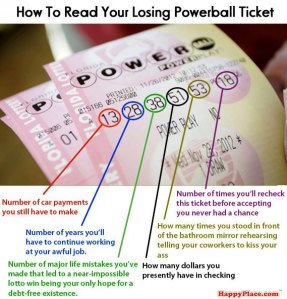
However, this picture, which has been traveling over the Internet, gave me an idea: Let the numbers represent positive possibilities. Only one of these include cash, and it wouldn’t be enough to buy another ticket. The numbers don’t represent an actual count; they refer to a different way of seeing.

13     Chance meetings with old friends

28     Walks in the park on a sunny day

38     Vacation photos that turned out A-OK

51     Cents found in last year’s winter coat pocket

53     Perfectly ripe red grapes

18     Birds of different species feeding peacefully at feeders

We didn’t win a single dollar, but I received an even better gift on Thursday. An aerobics instructor at the Y told me my husband raved about what a wonderful job I had done performing at a local music cafe on Tuesday. She added that he always talks about how proud he is of me. I walked away with a lump in my throat. We live an everyday life. In a small house. With a simple income. With the same difficulties everyone else in the world has. Yet, you can multiply all the above numbers, put dollar signs in front of them, then add a dozen zeros after, and you won’t find the wealth love can give.

Pass it on!

losing Poweball Ticket Lars Larson Show

Until death it is all life. (Don Quixote)

My father sleeps the awkward sleep of pain and old age. I kiss him on the forehead and he doesn’t respond. I hope he wakes up later, and sit next to him in the common room of the nursing home. My sister Claire will be here soon, after the accident clears on the expressway. She drives an hour—perhaps to visit the father she knew—perhaps to visit a shell of what he was.

I wait, pulling a folder of writing work into my lap, when a woman in a wheelchair catches my eye. She looks upset.

“There’s something in the back of this chair.”

I hesitate, and then notice her oxygen tubing. It’s probably the handle from the tank.

It is. One hand on her arm, I move the handle out of the way. “Is that better?”

“I don’t know.”

An aide appears with a blanket to tuck behind her. When my dad could still sit, I always wondered why one wasn’t inserted before this kind of irritation started. Then he was moved to a geri-chair that could be adjusted for lying down. No handle in the back, just the difficulties of a worsening condition.

“That should do the trick.” I smile and gently pat her arm. She smiles back.

“What’s your name?” I ask.

She answers with both her first and last name and her personality emerges, a wit hidden a few minutes ago. Touch, perhaps it is more magical than I think. Or—it is simply essential to well-being.

“I like your coat,” she says. “Gray and blue go together well. Hey,” she says to the woman in a wheel chair next to her. “You grab her and I’ll get the coat.”

Her comrade looks surprised.

“Just kidding.”

I laugh, talk to the pair for a few minutes and return to my work. I can’t help but overhear their talk about another resident. “She’s not happy about anything,” one of the women says to the other. “Well, I don’t know what you can do to change her.”

Later the woman I suspect to be the object of  their conversation appears. She battles with the personnel, puts on a genuine show. I wonder what internal demons she fights, and feel even more blessed by the first two women.

The core spirit doesn’t go away because the scenery has been altered. It remains, whether that individual is fighting traffic on the Interstate or exchanging conversation in a nursing home.

Claire arrives, smiling. She lives positive attitude. Traffic was blocked for miles. She tells the story, but doesn’t complain about it.

I introduce my sister to my new nursing home friend.

“Your sister is prettier,” she says. Then when I tell her Claire is a lot younger than I am, she smiles and adds, “Just kidding.”

Claire and I have the opportunity to have time together. Dad’s feet threaten to fall off the chair. Many times. We move them back, as gently as we can. He never rouses enough to know we are there, at least while I am present. I leave before my sister does.

But first, before I face rush-hour traffic and who-knows-what-kind-of-chance-to-lose-perspective, one more kiss on Dad’s forehead, even if he doesn’t know I’ve placed it there. After all, I can’t understand the twists and turns of existence, but “until death it is all life.”