Snow fell avalanche style. Margie didn’t bother to look out the window. Family Christmas celebration would wait until the week after New Year’s Day. It didn’t matter. Her husband Len had left this world. Ten years ago. On December 24. She hadn’t believed him when he told her he didn’t think his weak heart would hold out any longer. So unfair for a man in his fifties.
“We’re seeing the cardiologist on Monday. He’ll find something else we can do,” she had said, as he shook his head, eyes unblinking.
Len. He had seemed to be the lazy half of their relationship. Long before his illness. He always had an excuse for tasks like taking out the garbage. He would lean back and say, “I’ll do it after reading one more page of this book. You need to relax more and stress less, sweetheart.”
Margie often waited until the sun had almost set, then lugged the garbage cans to the curb. So many times.
Len had the energy level of a sloth on sleeping pills, but he was a scholar. PhD. Piled higher and deeper in anything on a metaphorical cloud. Nevertheless, he often bragged to his friends about how his wife could shoot a basketball from half-court and win the game with five seconds left.
Margie qualified the statement. “That happened once. When I was a sophomore in college” She couldn’t understand how she could love Len and be totally irritated by him at the same time. What could he do? It had to be more than cat lounge. She complained. Often.
Then of course there was the frequent argument. The one where Margie hit Len where it hurt him most. His family. Too many black sheep. A brother in prison. Two more who should be. Why he didn’t like to admit his last name, Crimm. Change the last letter and it could become crime. She bit her lip and was almost sorry it didn’t bleed. They never had time to make up. “Forgiveness,” Margie whispered to herself. “The only gift I really want for Christmas.”
The phone rang.
“Margie,” the voice called. “I have a huge favor to ask of you.”
“Sure, what do you need, sis?”
“A young woman named Dara is on her way from up north. She’s not far from your place, but she doesn’t think she can make it to mine. Okay if she stays out the storm with you?”
“Tell her to stop. If the snow settles soon, we will be at the celebration. If not, I would need more than my little Honda to plow through this stuff.”
“Thanks, Margie, I can always count on you.”
Her sister gave Margie an every-hair description of Dara Nubes. “Black straight hair, pale skin, large bustline, a continuous smile…” Her voice faded and disappeared.
Margie punched in her sister’s cell number. She didn’t get to the final digit before the doorbell rang.
Already. Dara had arrived.
“You are a lifesaver,” Dara said slipping off her boots. “The interstate is backed up for miles.”
“I am glad to help.”
“Awe! I smell something delightful cooking. Oatmeal walnut cookies.”
Margie opened her mouth, but nothing came out. This was the first batch of oatmeal walnut cookies she had ever made. She didn’t have much confidence in the baking world. This was an experiment. For Christmas at her sister’s. If it worked, wonderful. If not, no one needed to know about it. And what kind of sense of smell would someone need to recognize walnuts and oatmeal in a cookie?
Dara rushed to the kitchen, opened the drawer where Margie kept her kitchen linens. She opened the oven and handed the two thickest potholders to Margie. As she lifted the pan to the top of the stove, Dara oohed, “Could you give me that recipe. The smell shouts delicious.” She placed one hand on Margie’s arm.
Margie relaxed as if she had stepped into a whirlpool bath. Warmth. It didn’t come from the weather. Maybe she would figure it all out later and enjoy the moment. Some kind of psychic had visited her house, but at least she was a pleasant one.
“These cookies are lifting off the pan perfectly,” Dara said. “Do you bake often?”
“Not really.” Margie hesitated. “Not the kind of calories I want to wear.”
“Gotcha. Not when there’s so much you can do with a spinach salad.”
“Would you like one? I have some leftovers in the refrigerator.”
“Made the way Les liked them. With so much Caeser dressing the vegetables drown.”
“That’s exactly the way he put it.” She stared at Dara, then blurted out, “How do you know so much about me? And Les? I…I…”
“Your sister is a wonderful friend.”
“Yes. I know. But did she tell you this much about my husband?”
Dara didn’t answer the question. She paused before saying, “You are more valuable than you think. And Les is sorry.”
“What?” Margie wondered how she could stammer so much speaking one word.
“Okay. Let me try again. My name is Dara Nubes. Your sister has never met me. She does not know who or what I am. But all is well. More than well.”
“I’m sorry. I have no idea what you are talking about.”
“Les knew he put off facing his heart condition too long. And it was his biggest regret because he knows it hurt you.”
“How can you know this? Who are you?”
Dara handed Margie an envelope that seemed to suddenly appear in her hand. “A message for you. It’s why I am here.”
Margie took the envelope and stared at it. Inside was a handwritten note. When she looked up, Dara was gone. The front door had not been opened.
My dear Margie: Look inside the old chest in the bedroom. I saved all the letters you sent me when I was in the army. There are some other treasures there, too. And, my dear, please go back to sports, something super active again. Girl, you’ve still got it. You are only in your fifties. Sure, we’ll meet again, but not for a long time yet. My guardian angel told me when that will be, but it’s against heaven’s rules to divulge secrets. I am sending an angel to deliver this message. Let’s forgive one another, Les
Margie opened the chest. Inside were coins and jewelry, some possibly worth a fortune. There also were journals in Les’s handwriting from thirty years ago. Page one: Today I met a girl. She let me know I am worthwhile even if my family couldn’t do it. Her name is Margie…
In their innocence, very young children know themselves to be light and love. If we will allow them they can teach us to see ourselves the same way. Michael Jackson


Nature’s Creations 101

A young boy clasps a crayon with his fist
and draws an oblong, orange sun
with long uneven spokes.
He scribbles a
blue-clouded sky.
His big brother points out
the real sky
with patterns his kindergarten
colors can’t imitate.
The boy wads his drawing and his art into a ball
and throws it at his sibling.
Their mother grabs the crumpled paper.
She tells her sons
Nature creates superb designs.
But the sun is too hot
and too far away
to fit on the refrigerator.
Could the child please try again.
And, would Big Brother
please tend to
another art work Nature has provided.
The lawn needs to be cut.
The little girl stands on her imaginary stage made of ordinary maroon carpet on an everyday Thursday afternoon. A popular song drifts into the living room from the kitchen where Mommy cooks, and scrubs the floor.
She complains about how quickly three kids get it dirty again. The girl listens to the music and mimics the trills, the rises and falls,
and emotions in the melody, her gentle vibrato promising a clear soprano voice one day. She would have added gestures
for her make-believe audience, but Mommy appears at the doorway wielding her wooden spoon. So-who-do-you-think-you-are?
Mommy turns away without striking. Yet, the girl hears the warning and retreats into the dark, silent spaces between the lace curtains and window.
The song will not disappear. She hears it inside her head and saves the sound for a safer moment
when she will lead her children to follow dreams, write, discover subtleties, laugh, cry, or simply be.
A friend is a gift you give yourself. (Robert Louis Stevenson)
BETWEEN CHESTER AND ME
Mom and her friends said Chester’s dad was nuts for sending him to an expensive private school after he failed third grade in public school. Again. Especially since the money he spent on out-of-parish tuition could have replaced that worthless pickup truck he drove. But I pretended I didn’t hear. Mom didn’t care what I thought anyway. She said I may be eight years old, but I could give out eighty-years-worth of opinion. Seems to me I wasn’t allowed to have one different notion about anything, much less too many.
“We get nasty notes about how much money we owe,” Chester told me, his mouth so full of crooked teeth, even I stared, and I was his best friend. “But Dad always pays. Late maybe. Just has to borrow a little once in a while.”
“So, doesn’t change a single game we play,” I said. “Uhm. You can’t come over today. I’ve got a doctor’s appointment, just for a check-up. See you at school tomorrow.”
I ran off before Chester saw the lie in me. I wish he wouldn’t tell me about his money problems. His dad’s dark shaggy beard and one pair of paint-spattered jeans told me he didn’t have much, unless he owned more than one pair of pants with a star-shaped tear in the knee with copper flecks of something on the seat. Chester wore old clothes like the ones we gave to the Salvation Army, things that were too shabby to wear, but too good for rags. Mom said I should never say anything mean to him. But I shouldn’t bring him home either.
“Stacey, Chester’s not all there. Do you know what I mean?” she said.
“Not all where?” I lifted the lid to the sugar jar and tapped the sides. I thought about sucking on one of the crystal chunks that fell into the center, but I didn’t really want it. Besides, it would fall apart as soon as I picked it up. Just like most of my arguments with my mother.
“Don’t pretend ignorance,” Mom said. “You never know what someone like that is going to do. Besides, it wouldn’t hurt for you to play with another girl now and then.”
I knew better than to argue anymore. I always ended up with extra chores if I did. But Mom didn’t understand. The other girls wanted to be fashion designers or actresses. Or they played with dolls in boring lace dresses and talked for them in voices that sounded like they’d been sucking in helium balloons. I never understood how someone could prefer fancy-pretend to football. Of course, some of the boys would think they had to be bosses. I hated that. Chester never played by those rules.
Once I broke a string on a brand-new gold yo-yo. I tried to tie the broken part back on but knew that wouldn’t work. I was just being stubborn and trying to prove a point about how I lost good birthday money on a piece of junk. So, I got mad and hurled the worthless thing at a fat old tree. Chester grabbed the two broken halves and covered his ears with them.
“Hey, Stacey? Look, my head’s winding the string.” He squatted down and stood up again until he got dizzy. Then he stuck his tongue out at me, and I laughed so hard I forgot to be in a bad mood.
In class, Chester would suck in air through his teeth and fold his arithmetic papers like an accordion. Sometimes his answers were so wrong the other kids laughed their heads off. Then it would take Mrs. Craftwood at least five minutes to quiet everybody down. But I wouldn’t laugh, even if Chester said something really funny, like the time he asked if the earth was hollow like the globe in the science room.
“Yeah, hollow like his head,” Jerry Freeman whispered. Then he stared at me. “Are you going to marry Hollow Head?” Every freckle on Jerry’s face flashed malice.
I tripped him when he went to sharpen his pencil. He bruised his elbow when he fell into another kid’s desk. I claimed it was an accident, but I didn’t look the least bit sorry. Mrs. Craftwood sent me to spend the afternoon in the principal’s office, and I had to sweep floors after school, but it was worth it.
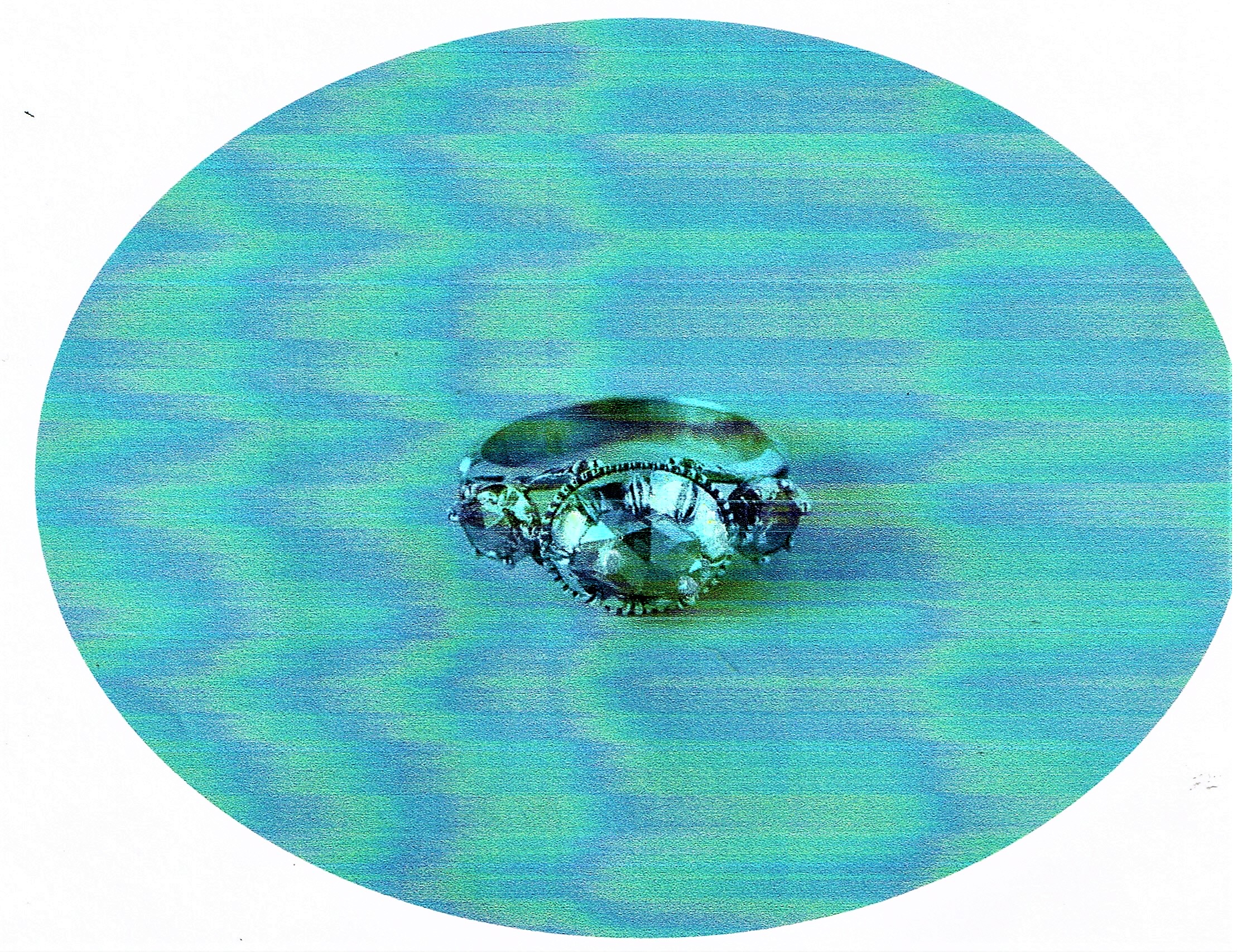
Chester kept a tiny, gray velvet box hidden in his pocket. A ring with a big white diamond lay in a soft spongy space inside. He said it belonged to his mom. She died and went to heaven not long after he was born.
“You can’t touch it, Stacey,” he said. “Only I can do that ‘cause it belonged to my mom. I like to hold it and pretend she’s right next to me. Dad said she had hair dark as molasses and a voice that made the angels cry.”
He rolled the ring in his palm, then held the jewel to the sun, as if he could see more than a few sparkly places. Then he carefully put the ring back inside, and we ran to find swings next to one another on the playground. If there weren’t any, we climbed the monkey bars, and he never seemed to care that I always beat him to the top.
One day in the lunchroom, Mrs. Craftwood saw Chester take the ring out of his pocket. She dragged him to the principal’s office. I threw away the other half of my bologna sandwich and followed them. They didn’t close the door. I saw everything.
“This ring had to be stolen,” Mrs. Craftwood told Mrs. Austin, “because this boy’s father is incapable of affording something like this.”
Mrs. Austin glared at Chester. “Stealing is a sin, son. You should know that.”
After school when Chester’s dad got to the principal’s office I sat outside the office and listened again. I knew that he had a job in a big, important office a long time ago, but the company closed one day, and he never found another job like it. Then after his wife died, he moved into an old four-room house on the edge of town and did odd jobs now and then. Folks said he didn’t seem to care anymore. But when he charged into Mrs. Austin’s office, it was clear he cared about something.
He didn’t say anything while she and Mrs. Craftwood accused Chester of stealing. Then he asked if either one of them took a close look at the ring.
“Why should that be necessary?” Mrs. Austin asked.
“Because it doesn’t take much light to see the truth in that diamond. Let me guess. Came in a gray box. Smells a little like grass stains and peanut butter.”
“What are you talking about, sir?” Mrs. Austin said.
I had to cover my ears because Chester’s dad got so loud. And this time the door was shut. He’d slammed it when he went inside. Hard.
“Would a real diamond look as scratched up as the side of a matchbox?”
“Please lower your voice,” Mrs. Craftwood said.
“Not until you return his mother’s ring.”
I wanted to lean into the door and catch everything that went on, but then Chester’s dad started talking about how his wife deserved better, and so does Chester. Wasn’t so exciting anymore. Something I couldn’t explain made me feel strange, almost like I walked into the boys’ dressing room by mistake. So, I sat on the bench outside the door and waited for what seemed like a long time.
“Thank you,” Chester said as his dad opened the door. Simple, like nothing was ever taken from him in the first place. He didn’t even see me right away because he was too busy slipping the ring on and off of his finger.
But his dad’s face looked so red it must have hurt. I could have sworn it burned right through his whiskers. He stopped when he saw me. “Stacey, you’re a good kid. Chester’s crazy about you. Don’t ever get too big for yourself.”
“I won’t,” I said. But I thought that was a strange thing to say.
Chester never did come back. He went away to a special-needs school on the other side of town. Mom said it was time for me to start playing with normal children.
“What’s normal?” I asked, and Mom accused me of being smart aleck.
But this time I wasn’t.
After that, I decided it was best to be vague about what I was doing. Sometimes I went to Chester’s house and we explored the woods behind it. We hoisted ourselves into the trees with lower branches and hunted for birds’ nests and woodpecker holes. He carved our names into a young beech tree.
“Someday when we’re old enough, let’s get married,” he said. “We’ll come back here and I’ll draw the heart and put the date on it.”
“Maybe,” I said. “But let’s look for salamanders down by the creek now.”
“Okay. But why can’t we ever go to your house to play?”
“Mom said I had to play outside. She’s cleaning.”
“You said she was sick last time,” he said.
“That’s because all she does is clean. And that much cleaning would make anyone sick.”
I stopped going to his house as much because I got tired of lying. To Mom. To Chester. Then one day I told Mom I was going for a long bike ride all by myself. I went to Chester’s house, but no one was there. When I peeked into his house it was empty, blind-dark. On the way home I felt mean, like somehow, I made Chester move away. I stopped at our beech tree in the woods, took a sharp rock and etched a shallow, lopsided heart around our names. It didn’t look very good. I’m not sure why I did it. Playing house never appealed to me. And Chester and I were never boyfriend and girlfriend.
But when I went to my cousin Janet’s wedding that summer, I thought about what it would be like to be a grown-up getting married. Maybe just for that day I would be willing to wear a lace dress, one made by a silly third-grade girl who grew up to be a fashion designer. Of course, I didn’t want to marry just anybody. The groom needed to be special, someone like Chester, who could give me a fake diamond, yet be real inside.
“I have lost friends, some by death—others through sheer inability to cross the street.” —Virginia Woolf
NO ORDINARY RECITAL
Jack:
Songs I recognized from at least twenty years ago rose from my daughter’s kitchen CD player. Amy seemed to prefer a beat to match her syncopated movements. So-much-to-do, although she never let anyone know what that so-much was, only some vague importance to taking out the garbage.
She stirred a pot to the rhythm of a rock band. She hummed as she turned up the oldies. However, when she turned to me, she reacted as if a snake-oil salesman had opened her back door, and then he had the audacity to sit at her kitchen table with a cup of her freshly brewed coffee.
My grandson had brought me the cup, as if it had been some kind of prize, before he left with my son-in-law for rehearsal. I’d visited because Mikey had invited me, the grandpa he wanted to know but didn’t. Yet.
Temporarily, I had moved in with Amy’s brother, at least until I could get back onto my own two feet. Amy saw the possibility of my walking a straight line as likely as a change in the Law of Gravity.
I had played keyboard, guitar, violin—you name it, lead guitar in a band, taught myself trumpet. I’d worked in an everyday office by day and ruled the stage at night. Before I lost just about everything. To king alcohol. A few months in jail.
The sweet jazz quartet calling from the player in a niche in the corner could have been the news reporting earthquakes downtown, or worse in my daughter’s backyard. Ten feet from the back door. Two feet from where I sat now. Then again, I felt an earthquake tremor begin in my chest and work its way to my stomach. My coffee grew cold. My daughter grew colder.
She stared at me with that look I recognized. Can’t-count-on-you-Dad didn’t need to come to her lips. Instead, the anger showed in her eyes, voice, the tight pull of her lips.
“So, you say you’ll be at Mikey’s recital Friday night. On time.”
“Yes.”
“And you will be sober.” She leaned over the table. “Not, but-I-only-had-two-drinks. Two quart-sized drinks?”
I had talked to Mikey. Before I’d set foot in the house. He’d run out to meet me. “Oh, Grandpa! My recital. It’s going to be great. You know what Daddy told me?”
I’d admitted I didn’t.
“Daddy said you played violin, too. You played really, really good. Could you play for me now? When we get inside.”
“How about some other day?” I’d answered. “Right now. I’m way too excited to hear you play.”
A partial truth. My heart wasn’t ready for music yet. It reminded me too much of what I’d thrown away.
I’d put my hand on his shoulder and Mikey didn’t pull away. He didn’t have the storehouse of empty promises in his memory his mom had. Her brother, too. He had taken me in—to a bed in his basement, next to the hot water heater. The upstairs door remained locked. I had to knock to get in. I’d stolen from both my children. I admit it. Giving back wasn’t easy.
“Did you used to live in Florida or California?” Mikey had asked. “Or was it another country?”
I’d bit my lip. I’d lived ten miles away before I passed out on the job. Mikey had no memory of me at all in his seven years of life.
Since then I’d managed to get a car, guaranteed only to be a car. I had my license back. I had a job, more of a pity offer with pittance pay.
Respect? That was going to take more time.
Amy: three days later
Mikey’s recital is about to begin. I know I should have told him about the call about his grandfather’s death. Jake, my chicken-husband won’t do it. The police swear the accident wasn’t Dad’s fault. He was stone sober and wearing his seatbelt. Probably wasn’t paying attention, however, as the semi crossed the middle lane.
Damn! I’d like to think something positive about my own father. And my insides feel just about as cold and empty. Maybe I didn’t give him much of a chance to apologize.
Mikey’s group is up last. Jake told him the best gets saved for the end, so nobody needs to follow it and feel less-than. Mikey thought that made sense. Of course, he believes in Santa Claus and the Easter Bunny.
“You’re awfully quiet,” Jake says. “Are you okay? Or at least as okay as anybody can be…under the circumstances.”
“We can’t just pretend Dad beamed up into a spaceship.” My voice doesn’t leak sarcasm. It explodes it.
“Mikey doesn’t have the same complicated memories you have. You can’t shield him from hurt. You can’t assign your feelings of guilt to Mikey either?” Jake’s voice is soft, but he doesn’t blink.
“What guilt?” I raise my voice and the lady in front of us turns around.
“Sorry,” I say to the woman, feeling heat rise to my cheeks. Guilt. Maybe. Dad tried to apologize. He said something about making amends. He could have been talking to an oncoming train.
Jake pats my hand. “I could have been kinder, too.”
I want to swat him but don’t. Not here. His words are like a fresh stab in a seeping wound.
I hear each musical presentation, the way I hear a passing train while waiting for safe passage. Yet I wonder if safe passage exists.
Mikey’s group appears. He doesn’t seem to see us right away. I don’t wave and make a point of the fact his newly discovered grandfather is missing. Then, Mikey begins his solo, an Irish song I recognize from forty years ago, when I was small. I asked Dad to play it all the time, and then danced across the floor.
My son’s technique and timing improved. He adds style I didn’t know he knew. Jake looks at me with his brows pulled together. He shrugs. Apparently, he wonders when Mikey transformed from a good violinist at age seven to a prodigy.
He is beaming as he leaves the stage. Several people grab and hug him before he gets to his dad and me, but his eyes seem to scan the back of the auditorium.
“Mom, Dad!” he calls. “Where did Grandpa go? He was here a minute ago. Why didn’t he tell me he was going to be part of the show?”
“He. Did. What?” I ask.
“With all those lights around him. In the back. You’d think everybody would be turning around to look at him! But I got it, the way he held his fingers on the strings and moved the bow—to make the song sound better. He didn’t seem so far away. He felt right next to me. I’m not sure how. For real. Not sure I could play the same way again without him.”
“You’re sure that was Grandpa?” I said, “because…” I choke on words that won’t fit together.
When we get to the car it is locked. However, Dad’s violin is lying across the back seat.
“A gift,” I whisper,” from Grandpa. “That was his. I’d recognize it anywhere. I knew Mikey would hear the story of his grandfather’s death in a different way now, a way he would be able to accept long before his dad and I could. Mikey believed in miracles.
Now I needed to believe in forgiveness.
originally published in Piker Press on May 8, 2017
There is a wisdom of the head and a wisdom of the heart.  Charles Dickens

I HAVE NO IDEA

I have no idea why
the two-lettered word me
is a lifetime challenge.

I have no idea why
pale, sun-sensitive flesh is deemed superior
when smooth, dark skin has obvious innate beauty.

I have no idea why
greed captures many
when the human spirit
offers warmth in any season.

I have no idea why
wisdom arrives with advanced age
as the body weakens.

I have no idea why
time reaches through weighty errors and trial,
then discovers purpose inside common wrinkles. I do know
waiting for storms to end avoids rainbows.
My great aunt, Marty Pestil, was a natural at tending to the dead. She got bodies ready for the all-night watch when folk gathered to make sure no bugs, dogs, or ghosts could get to the ripe-for-decaying flesh. I helped my aunt since I didn’t have no other place to go. My aunt took me in when my mama started talking to wallpaper flowers. Papa had walked off before I was born.
I never got schooling, but not many people did in mountain-tucked Gray Valley, Kentucky during the early 1920’s. We picked up a common-sense kind of learning. Aunt Marty taught me her trade. She said living and dying fit together the way bare-treed winter followed full-blossomed summer.
Almost everybody agreed, but some folk thought Aunt Marty turned the winter dying part into a show.
Men took care of the departed men and boys. The man who took care of the dead in Gray Valley looked the grim job. He wagged his finger so hard at my aunt it about blurred his whole arm.
“You act like you was bigger’n God—it just ain’t right. Pretending you can step off into the afterlife with the dead.”
My aunt stared him down. She didn’t argue. “Our job is to open the next world. When the silver coins fall off the eyes of dead folk, their souls got to be ready for the hereafter. Ain’t no more I can say about it.”
He backed off, groaning, like there ain’t no sense talking to a crazy lady. It wasn’t ‘til later I learned he got picked accidental-like to prepare the dead and hated every second of it.
Aunt Marty said the folks that set themselves for eternal damnation didn’t want to go, and Aunt Marty had to say somebody from the underworld would come for them anyway, so they may as well scat before the rotting set in, and their souls smelled, too. Besides, St. Peter listened to a good story. Usually they ran for that last chance.
I didn’t feel like I belonged anywhere. I got to be known as Lost Lacy. Hank Ross was my only friend. Hank helped my aunt and me with our truck garden. His papa owned the General Store. The Ross family didn’t care that Aunty Marty talked to floating souls.
Sometimes Hank and me would cook together. I thought of him as my connection to the earth and sun, to breathing, to the smell of boiling turnips and hot sliced pork.
“I like when you don’t have your hair pulled so tight on the top of your head, like it’s caught in a trap,” Hank said. “Relax once in a while.”
I shrugged. “It don’t make sense to hoe, pull weeds, or move bodies with hair in the way.”
Besides, I traveled from death to death the way a butterfly goes from flower to flower, especially when typhoid or scarlet fever hit. I guess Aunt Marty and me was lucky we never got no bad sickness. Butterflies get to drink nectar—I touched the cold skin of folk that followed both Beelzebub and St. Michael.
No matter how many times Aunt Marty handed me the magic coins and I rubbed them over my fingertips I never felt nothing special in them. They’d been used to close so many eyes. Everybody thought old Miranda Mill had been best friends with the devil. She cursed and stole and some folk even say she got away with killing her own husband.
I could have sworn I saw a body twitch as Aunt Marty talked honest to it, even though it was as hard-cold as a middle-of-February icicle.
Eleanor Case, the old schoolmarm, brought extra lunch-bucket food for the kids that didn’t have nothing. If angels ever wanted to borrow a human body, Miss Case is the one they’d use.
Bodies all just looked dead to me.
Aunt Marty told me I would inherit her gift. I didn’t want it. Maybe the magic coins knew how I felt and that’s why they wouldn’t let me know their secrets.
The strangest experience I had was when Ida Mae’s twin sister, Carrie Mae, died from a seizure caused by a high fever. Ida shook like a thunderstorm had formed inside her and was getting stronger and stronger, until it tore her apart from the inside. Aunt Marty must have noticed, too. Real slow, as if she was trying to soothe an injured bear, she reached over and patted Ida’s arm.
“I got a message for you. And it’s real important. Your sister says that she would have run out into the cold rain to pick apples even if you hadn’t had a hankering for them. She wanted some, too. And the fever—this is the important part—the fever didn’t have nothing to do with getting soaked through.”
Ida’s eyes opened about as wide as her face and she choked, “But how do you know about the apples? I never told.”
“Your sister’s telling you she can’t go to her eternal reward until you know her dying ain’t one-bit your fault.”
Then Ida dropped onto her sister’s body and sobbed. Aunt Marty didn’t stop her until I saw the slightest light, no brighter than a candle flame flicker, pass through Ida and out through the wall.
“But you didn’t send Carrie’s spirit into heaven,” I whispered to Aunt Marty.
“It’s okay,” she said. “Ida Mae done it.”
Ida Mae told her best friend that story. Versions of what happened got spread around the county. My aunt and me turned into either witches or messengers from the Almighty, depending upon the notions of who heard. Some thought we was gods, the kind that shouldn’t be approached ‘til there wasn’t no choice.
I loved my aunt. I would have been an orphan without her. But, the magic coins knew her, not me. Besides, in a month or two I would be sixteen-years-old. And all I saw ahead was more burying.
“Pick you some happiness if I could,” Hank said one spring day as we searched the woods for some poke for a salad.
So, I told him about how I wanted to do something different than travel from one pine box to another. “I wouldn’t mind rendering hog fat over a hot stove all day, if I could work for the living.”
“How about you and me getting married?”
“Ain’t never thought about it.” I looked at the basket of fresh-picked poke, good-for-you in early spring. Poison later in the season.
“I’m mighty crazy about you, and I think we can work together. Maybe even create living folk.” He turned red as a over-ripe tomato.
Hank made sense. Marrying him could change my life. A lot. “Think we should tell Aunt Marty together?”
He looked at me like I was a tadpole that turned into a full-growed frog fast as ice melts in a hot pot. “Should we tell her right now?”
“Yup. No point in waiting. She’d figure us out anyway.”
“Then I think it’s time you knew the secret.” He put his arm around my shoulder. “How do you think Aunt Marty makes them coins magic?”
“I figured she had some kind of special power over them. They don’t look no different.”
“She learned how from my papa. It’s a business we do most folk don’t know about.” He sat on a huge rock at the edge of the trail. “True, you seen these coins when they been put on the eyes of folk to keep them closed, when the time’s come to look inside and see the whole of themselves. Just before they open before eternity. You don’t know how the magic forms before that happens.
“The magic comes from inside a person. You’ve got to care about what you’re doing. A lot. And keep caring. All the time. But that ain’t how it ends.”
Hank pulled a coin from his pocket, like the ones Aunt Marty used. Then I put the poke on the rock and let Hank drop the coin into my hand. It warmed immediately. I suddenly felt drawn to Hank’s eyes. Strange how I’d never seen them the same way before. His eyes was the color of a lake at noon when the sun shines. I noticed how his smile seemed to come straight from his soul.
When Hank and I walked into Aunt Marty’s cabin, my aunt wasn’t in her cane rocker, like usual. She lay in bed, her face white as a bleached sheet.
“Ah, you are both here,” she said, as if her voice came from far away.
I took her hand, cold as snow.
“Good, you have found your path. I feel it.” She whispered, but her smile filled her face. “One last request. Lacy, you will send me on to my eternal reward. Then you and Hank will live in this house together. Promise?”
We both nodded. Aunt Marty’s body shook once and then remained still. We got her lying as peaceful as if she was taking an afternoon nap. Then I dropped an aspirin in a bowl of soda water and wiped her face. Hank waited outside the door while I done the full washing.
When I placed the coins over her eyes to keep them closed, the coins told me what to do. I called to Hank to stand by my side. A wavering light appeared.
“Follow the light. Your mama is waiting.”
The brightness turned around and came back into me.
Hank grabbed my hand and the light jumped into him, too. When I looked at our arms I saw the fresh skin of our youth turn the same sun-gold, and I realized we’d been given power.
We used our magic in the truck garden to grow enough vegetables to feed us, the poorer folk in town, and the young’uns in the orphanage in the valley.
Ida Mae took over for Aunt Marty, and when she got married her husband led the men to their destiny. They knew the secret of the coins, but they didn’t talk out loud to spirits like Aunt Marty did. They talked to them silent, soul to soul.
The magic coins never made our lives perfect, but they made us rich in a peculiar kind of way. As of this telling, Hank and me have been married sixty years. We had five girls and four boys, and each one of our kids had two or three young’uns, and they ain’t stopped growing the family. Our sons and daughters all know how the coins work. They continue to make better whoever they touch, so that nobody knows where the goodness starts or ends.
I think that’s the way it’s supposed to be.
originally published in Piker Press on January 13, 2014
“Live as if you were to die tomorrow. Learn as if you were to live forever.” — Mahatma Gandhi.
My brush fills with blue watercolor and finds sky on the paper. “Keep moving,” my teacher tells me. Watercolor isn’t as forgiving as acrylics. Sure, there are tricks. Looks like I may learn a few. Now.
Dab the spot out with a magic eraser.
Or add white to another color and paint something over it.
This mountain can be a tad higher.Or this ocean needs waves. This pot needs another flower.
Watercolor painting is like living life to the fullest. Stay awake. Let the colors of the day lead and follow what is important. Not every effort is effective. However, it can be a learningplace.
Let the first coat dry before attacking it with another. I want results now. Real life tells me something else.
That I am a student. At the age of 78. May the learning continue.




 terrypetersen