Feeds:
Posts
Comments

Posts Tagged ‘experience’

jobs

“Our deepest human need is not material at all. Our deepest need is to be seen.” – Eckhart Tolle


TWO FIFTY-DOLLAR BILLS


Cora rubbed the back of her head as she stepped onto the curb. Ooh, that really hurts! Damn, the stress has got me. She turned around and watched the traffic move at least twenty miles over the speed limit. Stress, right. Now that’s something like calling the ocean a tad damp. I’m 67, look 80, and feel 105.

A colorful sign caught her eye on the lawn of a charming three-story red brick house: Housekeeper wanted, great pay, inquire within. She hadn’t recalled seeing it before. The house didn’t appear familiar either. But survival had taken all her focus when she got on and off the bus Monday through Friday—when she’d had a job. She’d gone back today to try to get it back.

 “I’m sorry,” her old boss had told her. “The company now requires all employees to have a high school education. You should have chosen retirement last year. Why run around like a dog chasing his own tail?”

 I washed stuff and took out the trash for a company that made parts for something, ain’t sure what. You don’t need no education for that. Besides, this old brain ain’t got the energy for homework and exams no more.

“Hey,” she said to the sign. “What the heck. If the homeowner tells me to go to hell at least I can just turn around and say howdy to Satan. Eviction’s tomorrow. Wonder what I should wear for my first day on the streets.”

She walked to the door with her back as straight as possible. A junior high gym teacher had told her that good posture is confidence. Not much else brought it.  

 “Wish I had a purse,” she murmured. “Could use an ibuprofen. Not sure what hit me, but it had an attitude.”

 Uncertain, she knocked so softly only a hound dog could have heard her, but a short, round woman with hair the color of silver tinsel answered. “Come in. Come in.”

“Saw your sign…”

“Yes. Yes, of course. And do you mind cleaning a house of this size? I have twelve rooms, and none of them are small.”

“Huh? No.”

“Do you mind being paid in cash?”

“That’s, that’s fine.” Cora tried not to stare at the woman, at least half a foot shorter than she was. She would have pinched herself to see if she was dreaming if she thought the woman wouldn’t notice. However, this lady seemed to catch every breath and eye flutter.

The house looked fantastic! The polished oak floor gleamed. The blue leather furniture appeared to be new and easy to maintain. Sunshine streamed through the windows and found no dust. How much would she need to clean? And any question she asked in protest would show how inadequate she really was. She could think of only one.

“I’m sorry, ma’am. I don’t know your name.”

“Angela.”

“And yours?” Angela cocked her head to one side.

“Cora.”

“Now is $200 a day enough?”

Cora gasped. This woman hadn’t even asked for her last name.

“Then follow me. I will show you your room. Then I will remove the sign from the yard.”

“That’s it? I’m hired?”

“You will clean whatever you see that needs to be done.”

“There’s gotta be a hitch to this,” Cora said, sorry she’d opened her mouth.

“Not a hitch exactly,” Angela answered. “But it isn’t what you might expect. I will pay you half in advance.” She reached into the pocket of her old-fashioned flowered apron and pulled out two fifty-dollar bills. “Perhaps you can confront what is in your way as you work here. And by the way, I suspect your headache has lightened.”

“How did you know…?”

“Your forehead had bulldog wrinkles when you came in. And your eyes were scrunched together so tight you almost had one eyebrow. Easy-to-interpret signs. By the way, I read people extremely well.”

“Oh.” That made sense. Sort of. Cora scratched the back of her neck, a nervous gesture.

“When can you begin?”

 Afraid the money could be taken from her as easily as she had received it, Cora stuffed the fifties into her pocket. She glanced around until she saw a broom propped in a corner.

Angela seemed to notice. “Now that is the kind of attitude I like. We will talk later.” She pointed out the door to the room where Cora needed to start, waved, and went outside.

Cora expected her to return with the sign tucked under her arm, but when she peeked outside she didn’t see the silver-haired lady or the help-wanted sign. And she didn’t see anything that needed sweeping either.

She sighed. Clean what needs cleaning? Yeah, sure. This place is sterile enough for open-heart surgery.  Then she opened the door. And gasped. Dust filled the air. She opened a window and then ran to find bug spray in a hall closet. Spider webs filled the corners of the windows. Clothes lay on the floor.

When she picked up one of the T-shirts, she recognized it. Her husband’s favorite: tie-dyed with IT’S NEVER TOO LATE TO HAVE A HAPPY CHILDHOOD printed across the front. The brash colors irritated her. He had worn it the day he left to pick up their daughter from kindergarten. He’d been home with a headache, like the one she had now, but she was gosh-darned sure he was faking it. He’d had an argument with his fix-it shop partner. Cora figured this was Jake’s way of getting even. The business hadn’t been doing well. So, she insisted he pick up Millie from kindergarten that afternoon. Then she could finish the laundry.

He’d had a heart attack on the way home and crashed into a tree. In those days children were allowed to sit in the front seat. Both Jake and Millie died.

And Cora thrived on bitterness. Friends ran away. So did the money.

She grabbed the shirt, uncertain whether she wanted to tear it apart or cry into it. She screamed, “How can there possibly be two shirts like this one?”

No one answered. Angela had not yet returned. Cora felt the fifties in her pocket. She remembered what the silver-haired woman had said. “We will talk later.” Cora considered running, but she had no place to go. “We will talk about what?”

The only thing she knew to do was clean, get rid of garbage, scrub. She held her breath as she opened the closet. She suspected the unpleasant surprises had not ended. Yet. She saw a cardboard box of toys and knew the next horror had arrived—on top of the stack lay a naked doll with over-combed blond hair. She remembered how she had lectured her daughter Millie about taking off her doll’s clothes and leaving them scattered all over the house—hours before she would never see her again. And this doll was an exact clone.

Cora dropped the doll. Maybe it was better to live on the streets than to face that day again. She sobbed until she didn’t think she had any energy left.

She had not heard Angela re-enter the house and come into the room. “You can let go now,” she said.

“Let go of what?”

“You are doing a spectacular cleaning job,” Angela said. “I trust you destroyed the cobwebs of your past and said goodbye to the guilt you created in here.”

“I didn’t clean nothing.”

 “Well, actually I took your experience and gave it shape in here.”

 “Who are you and what is going on?” Cora’s eyes widened. She wanted to run but stood frozen.

 “You don’t remember how you got that headache, do you? But don’t worry. This memory lapse happens often after a ruptured brain aneurysm. It was fatal.”

“I may be dull as a rubber knife, but I know what fatal means,” Cora said.

 “And you are absolutely right. This may not be as terrible as you think it is. Perhaps you need to know you are forgiven. With absolute certainty. Come. You have visitors. They want to take you home.”

The front door swung open, and a five-year-old girl ran inside. “Mommy, Mommy, I have been waiting and waiting for you. Daddy is outside. He said to hurry.”

Cora looked down at her arms and saw young, untroubled taut skin. She reached into her pocket, pulled out the two fifty-dollar bills, and handed them to Angela. “I don’t need these anymore.”

 She ran out to meet her family as Angela placed the same sign in the front yard:  housekeeper wanted, great pay, inquire within.


Read Full Post »

“When infants aren’t held, they can become sick, even die. It’s universally accepted that children need love, but at what age are people supposed to stop needing it? We never do. We need love in order to live happily, as much as we need oxygen in order to live at all.”  Marianne Williamso


A toddler wanders wherever his curiosity leads 
while Mommy and older siblings caution him.
Greens, blues, and moving objects call
to his curiosity. Come. 

This moment is alive
even if he doesn’t know language
or time. Grandma’s wrinkles intrigue him. 
He sees intricate gold on her wrist,

not the hours held inside her memory.
To Grandma this moment seems
as limited as the space Mommy
permits her son to roam.

Toddler snuggles against
Grandma’s cheek. She knows
that all moments face limits.
Yet love endures.


Read Full Post »

The afternoon knows what the morning never suspected. (Robert Frost)

At dawn and dusk
the sun touches the horizon
with the same elegance.

I celebrate evening.
Not because night
dissolves the sky's brilliance.

But because day
if lived
brightens midnight.


Read Full Post »

One more time. I will try one more time. Copy and paste no longer works. Highlighted text no longer becomes bold. No, I do not plan to turn my computer into electrical compost. I may need to change web servers after all these years of sharing. Sure, I will accept help. However, please remember that my age is the ancient symbol for the eternal, or completion, the number 7, listed twice.

I celebrate this moment and pray that the goblin inside the webpage can be removed without ceremony. I don’t want to frighten the neighbors. In the meantime, I am adding my quote for the day at the end. And hope this isn’t a final moment, at least in this forum.

Experience is the hardest kind of teacher. It gives you the test first and the lesson afterward. Oscar Wilde.

Read Full Post »

park bench

“Being deeply loved by someone gives you strength while loving someone deeply gives you courage.” ― Lao Tzu

ONE MORE DAY IN THE PARK WITH INGRID

Mick:

“Ingrid, come sit next to me. I brought that blue jacket you gave me to sit on. Not that you need physical comfort. I want something you’ve touched, even if a breeze is more solid.”

My wife died five years ago.

I pat the plush lining and wait. My wife won’t take long to arrive. The veil between this world and the other side has been thin lately.

About a week ago she appeared in an early morning lucid dream as the young Ingrid. Even asleep I remained wobbly and weak. We walked hand-in-hand through this same park. I knew that everything I saw and touched would disappear when I opened my eyes.  Even so, all the subtleties of nature emerged as we traveled familiar passageways. I saw details in each rock, blade of grass, hill, and squirrel.

Ingrid told me that direct contact with the deceased happens only under special circumstances. I asked her how we qualified, but she told me I would find out later. “Just relax and enjoy.”

When I woke up, she was sitting on the edge of my bed. She comes and goes now. All I need to do is call her—no phone is necessary. I have enough sense not to blab about Ingrid’s visits. Recovering from toxic chemotherapy drugs is bad enough. I don’t need my daughter to worry that I need psych meds, too.

Within about thirty seconds my wife emerges next to me. Slowly. Similar to the way fog comes up from the horizon. But with a lot more warmth. At first, she seems as transparent as air. Her features surface. Young. Beautiful. The way she looked when we first met.

She places her hand on my arm. “Okay, dear, what’s on your mind?”

“Jan told me I could use some Vitamin D from the sun. That’s why I’m out here today while she and the kids hike down to the lake. As if I’d miss the chance. She doesn’t know I heard her talk to Les on the phone last night. He can’t babysit me today. Got a new client coming in. True, I have the hearing of the old dog I am. But Jan’s voice doesn’t need a loudspeaker when she gets excited. Seems lately our daughter has the disposition of a ticking time bomb.”

“I’d say she is upset, and her attitude is more about her than about you.”

I’d say it’s not easy taking care of your father when he’s recovering from chemo. Not easy at all. Sure glad that the final session’s over! Last treatment forever.”

Her hands have lost all their thick arthritic lumps now that she’s in a spiritual state. Her hands are small, delicate, and gentle again. She runs them over my head, mostly bald, with a few sparse patches of dull, almost colorless hair.

 “Ah, Mick! Jan’s not ready for a halo, but I wouldn’t jump to conclusions. Yet anyway. Tell you what. I’ll follow her for a while. Find out what’s going on and let you know. Then I’ll get back to you. The grandkids have been knocked down by your illness. They don’t understand what happened, or why Grandpa doesn’t have the energy to joke with them anymore. But you know you can count on me. We’ll talk tonight. In your dreams.”

Ingrid’s kiss on my forehead could be a warm, gentle breeze.

 I sigh as I hear the kids run ahead of their mom up the trail. Much faster than they would have if I were with them. They don’t know I’d feel just as sick at home. At least in the park, the sun casts incredible shadows through the tree branches. The birds sing an avian kind of harmony. The sky is never the same color longer than a few hours. It darkens or lightens, blends in with the clouds or not. A hint of silver has lined a cluster toward the west. Like the gray in the few clumps of my hair that refused to fall out. Maybe I have a stubborn streak. I have always worn my hair short as a hyphen, so I didn’t need to shave my head.

Change arrives slowly. Although Ingrid says the word that I’m searching for is transformation. Sure, I’m glad my wife broke through the impenetrable barrier from the other side. But I’d take the wrinkled-but-solid Ingrid to the see-through-yet-perfect version any day.  

Ingrid:

I watch and listen to Mick’s family as they pretend to be aware of what they are doing. Les has brought work home. He shuffles papers like a deck of cards and stares at his computer. “What do we do about your dad? Should we just, I don’t know…” He spit-whispers into the computer screen.

Jan leans her behind into the refrigerator and turns her body into an awkward V. From the look on her face, I’m guessing she wants the stretch to pull out all her anxiety.

“I could scream,” she says. “I won’t. Even though Dad isn’t listening in. He’s heavily medicated and sound asleep for the night. The kids are out for the count, too. It is a school night.

I hover over the kitchen table, one of the benefits of the afterlife.

“I talked to Dad’s doctor,” Jan continues. “No doubt about it. He hasn’t got much chance. A heavier course of chemo could give him a few more months. Tops.”

 “So why hasn’t the oncologist told your dad?”

“That doctor has professional knowledge. Yes. But he has the bedside manner of a debt collector. I told him I would give Dad the options.” Jan straightens up again. She groans, her hand on her forehead. “Actually, I insisted. Said he could answer Dad’s questions on his next visit.”

“Then?”

“Okay. Then I sort of chickened out.”

“You mean you chickened out. No sort-of about it.”

“Thanks for your support.”

“So, what do you want me to do? I’m a lawyer, not a social worker.”

“You are also my life mate. Come on. Give me an idea.”

“Okay. I’ll stop by after I see my last client tomorrow. We’ll tell him together. Calmly. Let him decide. In the meantime, let your dad know how much you love him. It’s all you can do. Yeah, you’re nervous about the situation. But all he sees is nervousness. He doesn’t know why.”

 Jan drops her head almost to her knees. “Hey for a lawyer that’s not bad advice.”

“Uh, thanks for the backhanded compliment.”

I stop hovering and put one arm around my daughter’s shoulders. She doesn’t know I’m the one comforting her, but after a few sighs she finally says, “Maybe I’m underestimating Dad.”

“More than maybe, sweetheart.”

In a few hours, I will slip into Mick’s dreams. I will break the news about what his children are going to tell him tomorrow. I know my guy. He will allay his family’s fears. Because Mick isn’t afraid. He’s seen me. He knows he will be okay. I will tell him why I broke the bridge between our worlds—because he and I are closer than he knew we were. I slipped through a hairline break between this world and the next one, the designated place where we were meant to meet. When the time came.

When he accepts my invitation, we will be together again. In a few days if he wishes. If he is ready all he will need to do is concentrate on the separation, nothing artificial or traumatic about the transition. In the meantime, perhaps I should set up the scene for his final dream: a sunny day…a park bench…a place where we both can run, laugh, and sing out of tune if we want. It doesn’t matter. Some details look different after passing through the light. But the beauty Mick and I savored will remain the same.       

Always. Always.

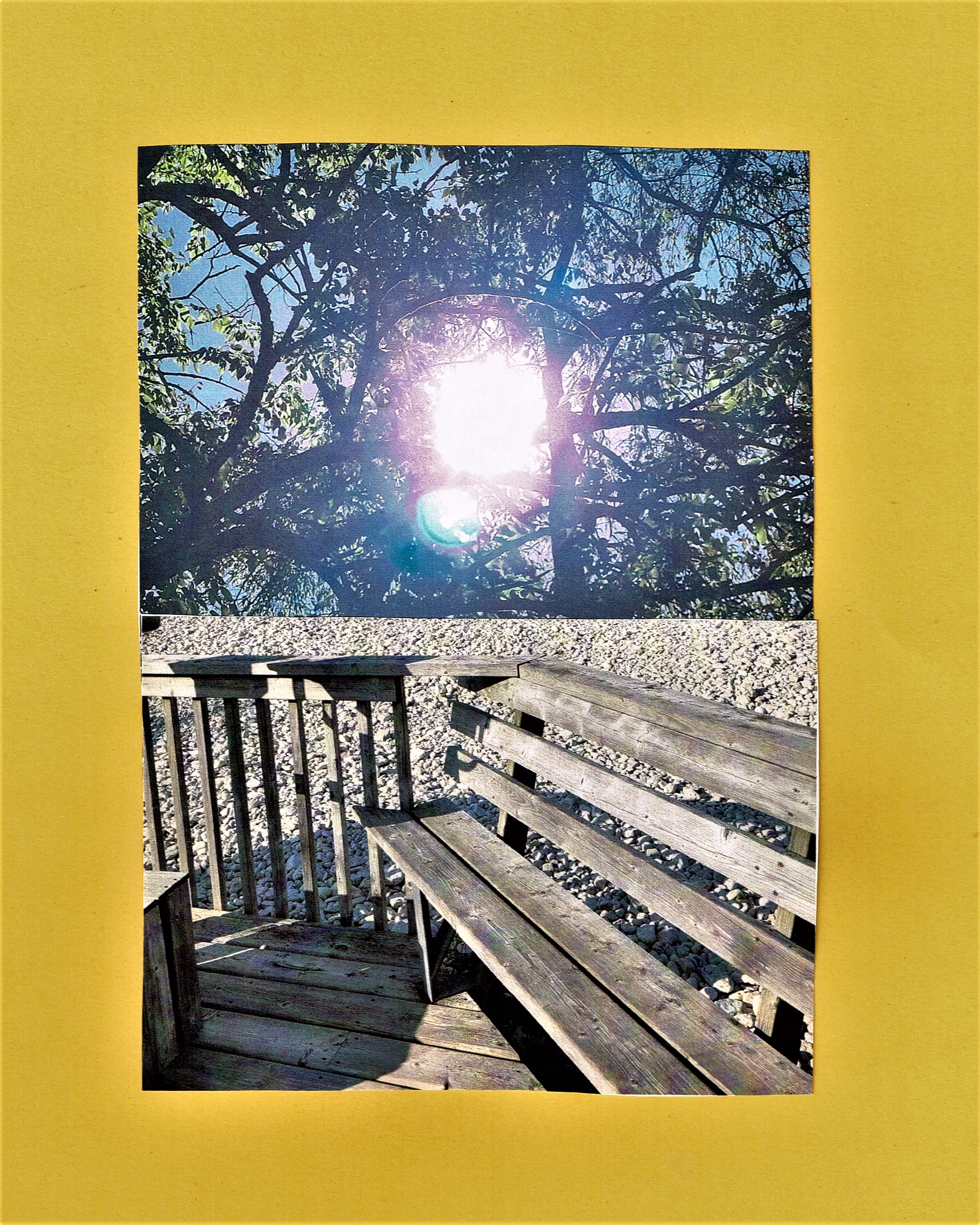
illustration created from two personal photos scanned together

story previously published in Piker Press


Read Full Post »

“The best tunes are played on the oldest fiddles!” – Ralph Waldo Emerson

Capturing the whole of life continues to evade me. I have been 70 for more than a few years. Yet, learning doesn’t stop. Life has too many complex parts.

When I stood waist-high to grownups, I thought gray hair and wrinkles belonged to creatures of a separate species. Children in the late 1940s and early 1950s lived in another realm. 

We learned rules after we broke them. For example, building a campfire in the basement is not advisable. Even if the responsible individual planned to put it out after the Native American ceremony. I was probably about five at the time. And yes, I was the child who found fire in a box by the hot water heater.

Children sat separately from their elders during family events. We didn’t listen to any adult discussions. Some of our questions received a laugh and others found censure.  

Why isn’t Grandma bald like Grandpa? The observation was innocent enough that a quick guffaw was the only answer. Asking why Mommy and Grandma were so fat was another matter.

Distance. A distinct memory of my early life. The higher and the lower class. Where they were to meet was vague.

Transitions take tangled curves. I wonder if an easy path would have left space to experiment and fail before succeeding.

Now, I speak to my grandchildren at eye level. We play. My three-year-old granddaughter has no understanding that my husband is my son’s daddy. There is no need to explain yet. Wisdom doesn’t come with a set of rules. It’s organic.

I earned the lines in my skin. I treasure a few more as long as each road offers new passageways.


 The above painting is part of something new I am discovering.


Read Full Post »

bloody keyboard

Monsters exist, but they are too few in number to be truly dangerous. More dangerous are the common men, the functionaries ready to believe and to act without asking questions.” ― Primo Levi

Dachau, May 1938

(Six months before The Night of Broken Glass)

Part I

The little girl overheard Mama tell Great Uncle Benjamin, “I feigned interest in marketplace pork.”

He answered, “You can’t fool Nazis. You should be true to yourself.”

The little girl was pecking the piano one key at a time, black and white, high and low tones. Uncle’s happy songs lay hidden inside the sounds like secret buried treasure, with a beauty that stretched from one side of the keyboard to the other, sweet sounds that rose and fell, music that told a story she wasn’t allowed to repeat, not even in whispers.

She wondered why the sons and daughters of  Abraham and Jacob’s Traditions should anger anyone. The child searched and found only dissonance under her fingertips when she added more than one key. Uncle had promised to come at noon the next day and lead her small fingers across the scales, but it would take work, an attentive ear, and love. She would practice. And learn.

But dark filled the sky And Uncle never arrived.

Papa came home and said Uncle had been taken. Papa had missed capture by a shadow.

He’d found a way to leave Munich with her and her mother, a passageway as narrow as the eye of a needle used for silk, dangerous, yet their only hope.

And the little girl followed, believing that Uncle would come someday and lead her hands into music because she could work, and listen, and love as well as anyone.

Part II

Benjamin felt the heat of the men next to him, a herd, silenced by fear so strong it had an odor, gut-wrenching and rancid.

One of the guards outside the gate glanced at Benjamin and then looked down. The guard’s face looked familiar.

Benjamin and the young guard stood beside a message bent into the metal: Arbeit Macht Frei, Work sets you free.

The guard had been his student, a youth who expected a golden sound from a flip of the wrist and a closed ear.

Benjamin’s six-year-old niece tried harder.

He imagined her waiting for him as he dropped his shoes next to the others, outside the sign marked brausebad, the bathhouse, the place of cleansing, perhaps the beginning, perhaps the end, but never destruction.

He prayed that even if he couldn’t return, and his niece didn’t learn his song, she would create her own.

previously published

Read Full Post »

road in the rain

They say the universe is expanding. That should help with the traffic. (Steven Wright)

I wonder how many drivers have made road trips—without wondering what the…heck is that guy doing? One driver is traveling at NASCAR speed and another is moving twenty miles an hour in a fifty-plus zone.

When my younger son was about kindergarten age I turned onto a narrow road behind a woman, obviously elderly. Her shoulders sloped, and her head leaned over the steering wheel. She drove the center yellow line as if she were failing a sobriety test in slow motion.

When I reacted, my youngster responded, “Oh Mom, maybe she just has old-timer’s disease.

I don’t recall how I got around her, or when she turned onto another road. My son’s innocence, however, stays with me.

His simplicity didn’t nullify the lady as a roadway threat. It did help me get through the moment.

Years later, my middle granddaughter was in the car when a driver cut me off with half a foot to spare.

I gasped, but my granddaughter saved the moment again.

“Grandma, is that what’s called a jackass?”

“Bad driver,” I answered.

Unfortunately, not every accident is an almost. Signs above the highway note the statistics.

Today I am driving in the rain. Someone, male or female—it doesn’t matter—passes me on the left over the center line, misses an oncoming car by about a foot, and then repeats the favor with the next car.

Peace, I think. Not in pieces. Someday. Somehow.

(The above is an edited blog from five years ago.)

Read Full Post »

apples in an apple

It’s not what you look at that matters, it’s what you see.  (Henry David Thoreau)

The Seed

The seed lay snug within her apple. Wind, rain, and sun brushed the surface of her fruit. Inside, protected, the seed grew dark and smooth. The tree told its growing parts that spring blossoms lived on the tree’s branches before they were formed. However, the seed did not want to hear about anything that happened a long time ago. She preferred to rest in a comfortable, firm sweetness that grew as summer brought warmth and long daylight stretches.

The seed expected endless safety. However, one afternoon in late summer, she felt a sharp jolt as her round, red home was snapped from its branch. Other apples left their places, too. They traveled miles from their birthplace.

The seed felt its fleshy home split with a sharp object. She was scooped out with the other seeds who lived with her. They were tossed aside.

“What is happening to me?” she called.

“Or us?” the other seeds replied.

But the seed didn’t hear. She was already taken away.

A dark time passed as the seed lay surrounded by moist soil in a small container for what seemed to be a century. Then something happened. She felt a violent tug in her center. She knew she was changing.

A creature, a lot like the one who pulled her from her home, grabbed her from the smaller container and placed her inside the ground. In time, she realized she looked much different. She was frightened.

“What is happening to me?”

A tall tree towered above her. She did not yet realize that she was also a tree, not until the days warmed and white blossoms appeared on her branches. They became fruit when the heat continued.

“Why did I worry so much. Everything I have experienced is natural. I must warn the other seeds. Somehow. They must not suffer like I did.”

She spoke to her own seeds. They didn’t listen. No matter how loud she yelled.

“Hush,” the wind told her. “You can’t find instant wisdom, especially if you haven’t discovered it for yourself.”

As the season passed, another creature appeared and stole one apple, and then another.

The seed, now a tree herself, watched.

“Wind,” she called. “Have I found wisdom yet?”

The wind did not answer. Nevertheless, the new apple tree waited even as winter came and robbed her of her gifts.

Read Full Post »

Living on earth may be tough, but it includes a free ride around the sun every year. (Author unknown)

Nature’s Creations

A young boy clasps a crayon with his fist
and draws an oblong, orange sun
with long uneven spokes.
He scribbles a
blue-clouded sky.
His big brother points out
the real sky
with patterns his kindergarten
colors can’t imitate.
The boy wads his drawing into a ball
and throws it at his sibling.
Their mother grabs the crumpled paper.
She tells her sons
that nature creates superb designs.
But the sun is too hot
and too far away
to fit on their refrigerator.
Could the smaller child please try again.
And would Big Brother
please edit 
another artwork Nature has provided.
The lawn needs to be cut.


illustration made from colored paper, chalk, and colored pencil, with paper towel clouds

Read Full Post »

« Newer Posts - Older Posts »