Feeds:
Posts
Comments

Posts Tagged ‘grandchildren’

One eye sees, the other feels. (Paul Klee)

This year will probably be the last one for our artificial Christmas tree. The bottom lower branch no longer lights. Our angel has toppled so many times she lies, as if exhausted, at the base. She is supposed to be reigning from above. Maybe she is afraid of heights. I suspect that is better than being a fallen angel.

My husband and I celebrate the full twelve days of the season, even if those days include the ordinary chores of laundry, rug-scrubbing, and bill-paying. Holiday music plays in the background. The greatest celebrations include a full day with our grandchildren.

On December 26 Miss Rebe pretended to be mommy-having-a-baby. Her imagination swelled as she followed that experience with a brain, and then a heart transfer with her newborn. None of these moments fit into anything resembling real life. However, Rebe did understand that surgery includes cutting followed by blood. Even in play young people recognize suffering.

“Don’t look, Daughter,” she told me. Of course within seconds the transformation had occurred and been reversed—several times. In a kindergartener’s world magic slips into the ordinary as easily as wind blows through an open window.

Somehow Rebe’s fantasy touched something real. Physical brain and heart transfers don’t exist beyond imagination. Empathy does. Answers may not come in easy packages. Time may not heal. In-a-better-place isn’t always the best response. Yet a quiet soul and listening ear can speak in unexpected, healing ways.

Most holiday seasons are tainted in some ways; that’s the nature of anything that has created form. This December has been filled with sadness, illness, and tragedy. I have seen friends and acquaintances suffer. Some have died, suddenly, at a moment when the lights were expected to be brightest. Instead they extinguished.

After her imagined ordeal Rebe told Daughter it was time to go home. Apparently she had returned into pretend-mommy mode. Baby, yet unnamed, lay tucked in the crook of her arm. We were on our way. She didn’t say where.

But then, life’s journeys aren’t mapped anyway.

pic from the Optimism Revolution

love tainted world Optimism Revolution

Read Full Post »

Nobody can go back and start a new beginning, but anyone can start today and make a new ending. (Maria Robinson)

Our family waits for the arrival of my husband’s mother and sister. They live six-hours west of us where nine inches of snow is possible. Jay’s mother, Mary, is 93-years-old. One of her daughters is driving her into town for a funeral. Mary’s sister has died and she is the last living person in her family.

As soon as the travelers arrive I let my sons know. We are concerned; Mary can barely stand. Yet, her heart remains rooted strong in family.

Part of Mary’s agenda includes plans for her own funeral. I’m familiar with the process, although I have never done it with the honoree  present. Mary’s other daughter has material handy for us to view. Whenever my mother-in-law shows emotion I know we are on the right track. When she says, “How do I know? I won’t be there,” I realize the mechanics of planning may be present; however, heart isn’t. She adds that she doesn’t want a eulogy that praises her; it should praise God. She also wants humor.

I suggest asking my older son, Greg, both a stand-up comic and a man active in his church community. The conversation drifts into a discussion of his latest book, “Open Mike,” the tightness of his style. She grins, proud, and laughs with us. A suggestion is made to complete the outline. “So, who do you want to do your eulogy?” But I sense a return to how do I know? I won’t be there.

Let our list of whats, wheres, and whens be sufficient as we return to the moment, to life as it is. Now. More family members arrive, just what Mary needs as an extrovert’s extrovert.

I think about the struggle I’ve had in the past few months with a pesky virus that is only now beginning to subside, even though my soprano has been knocked out by a throat as dry as desert-baked sand. A little alto sneaks out occasionally, but it is weak and inconsistent.  I realize that this is nothing in comparison to the suffering many people experience. No one is invincible, although as a young person I certainly lived as if I were.

Somehow I expected to be in my twenties forever, slender without needing exercise and diet control. Possibilities lay ahead of me—but I rarely chose them. Tomorrow would always be there, or so I thought. Those days will never return. Nevertheless, this moment lives, ready to be seized.

In my last blog I mentioned how three words, consider the source, became valuable advice from my father. My mother-in-law showed me how rich grandparent bonding could become. Since I worked in hospital pharmacy my hours didn’t fit a Monday through Friday schedule. I was off Fridays and asked to watch my first granddaughter on that day even though my son and daughter-in-law already had child care. I have never regretted that choice.

In fact my gift has tripled. I now have three grandchildren. I don’t think a day goes by that I don’t think about my granddaughters. Somehow even a Cheerio in the couch cushion isn’t the irritation it could be when I consider the source, a beautiful blonde four-year-old girl with a smile that could light the city.

I have no idea what legacy I will leave my sons and granddaughters, but I’m not sure the spiritual can be weighed anyway. I prefer to live this moment and build upon the next, with as much gratitude as I can manage. Today. Tomorrow isn’t promised.

more beginnings than endings PIQ

Read Full Post »

The great thing about getting older is that you don’t lose all the other ages you’ve been. (Madeleine L’Engle, 1918-2007) 

I made a big mistake when I told my two older grandchildren about the time my brothers climbed into the dollhouse my grandfather made for me. Since the house had been created for thumb-sized dolls, not little boys, the walls collapsed onto them.

Kate and Rebecca were horrified. Two giants had invaded precious pretend space and demolished it. Back then I probably saw the torn walls as slaughtered puppies. Now, I understand the viewpoint of my younger brothers, an exploration into uncharted territory. I really don’t think they planned destruction; it happened as a side-product of their exploration. Somehow, I expected my little girls to see with my adult point of view. They didn’t.

When Kate knew my youngest brother was coming to the house, she asked, “Is he one of the brothers who broke your doll house?”

“Uh, no, he was too little.”

I have a few weeks before my other brothers face my girls’ wrath—for a misdemeanor committed before computers, space travel, cell phones, and flat-screen television sets existed. Any pictures from that era would have been in black-and-white. They couldn’t have been instantly posted on Facebook.

Then again, my granddaughters may forget all about the long-ago dollhouse. Actually it’s likely. The holidays are filled with far more interesting opportunities. If the subject comes up I could ask if they ever made a mistake and then felt sorry about it later. The word, oops, appears early in a child’s vocabulary. I could mention again the story about the time my brothers and I wanted to play Indians in the basement when I was about four-or-five-years old. We needed a campfire. So I gathered some sticks from the front yard, placed them on the cement floor, and then lit them from the pilot on the hot-water heater. Fortunately, my mother had a good sense of smell.

“Did you get a spanking?” Kate asked.

“I don’t remember that part. But you can be pretty sure I did.” I certainly earned one.

The consequences of a fire in the basement didn’t occur to me at preschool age. I had planned to put it out. There was a faucet a few feet away, right next to the wringer washer. As an adult the thought of flames in the house strikes me with intense fear. I’ve apologized to my parents many times over the years.

Yet, somewhere deep inside me is that little adventurer who wondered what-would-happen-if? She learned to respect the parameters of reality, but appreciates the spunk of the kid with just a touch of mischief inside.

Yes, I loved that dollhouse my grandfather crafted for me. He was an incredible, gentle man. I loved my brothers even more. And, I still do.

save the kid in you

Read Full Post »

Success consists of going from failure to failure without loss of enthusiasm. (Winston Churchill)

The electricity goes out late Thursday morning seconds after I hear a loud blast—probably a transformer on an adjoining street. My husband has left the house to pick up Ella from preschool. My job is to have lunch ready. Our kitchen is small, with one window and low light. Fortunately I have a gas stove, and can turn-on the burners with a match. An open back door provides enough sun to let me know when my homemade soup is warm enough and the sandwiches are toasted, not transformed into charcoal. A chilly breeze slips through occasionally, but natural sun beats a candle flame.

Our little Ella adapts. After lunch she opens her school bag and pulls out her glasses. “Book,” she says. She doesn’t complain about inconvenience. Down syndrome has delayed her ability to communicate verbally. Nevertheless, she gets her point across, with a gentle, loving style.

She is way ahead when it comes to self-acceptance. She doesn’t battle pride on the level many people do. She doesn’t need to be the most accomplished kid in her class—among the most loving will do. People can live to be in their eighties without reaching her ability to accept, to give, to be without pretense.

As my husband reads to her I remember another child I saw last night at a memorial service for my father at his church.

Across the aisle was a family with a young boy who had some serious handicap or illness. I did not know him or anyone in his family. However, I noticed the way his mother held his hand and stroked his hair, how his father and siblings paid attention to him with simple, yet significant gestures. I watched as the mother nodded to the boy, unstrapped him from his stroller, and then lifted his limp body onto her lap. She carefully attended to his breathing tube. Then, smiling, she caressed him as if he were a newborn.

That family understood love.

The priest spoke of loss, its meaning. He also talked about life. I had no idea what hope the family held for this child, but they were living the present to the fullest.

Our little Ella has had pulmonary hypertension. We were told that she could, possibly, outgrow it. When she was small she was on oxygen 24/7; as she grew older she needed it only at night. Last week her numbers indicated that she no longer required oxygen. Our family celebrated as if a war had ended. My celebration changed, deepened perhaps, as I watched that family.

I still cherished our granddaughter’s healing, but I wondered about the strength of that family’s gifts. All I saw was a single moment in time, like the cover of a book that held thousands of pages filled with stories, some tragic, some beautiful. In my own tiny church community we can speak to one another, no one left out except by choice. In this large congregation that wasn’t possible. The ceremony was formal, and these folk left before we did anyway. Actually, I didn’t know what I could have said. My thoughts didn’t have words, only a vague sense of awe that would have been cheapened if I tried to translate them.

All I know now is that there is a book next to me that I can open at any time, or a pad of paper where I can write. However, on my other side is a little girl named Ella giggling over a computer game. And I don’t want to miss one second of it.

you are of infinite worth

Read Full Post »

The potential of the average person is like a huge ocean unsailed, a new continent unexplored, a world of possibilities waiting to be released and channeled toward some great good. (Brian Tracy) 

The outdoor parade at Rebecca’s kindergarten is cancelled. An indoor march will need to suffice. I’m surprised by the silence I feel inside the school.  I may be a few minutes early. But I can’t be the only parent or grandparent who wanted a good parking place. The lot isn’t empty.  I don’t look for Rebe’s daddy. He couldn’t have arrived yet. He called from work less than an hour ago to let me know about the change of plans.

The closed inner door is no surprise. It’s a security measure. The quiet, however, shouts change. The violence at Sandy Hook and other schools has affected facilities everywhere. When Kate was this age there would have been a group in the waiting area outside the office. Camaraderie, enthusiasm, and anticipation would have swelled, even in a small group, perhaps moved to the gym.

Someone from the office I recognize smiles and gestures me inside. I sign-in and she gives me a neon red badge. “Do you know where Rebe’s room is?” she asks.

I don’t. She leads me to the correct corridor. A few adults, probably teachers and aids, seem to be planning something. No children are in the room. Rebe’s teacher says the class is in the music room next door. I am welcome to visit. All this time I wonder where the rest of the visitors are hiding. Is hide-and-go-seek on the agenda? No one was in the gym. My watch reads 10:20. Class dismisses at 11:00. I assumed 10:30 should be a good time to arrive.

Rebe’s smile widens, yet she refrains from rushing into my lap. I can tell by her body language that she is using considerable restraint. When the teacher announces that the children will be watching a movie with Disney songs I see a chair in the back of the room and ease toward it. Perhaps if my granddaughter doesn’t see me the temptation to step out of line won’t be as difficult.

“Sing if you know the words, boys and girls,” the teacher says. A few of the kids turn around as I join in on such oldies as “Zip-a-dee-doo-dah” and “A Very Merry Unbirthday,” but they don’t comment. I keep my voice soft. After all, this isn’t a performance. I am visiting their space.

I am the only adult visitor in the music room.

If the action begins at 10:30 it will start late. My watch reads 10:40. Greg, Rebe’s daddy, calls my cell phone. He is in her classroom. Security has fragmented the visitors. Their numbers don’t appear until our little parade reaches the gym, hardly a mob. How many folk can get off work on a Thursday in the late morning? However, there are enough to create an audience to make a circle of children feel special. Greg may be present, but he needs to return to the office.

The children look no different than they did when fourth-grader Kate was beginning school. Superman flexes his immature muscles, ghouls rule, and one boy asks if he got to be in the picture Greg took of Rebe. I nod. He beams. However, I don’t recall Kate telling me about the drill they had at school about what-we-would-do-if-the-bad-people-came.

Rebe hugs me as I leave. So does one of the other girls. All I know about her is that she is in Rebe’s class, and that she is a precious kindergartener. One hug can’t overcome hate and fear. The problems that lead to violence are deep-rooted. They don’t have an easy fix. They need the attention of all, an awareness that transcends security.

Rebe is Rosie the Riveter. She wears a badge that reads “Yes, we can.” Perhaps that message can be extended beyond World War II. It will take time. Any worthwhile cause does.

hug power Charles M. Schulz Museum

Read Full Post »

The world is like that—incomprehensible and full of surprises. (Jorge Amado)

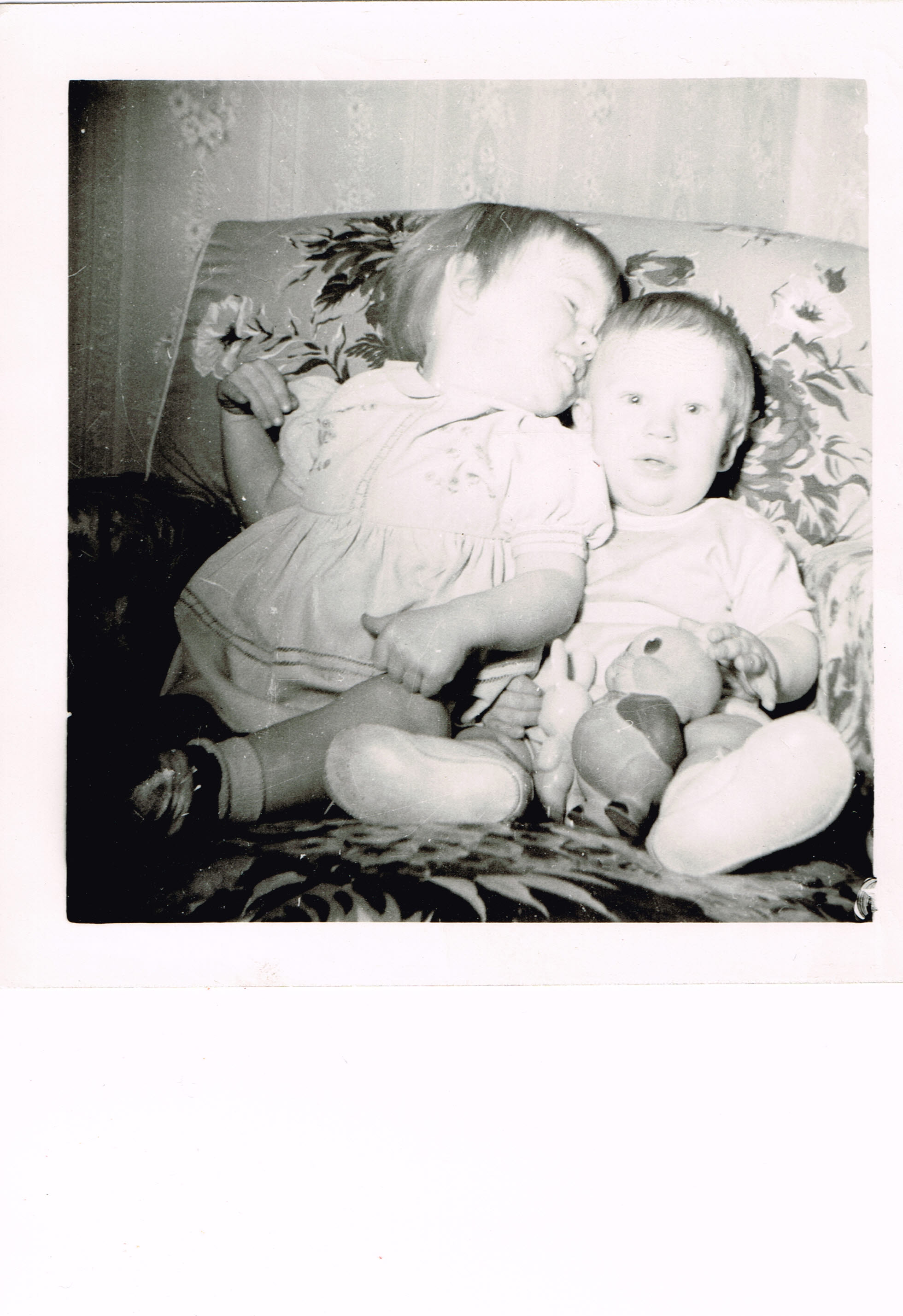
This photo of me and my brother is over sixty years old. It needs a caption: You mean this is my sister and I’m stuck with her? Or, that wasn’t a kiss, it was so slobbery I thought you were a Great Dane. I can’t use the informal word, pic, for any of the photos I found hidden in our attic. They belong to the time of rotary phones and black-and-white television. Folk wore suits and dresses, even to sporting events.

I can be found among my brothers easily in the collection. I’m wearing the frills. And yet the expressions on the faces of my family remain universal: Enthusiasm. Joy. Excitement. Wonder. Change the hairstyles and put jeans and sweatshirts on the people in the scenes and they couldn’t be distinguished from one taken in a modern family fifteen minutes ago. Although I’m not sure how to describe my brother in this picture: surprised maybe, definitely cute.

Little people remain little people in any age, in any culture. For me life didn’t exist beyond that floral stuffed chair and my back yard, Mom, Dad, Grandma and Grandpa and my brother, Bill. The future extended no further than alphabet soup for lunch or a picnic with Aunt Bette and Uncle Harold. Childhood seemed eternal.  Even at the advanced age of five, the fact that I would one day become a grandparent would have sounded as outlandish as Jack climbing the beanstalk and facing a giant. Actually, the giant appeared more believable. After all, I had scarcely reached the height of an adult’s naval by that time, probably not that high. I was a runt from the day I was born at four pounds and seven ounces.

Children believe life is what they live, wherever it is. In peace or in war. In the city or country. In a healthy home or one where love is only a word.

The multiple scenes of a baby girl in a silly floppy hat give me the notion that my family was excited to begin a new generation. Not everyone has had that experience. People tend to expand their own experience into another person’s thinking. One of my favorite quotes comes from Anais Nin, “We don’t see things as they are. We see them as we are.”

Perhaps that is why I find it so important to tell my grandchildren how innately good they are, every time I see them. At least once. And to encourage them when they show compassion for others. Nine-year-old Kate talks about setting up a benefit for a friend in need. No, I have no idea how she would do it. But that won’t stop me from encouraging her. The world is filled with surprises, and even if those surprises aren’t wonderful, if children learn they have power deep inside, they will be okay. At least eventually. That is my prayer.

Bill and me 08192013_0000

Read Full Post »

If you talk to a man in a language he understands, that goes to his head. If you talk to him in his language, that goes to his heart.  (Nelson Mandela)

Service we needed done in our house takes up a large portion of the afternoon: drilling, decisions, and comforting a five-year-old who doesn’t like noise. No time left to go to the Y for a swim. I expect Kate and Rebe to express serious disappointment. They handle the situation well.

Rebe gets custody of PBS Kids on my iPad while nine-year-old Kate and I do artwork in the second-floor storage area of our house. There is no air-conditioning here since we have no place for duct work, but this has been declared girl territory, a clubhouse arena of sorts. The heat isn’t as horrid as August usually offers. I’m holding out. Rebe manages for a while, and then returns downstairs to the cooler air and Grandpa.

“You can have this page,” Kate says, tearing it out of her brand-new book of designs to create and color. “You can make cards for the family, and then copy them on the computer.” Kate is always planning. She wants to turn our storage area into a play room. That will take not only time but ingenuity. With Kate’s enthusiasm, however, I can see it happening.

She watches as I show her how to blend colored pencil, rounding strokes inside a circle, adding depth by easing orange around the edges of yellow. “See how it looks if you leave a tiny bit of white in a block of turquoise—on purpose.”

We share, heart to heart. I feel free to tell her that someday Grandma and Grandma may need to sell this house and move to a condo, when Grandpa gets too old to mow the grass. Not now. Someday.

“I hope that never happens,” she says. “There are too many memories in this house.”

I am impressed by the depth of a child who hasn’t reached double digits yet. She adds that she is not disappointed that she didn’t get to swim today. She got to spend time with me.

I look around at the haphazard space around us: old blankets, photos, a box with my old published materials, the dolls I bought for my mother—nothing of outstanding value. No one from Better Homes and Gardens has ever approached us with an offer to do an article. Nor do I expect any in the future. Yet, I am blessed.

Finally Rebe returns upstairs, her demeanor comments on the heat as she looks at us working in the corner. “Whatever are you thinking?” she asks.

Kate and I laugh. One more memory has been added to the rest.

learning from children  morning coach

Read Full Post »

Probably one of the most private things in the world is an egg before it is broken. (M. F. K. Fisher)

I wanted to get in trouble when I was in sixth grade so that I would be given a unique punishment: Write 500 words on the interior of a ping pong ball. However, I was sure that the punishment would be changed, suddenly, inexplicably, the second I chose to play the role of rebel. Besides, for me out-of-line felt as uncomfortable as drowning.

Actually, I have no idea what I would have written, probably something based on fantasy. Too many decades have passed to know for certain. I know the real me hadn’t emerged yet. It was inside that ping pong ball—or probably a better metaphor—my egg hadn’t hatched yet. While many people yearn to be young again, give me over-sixty and retired any day. Sure, it brings plenty of problems. I didn’t have arthritis then, and I didn’t need to get up at night to relieve a complaining bladder. Yet, in those days I wasn’t aware that the world held almost infinite possibilities. A zit on my chin signaled disaster. And no amount of logic could have convinced me otherwise.

Maybe that’s part of the reason why I love to get eye-to-eye with my grandchildren, let them know they are not second-class citizens because they are under age eighteen. I can’t spare them crises as they grow older, but I hope to ward off as many unnecessary traumas as possible.

“You are a natural swimmer,” I tell Rebe. Then I ask Kate to make up one more song, on the spot about a topic I give her: rainbows, sports, sunshine. The subject doesn’t matter. And most of the time my poor hearing doesn’t catch her lyrics. Doesn’t matter. My girls need to know they can do whatever they choose to do. They have potential that can break open and grow at any time. They are not the nothing inside a ping pong ball—like I thought I was.

No one is.

cracked-egg

Read Full Post »

Some stories are true that never happened. (Elie Wiesel, writer, Nobel laureate) 

I open a desk drawer to get the fingernail clippers and get distracted by a huge bag of rubber bands. When did I buy them? And why? The answer isn’t what matters—it’s the story, locked somewhere in the past.

Who remember events that happened every summer of childhood? Well, there was that scout trip in the sixth grade. Or was it the seventh? Memory, it’s as solid as quicksand or as good a substitute for a tennis ball as a raw egg.

My husband and I were in the same room as someone told us a story; we didn’t hear the same version. I suspect that happens often. Anais Nin: “We don’t see things as they are. We see them as we are.”

Nevertheless, emotions draw from a different kind of truth. I look into the eyes of my grandchildren. Even though their perceptions may come from fantasy or a limited world view, the girls speak with fresh honesty.

Therefore, I want to be careful about the moments I leave in time. Some of the facts may be adjusted along the way, so I want to recognize the good in bad news, the beautiful in a broken glass, or the sweet possibilities in a lemon.

The bag of rubber bands has a gaping hole in its side. Many of the bands had to have been used. Perhaps a few have broken. Maybe some have bound important papers, while others found their way to the trash, or another state. Don’t know.

Truth lives in a deeper realm, a place poets touch yet never embrace. It passes through too many hearts.

heart cloud

Read Full Post »

If you ask me what I came into this life to do, I will tell you: I came to live out loud. (Emile Zola)

On land I could never run with a lanky nine-year-old girl on my back. In the water, however, I pretend to be a horse. So does my husband—with five-year-old Rebe on his back. Jay moves much faster. In or out of the water. I’m more pony height.

When Grandma horse and Grandpa horse trade riders, Rebe gives me a name. At first it is Sleigh-ride. Then she changes it to Head-chopper. Kate turns Grandpa into a dolphin, more appropriate for the water. Imagination “reigns.”

Then Kate chooses another game. What if things spoke? What would an object say if it could? She calls out a word and my job is to give it a voice in two to three sentences. Most of my responses wouldn’t be worth editing. Fine for grandparent-grandchild play, but way too silly for a public forum. Moreover, I can’t remember all of the inanimate objects she suggests.

“Freckle,” Kate says.

A good friend calls them angel kisses. Summer has made Kate’s darker and larger, a random pattern like wildflowers scattered in a field. I see part tomboy and part let’s-pretend feminine. I see blossoming kindness, innate to her being.

But I don’t alter the game with metaphors, even if they do compliment my young granddaughter. I say something about how the fresh dark freckle chatters away to a face, and that face ignores it. Somehow, Kate finds the scenario hilarious.

Objects don’t communicate, except in fantasy. And people aren’t always that good at it either. I know I can assume. Sure, I hear what another person says. Sort of. Not on every level. That takes time.

Perhaps I’m not always clear either. It helps if I can learn to live as out loud as my grandchildren. Celebrate life as it comes. Learn. Be. Grow. No matter what. Celebrate color as if it had the power of breath, and recognize the power of dreams.

I dream in color

Read Full Post »

« Newer Posts - Older Posts »