Feeds:
Posts
Comments

There is always more goodness in the world than there appears to be, because goodness is of its very nature modest and retiring. (Evelyn Beatrice Hall, biographer, 1868-1956) 

Since I have three granddaughters, stuffed animals, dolls, and plastic dishes rule our toy room. Dakota needs some male space. We go to a local discount store to find the first installment on a transition toward a more balanced collection. I can’t afford renovation. Gradual change is more fun for a little person anyway because our one male child is in on it.

As Dakota places his five-dollar car purchase on the counter, he smiles. The cashier responds. “Okay if I give you a hug?”

My little guy looks confused, his eyes searching his hairline, but he accepts the quick squeeze. He has no idea how much charm he emanates. Since I am present, I suspect he knows the cashier’s gesture is okay.

Dakota and I arrive home and create a mini traffic world. Up and down the grass outside, on the rug in the living room. Life is contained and uncomplicated—at least for a while.

Later, I smile as I think about how fortunate I am that this little man came into my life—a future step grandson.

The news repeats the same stories in an endless loop. Rationalizations for maintaining the status quo continue. The word change becomes a platitude, no more than a vague promise hidden behind plans for the wealthy to grow richer and stronger.

The world needs more than any one voice to discover answers. Argument is counterproductive. The world could use more people who give a gosh-darn for more than themselves. Political motivation gets in the way. Forget party affiliation; look at what is happening to human beings—everywhere. Simple, not easy.

In the meantime, beauty lives hidden within places that keep the spirit alive. In the nonjudgmental acceptance of a child, in the presence of each day, in genuine friendship, in the ability to continue to give.

Peace, upon all.

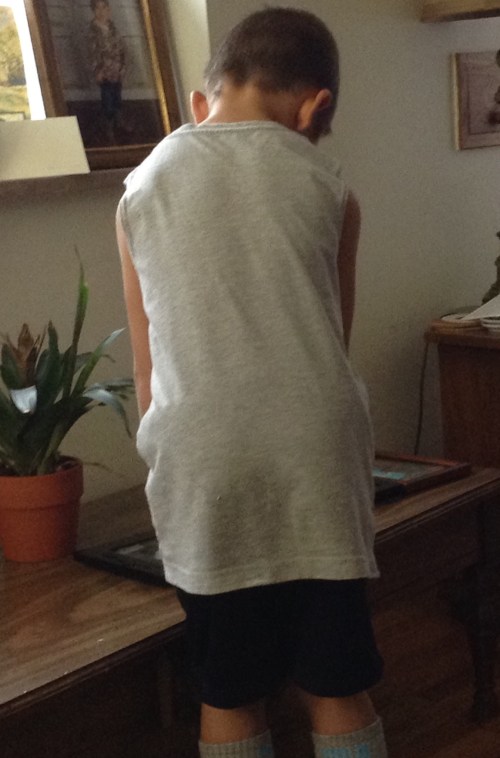
My little man likes to clean. He is cleaning our coffee table and dusting pictures.
Faith is taking the first step, even when you don’t see the whole staircase. (Martin Luther King Jr.)

My teenage granddaughter is helping me with a novel I’m writing; she sees with younger eyes. I value her perspective. I value Kate.

As I drive to her house to drop off the first few chapters, the early morning sun blinds me. Sunglasses dull the intensity of the glare, but the shadowy lenses darken the road and traffic as well.

A premonition hits me. This day is not going to be easy. I’m not completely well yet. Fatigue wants to take over my thoughts and body. I can’t let it.

Along the well-known route I pass a dead opossum in the middle of the road. Around the next corner I see a young boy with a backpack. He is probably waiting for a school bus.

I see both death and learning. 

One turn north and my eyes get a temporary respite. Maybe today’s metaphorical staircase will contain more winding, uneven steps than a direct passage, up or down, in or out of sun and darkness.

The discomfort in my gut lightens for a while, yet the pain I see in the world grows beyond what I understand.

I feel a need to begin with accepting whatever happens today, hear what others say. Even if I can’t understand.

Faith—it’s taking each step as it comes. Into the glaring light. Into the frightening darkness. Into the unexplainable. Into giving without judgment. Into peace.

Don’t try to make life a mathematics problem with yourself in the center and everything coming out equal. When you’re good, bad things can still happen. And if you’re bad, you can still be lucky. ( Barbara Kingsolver, The Poisonwood Bible)

Our flight to Berlin left three hours ago. Since my IV pole and the solution attached would get in the way on a budget flight, I guess this small hospital room will need to provide any current adventure. The standard-issue hospital gown might be slightly distracting as well. The fact that I am ill could also be a travel problem.

As Friday night became Saturday morning an overfull emergency room wasn’t the kind of adventure I had in mind. True, airport hassle may be distressing, but it doesn’t compare to intense pain caught in a continuous cycle. The clock measured each deep poke into the center of my body and back.

I watched the other folk who also waited.

A woman with blood mimicking a single-tone red tie-die covered her belly. Then I noticed her raised hand, the source. Nevertheless, she appeared calm.

Then, there was a woman who wondered about as if aimless. She sat on the side of my chair.

“You can have this chair if you need it,” I told her. “I can move to the other side.” One spot was open.

She barely turned around, and then moved away. Quickly. I sensed something deeper than physical desperation, but couldn’t prove it. I guessed her injury to be bigger than any hospital could fix.

Once my tests determined I needed to be admitted, I waited in my emergency cell until eight in the morning when a room was ready. My husband had wanted to wait with me, but I told him I was safe. He should care for himself. Go home. Rest. Then, he could care for me.

Yes, the pain continued, but my husband’s deep sense of sacrifice buoyed me.

I have some form of pancreatitis—obviously not connected to alcohol use since root beer is the only beer in my experiential vocabulary. No known connections yet. I’m told they may never be found. Sometimes, even the professionals never discover answers.

Today, I deal with much less discomfort, but many more questions. What the heck happened, and why now? Perhaps answers aren’t always what life is about.

This question I can answer, however: When will you be discharged? The answer: today. As early as this afternoon.

From the huge window in my room, I watch as a flock of geese fly through the rain. In V-shaped formation. Undeterred.

True, my original flight plans didn’t work out. Maybe on the next takeoff I will be more prepared. For now, I’m happy simply to return home.

Goodbye, IV line and helpful staff. I’m ready for departure. Hello, ordinary Tuesday.

composite photos of my room, a colorful approach

A certain amount of opposition is a great help to a man. Kites rise against, not with, the wind. (John Neal)

I meet every Tuesday morning with a spiritual group I joined when my older son was a toddler. The subject of hope keeps bouncing to the surface. I could use it.

Watch the news for more than five minutes, and the desire to remain on the couch indefinitely becomes tempting.

Deportation of innocent young people, hurricanes, earthquakes, the exploitation of personal tragedy, hate and greed take over the screen. 

As my friends and I talk about love that reaches deeper than the average Valentine card, I lift my socks-covered feet onto the coffee table. A deep purple bruise has taken over my right foot.

I knocked a few books off the shelf and gravity won. The foot swelling will heal. In comparison to the grief I see around me, this pain is a pinprick. The difficulties we explore are stab wounds.

However, my friend gives me an icepack. Love wrapped in a maroon towel. A symbol of hope. My friends share both encouragement and experience. Not lofty, disjointed everything-will-be-okay platitudes.

I share a short video. A Canadian politician is hassled by someone who confuses Sikhism for Islam. Clarification between the two groups is less important than the interruption centered in hate. Resolution comes through the leader’s call to peace. I hope the welcome greeting eventually touches the angry woman. Prejudice is heavy armor; it restricts movement and disables the heart. Hate armor takes time to build and time to remove.

The video can be found at this link: Sikh Politician Gets Verbally Attacked and Handles Gracefully.

In our small Tuesday group, we pause to check our responses. What preconceived notions do we hold? What views are opinions, taught, not experienced? And not true.

Kites fly through gentle wind; their fabric fails during turbulence. I choose where to fly a metaphorical kite, and where to call for reinforcements.

In the meantime, my foot loses some of its discomfort under the ice. I can decide to pass along kindness with the examples of my friends—or, I can add to the turbulence with discontent.

Peace. Upon all. Whether our political views coincide. Or not.

In the meantime, I will fly into Europe and meet other people. And see other ways of knowing life. Hopefully, I will come back with fresh perspective. And just a little more understanding.

photo-shopped public domain pic

What is a weed? A plant whose virtues have never been discovered. (Ralph Waldo Emerson)

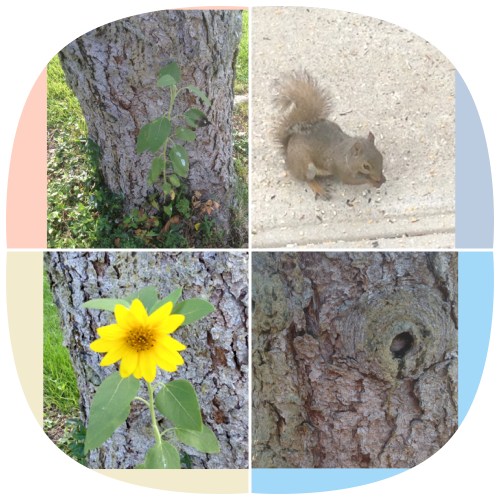
The flower our beggar squirrel beheaded has replaced itself—threefold. I suspect what I thought was a sunflower gift is a weed, a wild sunflower. The plant’s leaves appear as worn as my septuagenarian skin. I photographed the whole plant anyway. The leaves are part of its reality. I wear flawed parts, too, like every other ephemeral life form.

I struggle to conquer uncertainty and borderless fears. My husband and I are traveling to Europe soon. On past trips, I have met people who have brightened my spirit. Nevertheless, the worry-pain I build-up feels like surgery without anesthesia.

I have the same sense of direction as an untethered balloon. Leave my familiar surroundings and I float wherever the wind takes me.

I imagine telling my husband, “Sweetie, I’m following you everywhere you go as we travel. I hope you don’t mind.”

“Um, even on my way to the men’s room?”

There may be a few problems with my plan. Maybe I’ll take everywhere out of my request. Superlatives such as everywhere, the greatest, the worst, and all, lose truth somewhere. Death is final, as far as I know, at least as far as my limited vision can see. The other side has only sent subtle hints, two or three pieces from a billion-piece more-than-I-can-fathom puzzle.

In the meantime, I study the weed in my front yard. Yellow. Green. Hints of brown. Sun. Shadow. And I wonder how one dull, broken stalk replaced one flower with three.

“Hey, girl!” I tell myself. “You’re taking a trip that frightens you because you know it’s worth the risk. Have a good time, and recognize the flowers among the weeds. Who knows what lies ahead?” I’m about to find out.

I urge you to please notice when you are happy, and exclaim or murmur or think at some point, “If this isn’t nice, I don’t know what is.”   (Kurt Vonnegut)

No point putting my socks back on—my feet are covered with sand—from my son’s backyard sandbox. Yes, this senior citizen has been playing with dump trucks and plastic buckets. I follow the lead of my favorite kindergartner, Dakota.

He asks about what kind of work both my husband and I have done, and what I do now.

I state as simply as possible the jobs we had in young-person language. “I write books now.”

“Sounds boring.” He rams a motorcycle over a sand ramp. A wheel falls off. He grins as he clicks it back on.

I suppose when an individual’s written vocabulary is limited to one and two-syllable words, it could be. My granddaughter Ella has been reading since she was four. Different interests.

But, I don’t say anything. I let his opinion stand and heap a plastic shovel of packed sand into the next project, a castle. The building lasts almost three seconds before Dakota smashes it and turns it into something else. Another truck obstacle.

At age six, the pretend world is always in progress.

Next, he introduces me to a new Wii game. I have no aptitude for sports in the tangible world. On the flat screen, my lack reaches a new low.

“Well, I guess you win again,” I say.

We are ready to go outside for more activity, and he takes my hand. A gentle gesture. Dakota is considerate. I mentioned once today as I swung an invisible baseball bat, that I was thirsty and he ran to get me water, with ice. He also wanted to wash dishes, but left the big knife for me. A smart decision.

By tomorrow, my at-home to-do list will be too long to fit on the side of a mile-long wall. Those tasks will wait. Today I spend time with a young gentleman who doesn’t care about what I can or what I can’t do. He knows I care a lot about him, and he cares a lot about me. We are family, and that is all that matters.

You are right, Mr. Vonnegut. If this isn’t nice, I don’t know what is.

(photo-shopped public domain photo)

.


The worst form of inequality is to try to make unequal things equal. (Aristotle)

Monday’s focus: the eclipse across the United States. Nature’s rare event preempts hate broadcasted in a continuous loop—at least for a while. The moment was so brief many of the clickable links have already been removed.

I had appointments during show time, so I look for photos taken by other people, extend that moment and revel in it.

The shadows. Conquering real-life human darkness remains.

Us and them.

Blame taken to blind extremes.

If taken literally, of course all lives matter. However, the notion bypasses struggle that doesn’t fit the whole. Equal as human beings? Yes, we are—in universal acceptance of that fact, no. The privileged don’t need to fight for privilege.

In several different groups, the same topic comes up, and I wonder if it is a divine accident. As friends, the people in these groups trust one another. We talk about both understanding and misunderstanding in the nitty-gritty of the everyday. The blatant and the subtle, the repercussions. The details of our sharing can’t be spread in a public blog. The common human threads can.

The moon and the sun aligned this week. May the people who rely on Mother Nature, eventually, join as family.

(pic: made from public domain photos)


Shadow owes its birth to light. (John Gay, poet and dramatist)

My fractured metacarpal is healed. Or at least the break appears as a fading memory on an x-ray. Just below the mended crack, in my middle finger, the damage remains. Arthritis, lots of it. Severe. Yet, amazingly less painful than the word severe would indicate.

The bone’s joints are not aligned. Middle finger knocks its smaller digit comrades into a crossover position. Make-a-fist is no longer a realistic possibility. Adaptation is my next goal.

In fact, the doctor opens his computer and shows me guitar tools…thumb picks. He discovers devices to aid the less-than-perfect hand.

(I try to find the link later—no success. However, I can find guitar stores.)

“I guess I have a challenge then,” I tell the doctor. And he agrees. He also adds that studies have shown pain and attitude are linked. The more positive a patient is after surgery, the more likely the individual will need fewer, if any, opioids.

For me, surgery is not the best option, however. Maybe that is a good thing. Continuous movement is natural for me anyway.

My friend, Mary, recently broke her hip. She spent some time in a rehab facility. She managed her pain with only ibuprofen. At the time, I was amazed. How could she do that? Now I understand. She did it with her upbeat attitude.

Later in the day, I spend time with a friend who sees shadow even when her eyes are open. Nevertheless, she has brought me light. Ann is blind. I am driving her to a doctor’s appointment. We chat. About everything from our lives as they really are, not our show-selves, to who has the best fried chicken. Somehow, she knows what part of town we reach as I turn from one street to another.

I tell her about my granddaughter Rebe, how she and her sister, Kate, made a bridal veil out of a white shawl and a pair of my underwear. Ann tells jokes.

As we leave the office Ann says, “Okay if I drive home?”

“Well,” I answer, “only if you drive wa-a-y too fast. I need some adventure.”

A gentleman is waiting for the receptionist. He smiles. I hope we have made his day, too. Light mingled with shadow, in unpredictable patterns.

No, Ann does not drive my car home. She does drive my spirit in the right direction. And I am grateful.

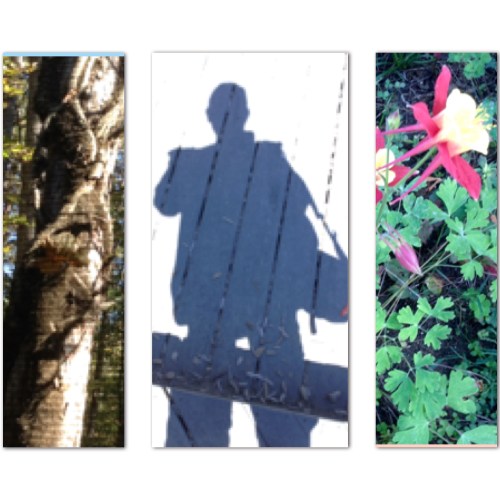
light and shadow, flowers blooming in light

My crooked fingers remain less than photographable, better left to the imagination.

You can’t be suspicious of a tree, or accuse a bird or a squirrel of subversion or challenge the ideology of a violet. (Hal Borland)

The sunflower that bloomed at the base of our blue spruce wasn’t meant to be as permanent a gift as I thought it would be. I watch a squirrel nibble on stray birdseed and then chomp off the yellow head of the flower.

Beauty gone in seconds. And a meal on the run for the squirrel.

Unfortunately, the tree, towering above the yard, has lost branches to disease. My husband’s uncle gave us the spruce when our first son was a toddler. In recent years the tree’s maintenance has cost enough to support an arboretum. Spruce’s upkeep has ended. Nature’s natural longevity will take over. Nature wins.

Later in the afternoon Jay, Ella and I wait on the front porch for Ella’s daddy to arrive. A squirrel stops to eat seed in the yard. He moves closer and stares at us. Ella moves toward the critter; the critter doesn’t skedaddle. I pull my granddaughter back. This is NOT natural for a squirrel. I get up to shoo the pest.

Jay grabs some feed from the bag not far from the front door, inside the house. “That’s probably the squirrel I fed yesterday. He’s looking for more birdfeed.”

Squirrel waits while Jay tosses a seed meal onto the sidewalk. Critter does not care that I photograph him. His snout has a slightly dark edge. Is this the thief that beheaded the sunflower? Maybe. Don’t know for certain.

My thoughts are not sweet. Don’t like you, squirrel. Yet, as he eats I see parts of life that are graceful and disarming, annoying yet universal and not made of solid darkness. All living beings need to eat. The way he picks up tiny seeds has charm.

And yet, I don’t want him too close to my family. Wild animals, even small ones, need to remain wild.

Fear, however, needs to be tamed. I think about the news, the same inflammatory stories repeated on an infinite loop, tenebrous expressions on a national leader’s face, dark enough to suggest malice, worse unspoken. Horror grows strong in the imagination.

Reaction born of hate, however, adds fuel to malice.

The next day as Jay leaves for a class he calls to me, “Your squirrel is here. He’s begging to be fed.”

“Not my squirrel,” I answer laughing.

However, squirrel has a handful of seed before Jay leaves the driveway. The seed is given via my hand. I admit it; I don’t have all of life’s answers.

After squirrel’s feast, with photo of possible suspect

Before the crime with a pic of the injured tree


The most valuable possession you can own is an open heart. The most powerful weapon you can be is an instrument of peace. (Carlos Santana, musician)

I don’t take breathing for granted—not after a two-month fight with asthma and bronchial issues. Then I broke my hand and the complications escalated. My second book in the Star League Chronicles, Stinky, Rotten Threats, came out.

While my hand was in a brace, a pen could have been a foreign object. For weeks after my hand was freed, I wrote with a strayed moth-like path across the page. Typing wasn’t much better, slower, yet possible. My twisted middle finger crossed over my ring and little finger.

I continue with occupational therapy to correct the problem. My handwriting is legible. Pain is minimal.

Now, as I drive in the rain I wonder what to do next. Each day I missed allowed my work to get lost among the grand onslaught of well-known-first-to-be picked publications, then independent press and self-published books.

In my new fantasy, Chase and his friends face evil capable of destroying their magic woods and killing their leader. The kids don’t give up; they can’t. And, of course, as the writer, I saw snags appear along my way—like a computer that turned itself off as I finished final edits the day before my deadline. The gosh-darned-electronic-device erased a whole slew of edits.

No, I didn’t take that incident as a quit-while-you-can prophecy. I understood it as a challenge. (After a few cleansing yet non-repeatable expletives) Can I do the same with my health issues?

I begin the uphill drive home when I see a woman walking with a cane in the downpour. If only I had Star League powers… Maybe magic tools don’t exist in real life, but I do have an umbrella. And several more at home. I pull over and call to the woman, offer protection from the deluge, albeit late. Her hair hangs drenched in her face.

“I’m almost home, but…” She pauses. “Thank you. Not many people would stop and do that. You can pray for me, though. My name is Geneva.” She stands in the wet and shows no sign of urgency. “I paid my rent. I really did. My landlord says I didn’t. He’s going to evict me.”

I am dry inside the car, yet feel a sudden chill. “Of course, I will.”

Geneva asks for nothing else. The futility of a one-umbrella gift hits me, and yet she says, “You’ve made my day, though. Thank you. Thank you more than I can say.” She turns and continues to walk.  Without the umbrella. Uphill, far more uphill than I drive. Far more uphill than any challenge I face.

As the day passes I’m tempted to go back and look for Geneva. Perhaps, I will find her again. I don’t know. In the meantime, I pray not to forget that moment. Or her.

Photo: Sun and Rain

The sunflower appeared compliments of a visiting bird. No sunflower seeds were planted. It was nature’s gift.